Retail centers
How to attract tenants to a small shopping center
For most owners of a neighborhood or strip center, the practical answer is to hire a retail leasing broker and hold that broker to a written marketing plan with monthly reporting. The owner still controls the facts a prospective tenant checks before calling: which suites are open and in what condition, a readable site plan, the signs and the phone number on them, the center's website and Google listing, and the terms the owner is prepared to offer. When those facts are complete and consistent, every channel works better, including the broker's.
What the Orange County retail market means for one vacancy
Orange County retail space is tight. Kidder Mathews reported a countywide retail vacancy rate of 3.8% in Q2 2026, 20 basis points higher than a year earlier, with an average asking rent of $2.72 per square foot per month and 240,744 square feet of positive net absorption for the quarter. Those are county figures for all retail space, and they do not describe any single suite.
The useful reading for an owner is diagnostic. If a suite has sat available for several months in a market this tight, the cause is more likely to be something specific to the space or to how it is presented: an asking rent out of line with the corridor, a deep and narrow floor plate, a use restriction nobody wrote down, a second-generation restaurant with equipment of unknown condition, a sign panel that still shows the last tenant, or a phone number that goes to voicemail. Most of those can be found and fixed, which is the point of the rest of this guide.
Do you need a leasing broker for a small center?
Usually, yes. Retailers, franchisees and restaurant groups that are expanding tend to work through tenant representatives, and those representatives look first at what listing brokers put on the market. A good retail leasing broker brings relationships with those representatives, a working knowledge of what comparable suites nearby have leased for, a presence on the listing portals, and the time to show space and negotiate. For an owner of one center who also has a day job, that time is often the deciding factor.
Leasing your own space is legal in California. The Business and Professions Code defines a real estate broker as someone who leases or offers to lease property for compensation and for another person, so an owner leasing its own property is outside that definition, and Section 10133 exempts corporate officers and general partners acting for their own entity without special compensation. Paying someone else to find tenants is a different matter and generally requires a license. This is general information and not legal advice; ask your attorney how it applies to your ownership structure.
Owner-direct leasing tends to work best for small spaces that attract local users, such as a service business, a studio or a small office tenant, and for owners who can answer calls and show space promptly. One owner of small office buildings reported on BiggerPockets that most of his tenants came through Facebook rather than LoopNet or Crexi. That is one owner's experience with one property type, and it is a reminder that local users and expanding chains find space in different ways. If you lease direct, decide in advance whether you will pay a commission to a tenant's broker, because many tenants arrive represented and their broker will ask.
What to expect from your leasing broker's marketing
A listing agreement usually describes the commission and the term in detail and the marketing in a sentence. Ask for the marketing plan in writing before you sign, and ask to see the actual materials from a recent retail listing the broker handled. The table below is the list we would use to compare two brokers, and it doubles as a checklist for a listing that has gone quiet.
| Item | What good looks like | What to ask for |
|---|---|---|
| Marketing plan | A dated plan naming the channels, the target tenant categories and the first 30 days of activity | The plan itself, attached to the listing agreement |
| Availability sheet | One row per suite with size, condition, previous use, asking rent and charges, and available date | A copy you can check against your rent roll |
| Leasing package | A brochure written for a tenant, with photos, site plan, trade area, suite details and contacts | A draft for your review before it is sent anywhere |
| Portal listings | One listing per available suite on LoopNet and Crexi, with the same facts as the brochure | The links, and the date each was last updated |
| Property web page | A page with its own address that holds the brochure, the plan and current availability | Who hosts it and what happens to it when the listing ends |
| Signs | A sign on the property with a number that a person answers during business hours | Whose phone the number rings, and how calls are logged |
| Direct outreach | A named list of tenant representatives and target tenants the broker will contact | The list, or at least the categories and counts |
| Reporting | A monthly note covering inquiries, tours, proposals and the reasons prospects passed | The reporting format and the day of the month it arrives |
The reporting line matters most. The reasons prospects pass on a space are the most useful information a listing produces, because they tell you whether the problem is rent, condition, parking, co-tenancy or visibility. A broker who reports only the number of inquiries is giving you half the information. Our guide to what to do when a listing is not getting activity covers how to read that feedback, and the commercial property marketing plan shows what a written plan can look like.
The parts of the marketing the owner controls
A broker markets the facts the owner provides. Several of the most important facts, and several of the places tenants check them, belong to the owner regardless of who holds the listing. They are also the parts that stay with the center when a listing agreement ends.
A center website with suite-level availability
A tenant representative who hears about your center will search for it. What they should find is a page that names the center, shows where it is, lists the current tenants, and gives each available suite its own size, condition, photos and position on the site plan, with a direct way to reach the leasing contact. Treat the suite as the unit of information. A page that says "space available, call for details" asks the tenant representative to do work they will usually skip.
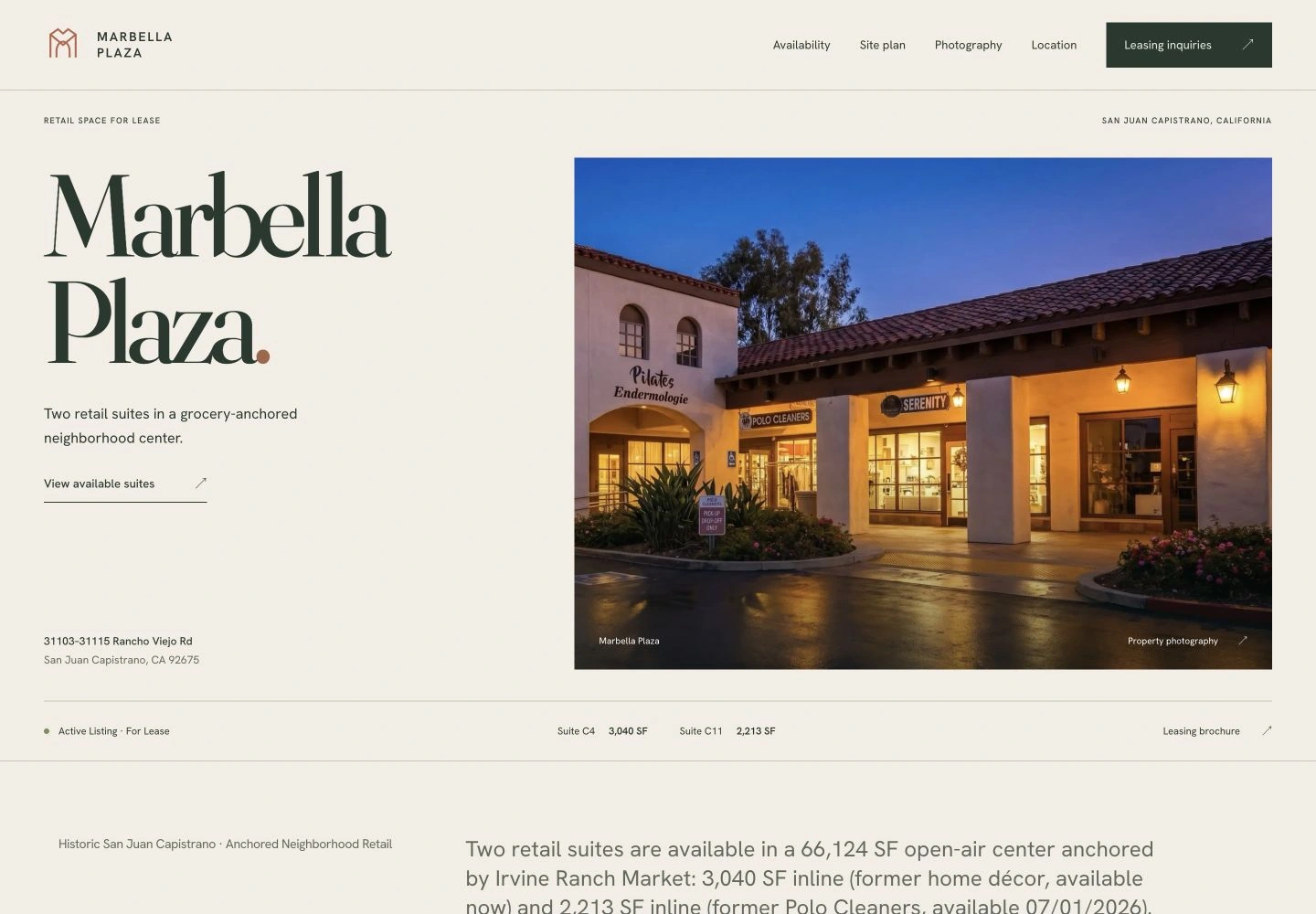
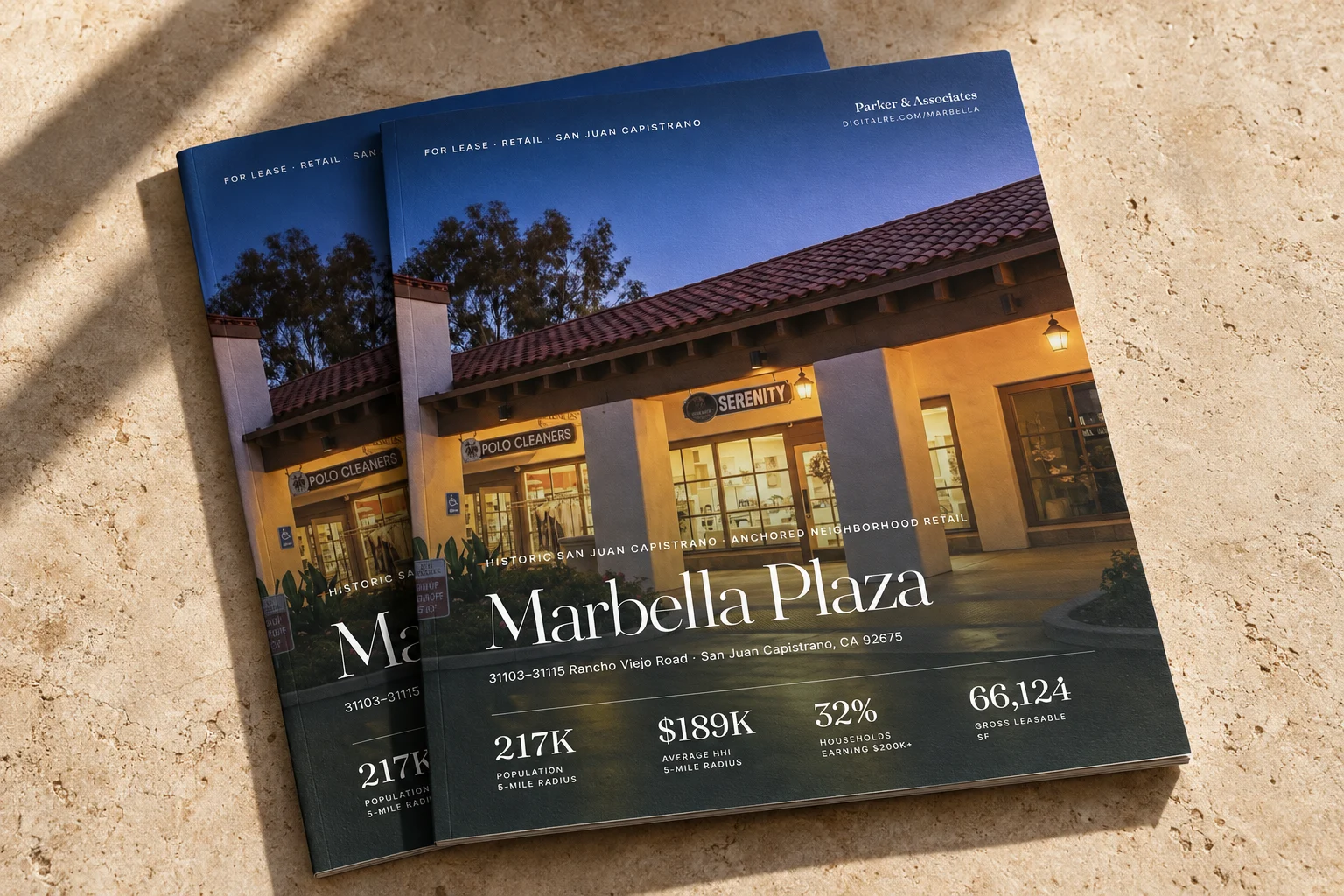
The website Endcap built for Marbella Plaza, a 66,124 square foot, 27-suite center in San Juan Capistrano leased by Parker & Associates, Inc., brings the property photography, suite information, plans, tenant details and a path to the leasing team into one place. The leasing brochure uses the same photography and property information, so the two do not disagree. The reasoning behind a dedicated page is in single-property websites, and where that page should live is covered in domain names for property websites.
A site plan people can read
The site plan answers the questions a tenant asks before the first call: where the suite sits relative to the anchor, the entrances and the parking, and how much frontage it has. Suite numbers on the plan should match the numbers in the leases, on the directory and on the website. Mismatched suite numbers are a common and avoidable source of confusion. We cover what to show and what to leave off in site plans that lease space.
The signs and the number on the "for lease" sign
The monument or pylon sign is the most-seen piece of marketing a center has. A blank panel, or a panel that still shows a tenant who left two years ago, tells every passing driver that the center has trouble filling space. Replace stale panels promptly, and check first whether the center has an approved sign program with the city. Many multi-tenant centers do; the City of Buena Park, for example, reviewed Sign Program No. SN-24-5 for an existing multi-tenant center on Beach Boulevard, and a program of that kind sets the size, colors and letter styles a new panel must follow.
The "for lease" sign should carry a number that a person answers. A call from a sign is often a local business owner driving past, and that caller may not leave a voicemail. Our article on why the cell number on the listing sign is the wrong number explains the problem, and leasing signs and QR codes covers the sign itself.
The center's Google Business Profile
Most centers already appear on Google Maps, often with an unclaimed profile, customer photos and hours nobody set. A tenant representative scouting an intersection will see that profile before any listing. Claim it under an account the ownership controls, name it exactly as it is signed, add current photographs, and point its website field at the center's own site. Google's guidelines for representing your business require the real-world name, without added keywords. The full setup is in Google Business Profile for shopping centers.
The tenant mix story
Tenants lease into a center partly because of who is already there. Write a short, factual description of what the center is for: the anchor or daily-needs tenants that bring regular visits, the hours the center is busy, the households nearby, and the categories the center is missing. Pair it with a plain list of existing exclusives and prohibited uses, so the broker does not spend a month on a prospect the leases do not allow. The trade-area side of that story is covered in retail trade area analysis.
Second-generation restaurant space
A former restaurant suite can lease quickly to an operator who can reuse the infrastructure, or sit for a long time if nobody knows what is actually there. List what remains and its condition: hood and fire suppression, grease interceptor, walk-in cooler, gas service, electrical capacity, restrooms and seating. In Orange County, the Health Care Agency's plan check unit reviews plans for all new and remodeled food facilities, and the agency states that health permits are not transferable, so an incoming operator will need its own permit and, if it remodels, a plan review. Saying so in the package helps an operator judge the timeline. More detail is in marketing a restaurant space.
Incentives and improvements stated as facts
"Landlord will consider tenant improvements" tells a tenant almost nothing. State the condition you will deliver (as-is, cold shell, warm shell or a finished suite), whether you will fund improvements and on what basis, and whether free rent is available for a longer term. The broker can hold back the numbers for negotiation, but the owner should decide the ranges before marketing begins, and should not publish terms the ownership will not honor.
What a suite entry should state
The table below lists the fields we put in a suite entry on a property website or availability sheet. The example values are illustrative and do not describe a real property.
| Field | Illustrative example | Why a tenant needs it |
|---|---|---|
| Suite and size | Suite 104, 1,250 SF | Matches the lease, the plan and the directory |
| Frontage and depth | 20 ft frontage, 62 ft deep | Decides whether the layout works for the use |
| Condition | Second-generation salon, plumbing in place | Sets the build-out cost and timeline |
| Location in the center | Inline, two doors from the anchor entrance | Visibility and foot traffic |
| Utilities | 200-amp service, no gas | Rules out some uses immediately |
| Parking | Shared field, ratio stated in the brochure | Critical for restaurants, fitness and medical uses |
| Signage | Storefront sign and one pylon panel | Tenants weigh visibility heavily |
| Use restrictions | No restaurant use; existing coffee exclusive | Saves both sides a wasted tour |
| Rent and charges | Asking rent plus estimated NNN charges | Tenants budget on total occupancy cost |
| Available date and contact | Now; leasing contact with a direct line | The next step |
How this looks on Endcap's own projects
Endcap's leasing work so far is at the small end of retail, which is the subject of this guide. For Marbella Plaza, the work was a property website, photography, film and a leasing brochure for a center that already had its name and its leasing team; Endcap did not design the center's logo. The Marbella case study shows the website and brochure. For 5801 Lincoln in Buena Park, the assignment was a single 2,660 square foot corner suite for the owner, KFS Properties, with a property website, photography, film and a seven-page leasing brochure. The three-day build describes how that went together.
The leasing broker's own website matters too, because tenant representatives check who is behind a listing. The brokerage site Endcap designed and built for Parker & Associates, Inc. gives each listing its own page with photography, available-space information and documents. None of this replaces a broker's relationships. It gives the broker and the owner accurate material to send.
A first pass an owner can do this week
- Compare the rent roll with the directory sign, the pylon panels, the center's website and its Google profile, and list every place that shows a tenant who has left or misses one who arrived.
- Call the number on the "for lease" sign at 5:30 on a weekday and see who answers.
- Search for the center's name on Google Maps and check who controls the profile.
- Look up each available suite on LoopNet and Crexi and check the size, asking rent and photos against your own records.
- Write down, for each vacancy, the condition you will deliver, the improvements you will fund and the uses the leases prohibit.
- Ask your broker for the reasons the last five prospects passed.
If the answers show that the center's own materials are the weak point, that is the work Endcap does: vacant space marketing, property websites and property branding. The broader view of running a center's marketing is in shopping center marketing.
Work with Endcap Design
Shopping center websites
We build shopping center websites that serve shoppers and prospective tenants: a tenant directory, available suites, plans, photos, and a leasing contact.
Included
- Tenant directory and leasing information on one site
- Mobile layout and a broker inquiry form
- Two revision rounds, with launch checks on every page and download
From $1,950 · Up to 5 pages, 20 tenant entries, and 10 availability entries · Hosting and updates quoted separately
We agree on the scope, timing, and price with you before work begins.
Get a quote for your center's websiteSee the full service ↗Contact Endcap
START A
project.
A website, a brochure, or a complete set of materials.
We’ll agree on the scope, timing, and price before starting.