Retail centers
The first 90 days after buying a shopping center: name, signs, website, listings and leasing package
In the first week after closing, take control of the accounts the center already has: its domain and website, its Google Business Profile, its portal listings, its social pages and the phone number on its signs. In the first month, audit everything the public sees against the rent roll and decide whether the name stays. By the end of the third month, the center should have a current leasing package, corrected listings and sign panels, and a website that the new ownership controls.
Why the order matters
A new owner's instinct is often to start with the visible work: a new name, a new logo, new signs. The accounts come first because they are the part that can be lost. A domain registered in a former employee's name, a Google profile verified on a former manager's personal email, or a LoopNet listing under the last broker's login can each take weeks to recover once the people involved have moved on, and until then the center's public information is controlled by someone who no longer has a reason to keep it current.
Tenants come next, ahead of any public change. They pay the rent, their customers use the center's name as a landmark, and many of them print the center's name on their own materials. They should hear about new ownership, new management contacts and any planned changes from the owner before they read about them anywhere else.
This guide covers marketing and public information. It is general information rather than legal advice, and several items, particularly what the seller must deliver at closing, belong in a conversation with your attorney before the purchase agreement is signed.
Week 1: take control of what already exists
Start with an inventory of every account and file that represents the center publicly, who holds each one, and how to reach that person. The seller or the outgoing property manager is the usual source. If you are still in escrow, ask your attorney whether these items should be listed among the seller's closing deliverables, because cooperation is easier to get before the sale closes than after.
- Domain and website. Find the registrar, the registrant named on the domain, the hosting account and the website login. The owner of record should be the ownership entity, with the manager or agency added as a user. The detail is in our handoff checklist for when management changes.
- Google Business Profile. If the seller's team holds the center's profile, ask them to add you as an owner and then transfer primary ownership. Only the current primary owner can do that, and Google makes new owners and managers wait 7 days before they can remove other users or change primary ownership. If nobody will respond, Google's request ownership process gives the current owner 3 days to reply, after which you may have the option to claim the profile. Google notes that the option is not always available.
- Portal listings. Search LoopNet and Crexi for the address. Listings posted by a previous broker or manager stay under their accounts until they remove or update them. Crexi's help center states that owners can list space for lease but need to add the Property Manager role to their profile to do so.
- Phone numbers. Note every number on the pylon, the "for lease" signs, the website and the Google profile, and find out whose line each one rings.
- Social accounts, review sites and directories. List them, find the administrators, and ask for access to be added before anyone's access is removed.
- Files. Ask for the photography, the site plan in its original format, the sign artwork, the tenant directory files and the last leasing brochure's source files, together with any licenses for the photography.
Month 1: audit what the public sees
With access in hand, compare the center's public face to the rent roll. The goal is a single list of every place that is wrong, with an owner and a date for each fix.
The tenant directory and pylon panels
Walk the property with the rent roll. Check each directory panel, each pylon and monument panel and each storefront suite number against the leases. Panels for tenants who have left, blank panels and suite numbers that do not match the leases are the most common problems. Before ordering new panels, ask the city's planning department whether the center has an approved sign program. Cities review these for multi-tenant centers; the City of Buena Park, for example, reviewed Sign Program No. SN-24-5 for an existing center on Beach Boulevard. A program of that kind governs panel size, colors and letter styles, and changing it is a separate application.
The Google profile, website and listings
Check the Google profile's name, category, hours, photos and website link, and read the last year of reviews for recurring maintenance complaints about lighting, parking or cleanliness. Check whether the website's tenant list and availability are current, and whether its contact details still point to the previous owner or manager. Check every portal listing for suites that have leased, for sizes and rents that disagree with your records, and for the previous broker's contact details.
Accessibility documentation
California Civil Code Section 1938 requires a commercial lease to state whether the premises have been inspected by a Certified Access Specialist (CASp), and sets out what the landlord must provide in each case. Find out whether the seller had any CASp inspections done, and keep the reports with the leasing files, because every new lease you sign will need to address the question. Your attorney can advise on the details.
Should you rename the center?
A rename can be the right decision for a repositioning, a redevelopment, or a name tied to a reputation the new owner wants to leave behind. It is also the most expensive marketing decision a new owner can make, and much of the cost falls on tenants who have printed the name on menus, vehicles, packaging and their own listings. Decide after the month-one audit, when you know what the center needs, rather than in the first week.
Two costs are easy to miss. The first is Google. The guidelines for representing your business allow a profile to be renamed in place only for a minor change, where the proper nouns and services in the name and the business category stay the same. For a substantial name change, Google says to mark the existing profile as closed and create a new profile under the new name, and a new profile does not carry over the old one's reviews. The second is search. People will keep searching for the old name for years, so the website should say "formerly known as" in plain text, and old web addresses should redirect to the new ones. Our guide to rebranding without losing search traffic covers the redirect work.
Large redevelopments show how long a naming process can run. Merlone Geier bought the Laguna Hills Mall property in 2013, and the Orange County Business Journal reported in May 2021 that the redevelopment plan had been renamed Village at Laguna Hills, replacing the earlier Five Lagunas name. In that case the name followed a multi-year redevelopment plan. For a neighborhood center that is simply changing hands, keeping a known name and cleaning up how it appears is often the better use of the first year's budget.
If you do rename, run the availability checks in naming and branding a shopping center before anyone presents the name, tell tenants first, update the Google profile and listings next, and replace the physical signs last. Endcap's property branding work covers the name, the identity and how they are applied to signs and the website.
Months 2 and 3: rebuild the leasing package and listings
The leasing package inherited from the seller was written for the seller's purposes, and if the center was marketed for sale, it may be an offering memorandum rather than a leasing document. Tenants and their representatives need different information from buyers: suite sizes and conditions, the site plan, co-tenancy, the trade area, signage and the leasing contact. We explain the difference in a leasing package is not a sale OM.
- Photography. Commission new photographs if the existing set shows departed tenants, old signage or construction, and get a written license that names the ownership entity and allows use by future brokers and managers. The shot list and costs are in commercial real estate photography.
- Site plan. Redraw it if the suite numbers disagree with the leases, and keep the source file. See site plans that lease space.
- Leasing brochure. Build it from the same photographs, plan and suite data as the website, so the two stay consistent when a suite leases.
- Portal listings. Give each available suite its own listing on LoopNet and Crexi under the current leasing contact, and ask the previous lister to remove the old listings. The details that make a listing easy to find are in portal listing optimization.
- Website. A center site serves shoppers looking for tenants and hours, and tenants looking for space. It should hold the directory, current availability with the site plan, and the leasing contact.
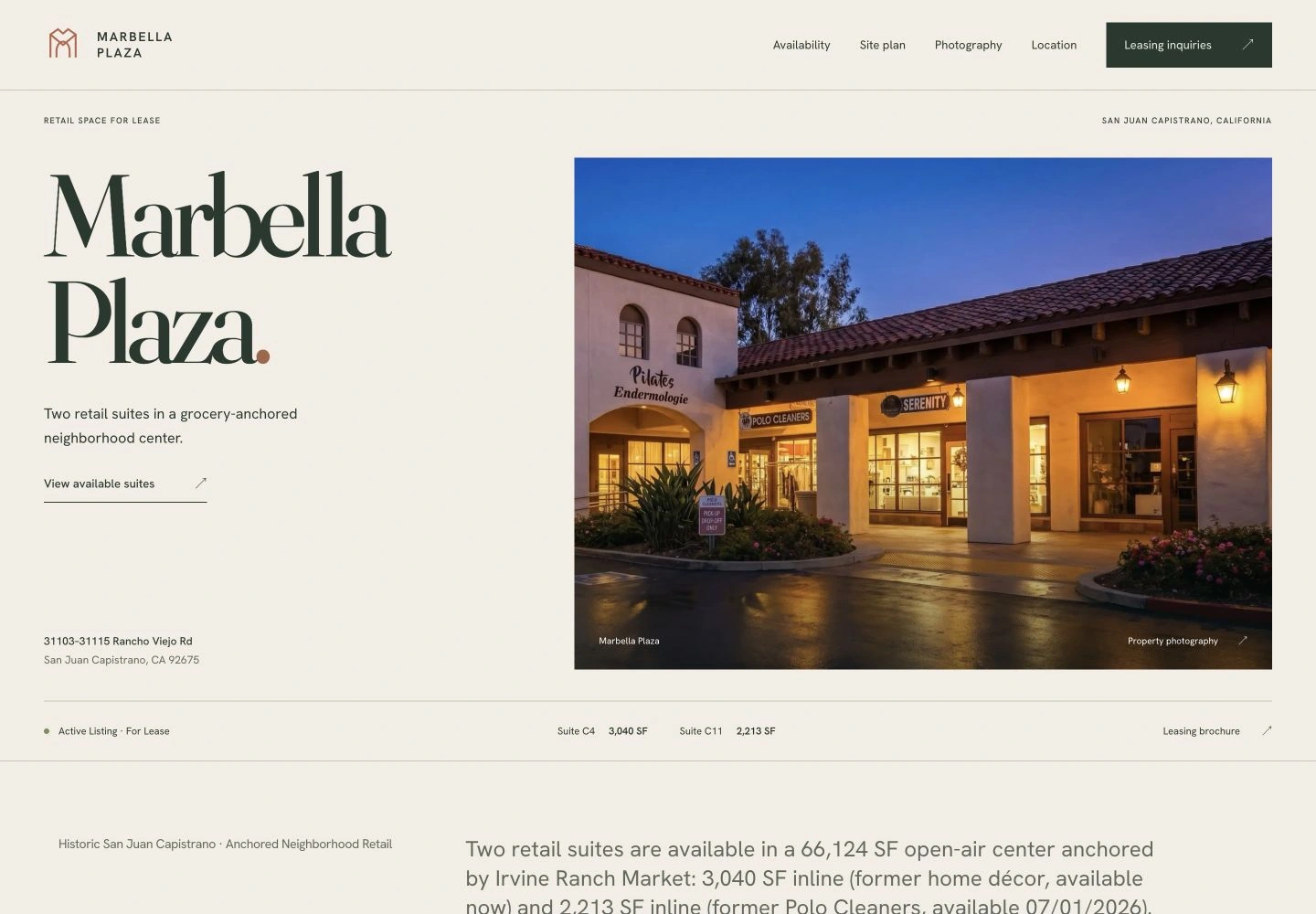
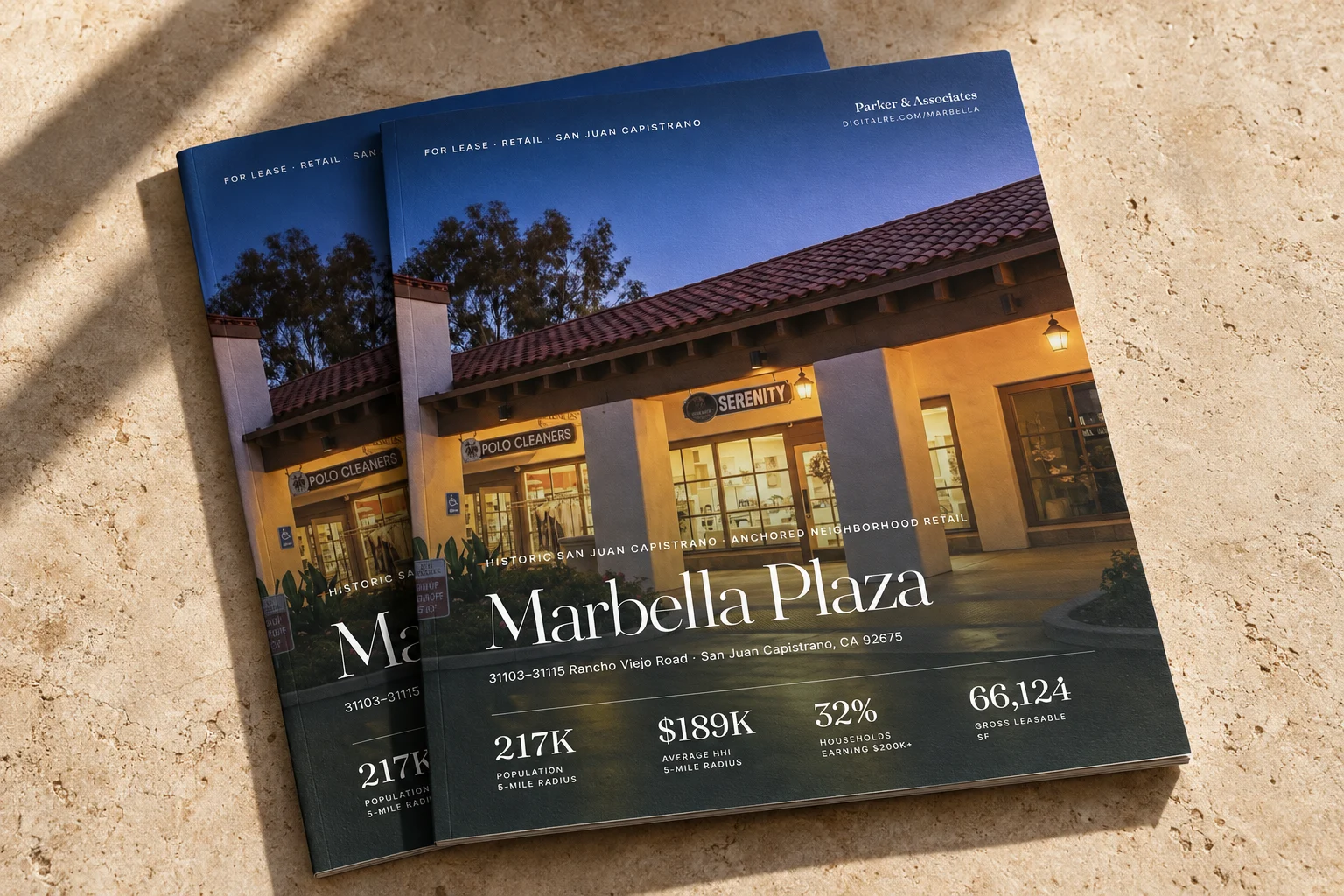
Marbella Plaza in San Juan Capistrano is an example of the finished pieces working together. Endcap produced the property website, photography, film and leasing brochure for the 66,124 square foot, 27-suite center, which is leased by Parker & Associates, Inc. The brochure and the website use the same photographs and property information. The center arrived with its name and logo, and Endcap did not design either. The Marbella case study shows the website and brochure, and 5801 Lincoln shows the same approach applied to a single suite.
The 90-day checklist
| When | Task | Usually handled by | Done when |
|---|---|---|---|
| Before closing | List public accounts and files among the items the seller will hand over | Buyer and buyer's attorney | The list is agreed in writing |
| Week 1 | Take over the domain, hosting and website logins | Owner or incoming manager | The ownership entity is the registrant and holds the admin login |
| Week 1 | Transfer or request the Google Business Profile | Owner | The ownership entity is primary owner and the manager is a user |
| Week 1 | Notify tenants of new ownership and management contacts | Owner or property manager | Every tenant has the new contacts |
| Week 1 | Find the lister of every LoopNet and Crexi listing | Leasing broker or manager | Each listing has a known owner |
| Week 2 | Route every published phone number to someone who answers | Property manager | A test call at 5:30 pm is answered or returned the same day |
| Month 1 | Audit directory, pylon and suite numbers against the rent roll | Property manager | One list of fixes with dates |
| Month 1 | Check the city's sign program before ordering panels | Owner or sign contractor | The program and its requirements are on file |
| Month 1 | Locate CASp reports and other leasing documents | Owner | They are filed with the leasing records |
| Month 1 | Decide whether to keep or change the name | Owner | A written decision, with availability checks done if changing |
| Month 2 | Commission photography and a corrected site plan | Owner with a studio or photographer | Files and a written license are held by the ownership entity |
| Month 2 | Replace stale sign panels | Sign contractor | No panel shows a departed tenant or is blank |
| Month 3 | Publish the new leasing brochure and website | Owner, broker and studio | Both show the same suites, sizes and contacts |
| Month 3 | Replace portal listings with one listing per available suite | Leasing broker | No listing shows a leased suite or an old contact |
What inherited web presence can look like
An inherited website can be in worse shape than the property. When Endcap took on Great OC Condos, a ten-home residential portfolio in Laguna Hills, the previous site was a 2013 iWeb export with a fixed-width layout and an expired-hosting banner. Endcap recovered 19 pages and 53 photographs from it before building a new identity and website. That was a residential portfolio rather than a shopping center, but the order of work was the same one described here: secure what exists, recover what is worth keeping, and then build.
The leasing broker's website matters as well, since tenant representatives check who is behind a listing. The site Endcap built for Parker & Associates, Inc. gives each listing its own page with photographs, available-space information and documents, which is the kind of page a new owner should expect the leasing team to provide.
If you have just bought a center and want the website, leasing brochure and listings handled together, see shopping center websites, vacant space marketing and property websites. For the leasing side in more depth, read how to attract tenants to a small shopping center and Google Business Profile for shopping centers.
Work with Endcap Design
Shopping center websites
We build shopping center websites that serve shoppers and prospective tenants: a tenant directory, available suites, plans, photos, and a leasing contact.
Included
- Tenant directory and leasing information on one site
- Mobile layout and a broker inquiry form
- Two revision rounds, with launch checks on every page and download
From $1,950 · Up to 5 pages, 20 tenant entries, and 10 availability entries · Hosting and updates quoted separately
We agree on the scope, timing, and price with you before work begins.
Get a quote for your center's websiteSee the full service ↗Contact Endcap
START A
project.
A website, a brochure, or a complete set of materials.
We’ll agree on the scope, timing, and price before starting.