Property websites
Domain names for property websites: where a listing site should live.
Every dedicated listing site needs an address, and the address gets picked in about four seconds, usually by whoever is holding the credit card. That decision outlives the listing. It decides who can update the site in year three, what happens to the link on the sign when the broker changes firms, and whether a renewal notice in somebody's spam folder can take the whole thing offline.
Three addresses, and they are not equivalent
There are only three real options for a property website, and the difference between them is not aesthetic.
- A standalone domain. marbellaplaza.com, or whatever is still available. Its own registration, its own renewal date, its own DNS.
- A path on a domain that already exists. yourfirm.com/marbella, or yourfirm.com/listings/marbella. No new registration, no new certificate, no new anything.
- A subdomain. marbella.yourfirm.com. One registration, but its own hostname, its own certificate, and in practice its own maintenance.
Most owners assume the first is the serious choice and the second is the cheap one. In our experience it is closer to the reverse. The standalone domain is the option that fails quietly, and it fails eighteen months later, when nobody is watching it.
What a standalone domain actually commits you to
A domain is a subscription with a hard cutoff. When one expires, ICANN's Expired Registration Recovery Policy gives the registrant a redemption window of at least thirty days to pull it back, and restoring a name from redemption typically costs far more than a normal renewal. The failure mode is not dramatic. A card expires, the renewal notice goes to an assistant who left the firm, and the property site that every flyer and every sign panel points at starts resolving to a parking page.
The second cost is search. A domain registered last week carries nothing with it. No links, no history, no relationship to the firm's existing pages. Every property that gets its own domain starts from zero and stays there, because a listing site is a short campaign and short campaigns do not accumulate authority. When those same pages live as paths under a domain the firm has been publishing on for years, they inherit that standing on day one. That is the mechanism behind the advice in our SEO guide: the firm's domain is the asset, and every listing page should be feeding it rather than competing with it from a different address.
There is a narrow case where a standalone domain is right, and it is worth naming honestly. A ground-up development or a repositioned center with a new identity, something that will be marketed for two or three years and will eventually need a permanent consumer-facing home for tenants and shoppers, deserves its own name. That is a place, not a listing. We cover that decision in naming and branding a shopping center. A 2,600 square foot inline suite is not that.
A listing lives for months. A domain registration lives until somebody forgets. Do not let the shorter thing depend on the longer one.
Why a path usually wins
Nesting the property under a domain you already control removes an entire category of future problems. There is nothing separate to renew, nothing separate to secure, and nothing separate to remember. Google's Search Central documentation treats subdomains and subdirectories as equally crawlable and indexable and tells site owners to choose based on what is easier to maintain, which in a brokerage is not a close call. One domain, one certificate, one hosting setup, one place where every property page lives.
It also reads correctly. A tenant rep who lands on yourfirm.com/marbella knows in the first half second who is behind the listing. A standalone domain with no firm name on it has to earn that trust from scratch, in a market where a professional looking page and an unaffiliated page look increasingly alike.
The practical objection is that a path is long to say out loud or print on a panel. That is a real constraint and it is solvable without buying anything: a short redirect, a QR destination, or a listing number on the sign. We wrote up how to handle the sign side of it in leasing signs and QR codes that actually get scanned.
Where subdomains earn their keep
The subdomain is the middle option and it is the one that most often gets chosen for the wrong reason, which is that a platform required it. If your listing pages are on a hosted product that cannot serve from a folder on your main site, you get a subdomain whether you wanted one or not.
Chosen deliberately, a subdomain makes sense when the property site genuinely needs to run on different infrastructure than the firm site, or when a joint venture needs a home that is clearly adjacent to the firm rather than part of it. What it does not do is save you work. Each hostname needs its own certificate, its own analytics property or filter, and its own place in the deploy process. You take on most of the overhead of a separate site and keep only part of the benefit.
What we do on our own listings
Both of the property sites we point people at are paths, not purchases.
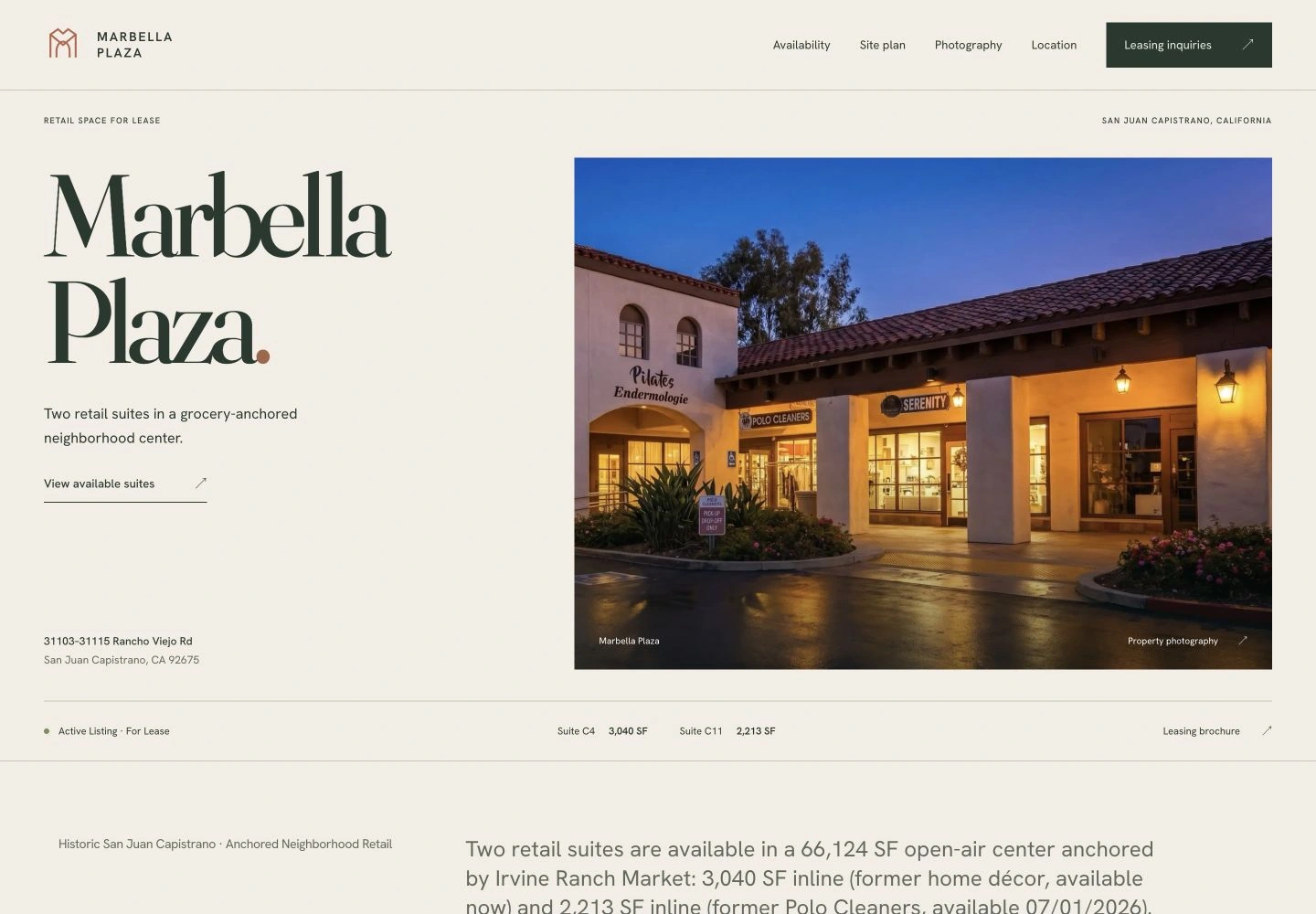
Marbella Plaza, a 66,124 SF grocery-anchored center in San Juan Capistrano, is live at endcap.design/listing/marbella. It sits inside the same domain as this article, the case study, and everything else we publish. Nothing about it renews separately. The full case study covers what went into the build.
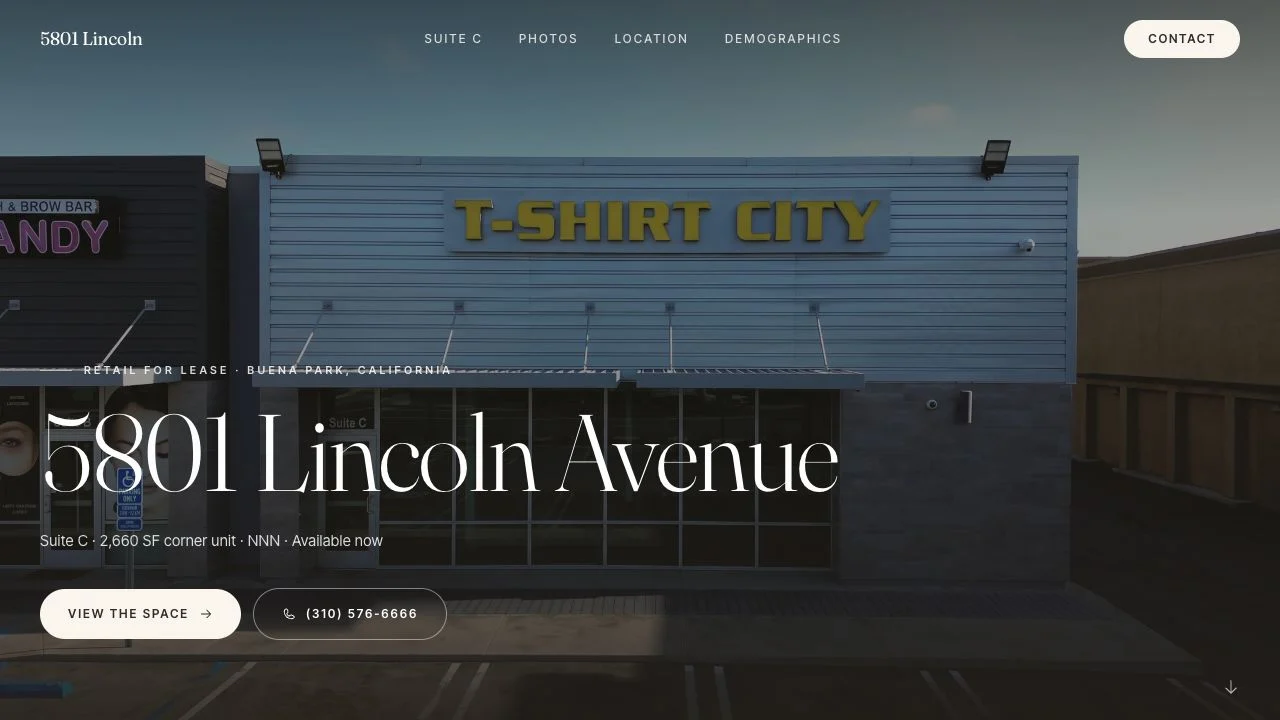
The Lincoln listing, a 2,660 SF corner suite in Buena Park that went brief to live in three days along with a seven-page flyer, lives at endcap.design/listing/lincoln, a property page hosted by Endcap. Ken Simon at KFS Properties is the sole listing contact; Endcap provides the marketing and hosting. A studio-hosted page is also an option when the client does not need the listing inside its own website, provided the page clearly identifies the listing brokerage. The timeline is in the three-day build writeup and the work itself in the Lincoln case study.
Neither project needed a registrar. Both were live faster because of it.
Who holds the keys
This is the part that gets skipped in the kickoff call and litigated later. If a property website is going to exist for years, somebody specific has to be able to change it, and that somebody should not be a vendor who has moved on.
- Register in the client's name, not the agency's. If a standalone domain is the right call, the registrant should be the owner or the brokerage, with the studio added as a technical contact. A domain held in a vendor account is a hostage waiting to happen.
- Decide the co-listing question in writing. On a co-brokered deal, the site lives on one firm's domain and both firms appear on it equally. Pick which domain before the flyer goes to print, because that URL is about to be printed on everything.
- Write down the renewal. Auto-renew on, a card that does not expire before the listing does, and the renewal date somewhere a second person can see it.
- Keep the analytics with the address. Whoever owns the domain should own the measurement property attached to it. What an owner should be able to ask for is in our note on listing analytics.
What happens when the space leases
A property site does not get deleted. Deleting it breaks every link that was ever printed, emailed, or scanned, and those links keep getting used long after the deal signs. The page becomes a leased notice with the deal facts and a line to the broker, or it redirects to the center's page. Both are trivial when the site is a path on a domain you control. Both are somebody's chore when the site is a standalone domain that now has to be renewed to keep a redirect alive.
Firms that plan for this end up with an inventory of property pages that quietly compounds, which is the same argument as the case for dedicated property websites extended past the closing date. Firms that do not end up with a graveyard of expired domains and a printed flyer archive full of dead links. If a rebrand is anywhere on the horizon, the redirect discipline in rebranding without losing search traffic applies to these pages too.
The rule we use
Default to a path on the client's existing domain. Move to a subdomain only when the platform or the infrastructure forces it. Buy a standalone domain only when the property is a named place with a life beyond the current campaign, and when it is bought, register it to the client with auto-renew on and the date written down.
None of this is expensive to get right at the start and all of it is annoying to fix later. When we scope a property site, the address is settled in the first conversation, before a single pixel is designed. You can see how we scope the rest of it in our services.
Work with Endcap
Not sure where your next listing site should live?
Work with Endcap Design
Property websites
We build a website for one property: your photo gallery, property facts, plans, brochure download, and a broker inquiry form.
Included
- Your photo gallery, property facts, plans, and brochure download
- A broker inquiry form and a layout for desktop and mobile
- Many sites launch in about a week once the material is ready
“We own ten homes at Casa De Laguna and were still sending people to a site built in 2013. Noah pulled the photos and details out of the old site, designed a logo from the rooflines and the pond, and put the community, the homes and current availability in one place. It’s the first time the website has looked like the place we actually rent.”
A one-page property website using your approved content · Two revision rounds
We reply within an hour during business hours, and we only use your details to answer you.
Get a quote for a property websiteOr email Noah at hello@endcap.design
See the full service ↗Contact Endcap
LET’S
talk.
A website, a brand, or a complete set of materials.
We reply within an hour during business hours, and we only use your details to answer you.
Let’s talk or email Noah at hello@endcap.design