Web design
The property management website that works every day.
A brokerage site is read by people deciding something once. A property management site is used by people with a problem right now: a tenant whose roof is leaking, a vendor who needs the gate code, an owner checking whether the vacancy list matches the one in last month's report. Most management firm sites are built for the first audience and quietly fail the second, which is the audience that renews the contract.
Two audiences, and only one of them is browsing
The site has to serve an owner who is evaluating your firm and a tenant who already lives with it. Those are different jobs and they fail differently. The owner reads the site once, for twenty minutes, usually before a pitch meeting. The tenant hits it at nine at night on a phone in a dark parking lot and needs one thing in under thirty seconds.
The failure mode is predictable. Firms design the whole site for the owner, then bury the tenant's task behind a stock photo and a paragraph about integrity and stewardship. The result is that every service request arrives as a voicemail on Monday morning, and the property manager's week starts underwater. Design the tenant path first. It is the path that gets used a hundred times for every one time an owner reads the About page.
Availability is the page that gets checked
The vacancy list is the most valuable page a management firm publishes, and the most often stale. It is where a tenant rep starts, where an owner sanity-checks your reporting, and where the search traffic lands. It should carry every property under management, every available suite, the square footage, the status, and a date stamp saying when the list was last touched.
Two structural decisions decide whether it stays true. First, the suite is the unit, not the building. A center with one available inline suite and one available pad should say exactly that, with each suite's own facts and photos, which is the same discipline behind an interactive site plan that leases space. Second, there is one canonical source. When the portal listing, the flyer, and the site each hold their own copy of the availability, they drift, and the drift is visible to exactly the people you did not want to see it. We wrote about that specific failure in portal listing hygiene.
For the assets carrying a real leasing campaign, the availability page should hand off to a property page with its own address rather than trying to hold everything itself. That is the argument in single-property websites, and it applies to a managed portfolio as cleanly as to a listing assignment.
The tenant surface is three things, not a software project
Nobody should rebuild a tenant portal. If your firm runs Yardi, AppFolio, MRI, or Buildium, the portal exists and the accounting lives in it. The website's job is to get people into it and to handle the things the portal handles badly. Three pieces cover most of it:
- The service request path. One obvious link, above the fold, on every page. If it opens the portal, say so in the link text so nobody is surprised by a login screen. If your firm takes requests by form, the form should capture property, suite, contact, category, and photos, and it should route by property to the manager who owns it rather than to a shared inbox that nobody owns after five.
- After-hours and emergency, stated plainly. What counts as an emergency, the number to call, and what to do about a fire, a flood, or a gas smell before calling anyone. Put it on its own page with a short URL a manager can text. This page costs an afternoon to build and saves a career's worth of angry Mondays.
- The documents nobody can find. Certificate of insurance requirements, vendor onboarding, rules and regulations, tenant improvement submittal packets, the moving and delivery policy, and the parking rules. Every one of these is currently a PDF in somebody's sent folder. Published once, with a stable link, they stop being a request.
A management website is judged on a Tuesday afternoon by somebody with a leaking roof, not on a Monday morning by somebody admiring the typography.
One caution on portal links. Tenants have been trained by a decade of phishing to distrust anything that asks for a login. Link to the portal from your own domain, name the software in the link, and never route a payment link through a shortener. A management firm that handles other people's money should look like it takes that seriously.
The owner-facing page most firms never write
The other half of the site sells management services, and it is usually the weakest half because it is written as adjectives. An owner comparing two firms is deciding three things: what you actually do, how they will find out what you did, and what it costs. Answer them in that order, in specifics.
Scope, itemized. What is in the management fee and what is billed separately: accounting, CAM reconciliations, construction management, lease administration, tenant coordination, after-hours response. Say who does the reconciliation and when it goes out. An owner who has been through a bad reconciliation cycle will read that paragraph twice.
Reporting, shown rather than described. Publish a sample monthly package with the numbers changed. One page of an actual rent roll, an actual variance report, an actual work order summary. Nothing in a pitch deck outperforms the real deliverable, which is the same argument we make about what belongs in a leasing pitch.
Fee structure, at least directionally. Firms fight this one, and the objection is always that every assignment is different. That is true and it is also true of every service business that manages to publish a starting point. An owner who cannot find any pricing signal assumes the worst number they have heard, then calls somebody else.
Then name the portfolio. Property types, total square footage under management, the submarkets you actually cover, and how many people are in the office. An owner in Orange County wants to know whether you drive by their center or dispatch to it.
What carries over from the property sites we build
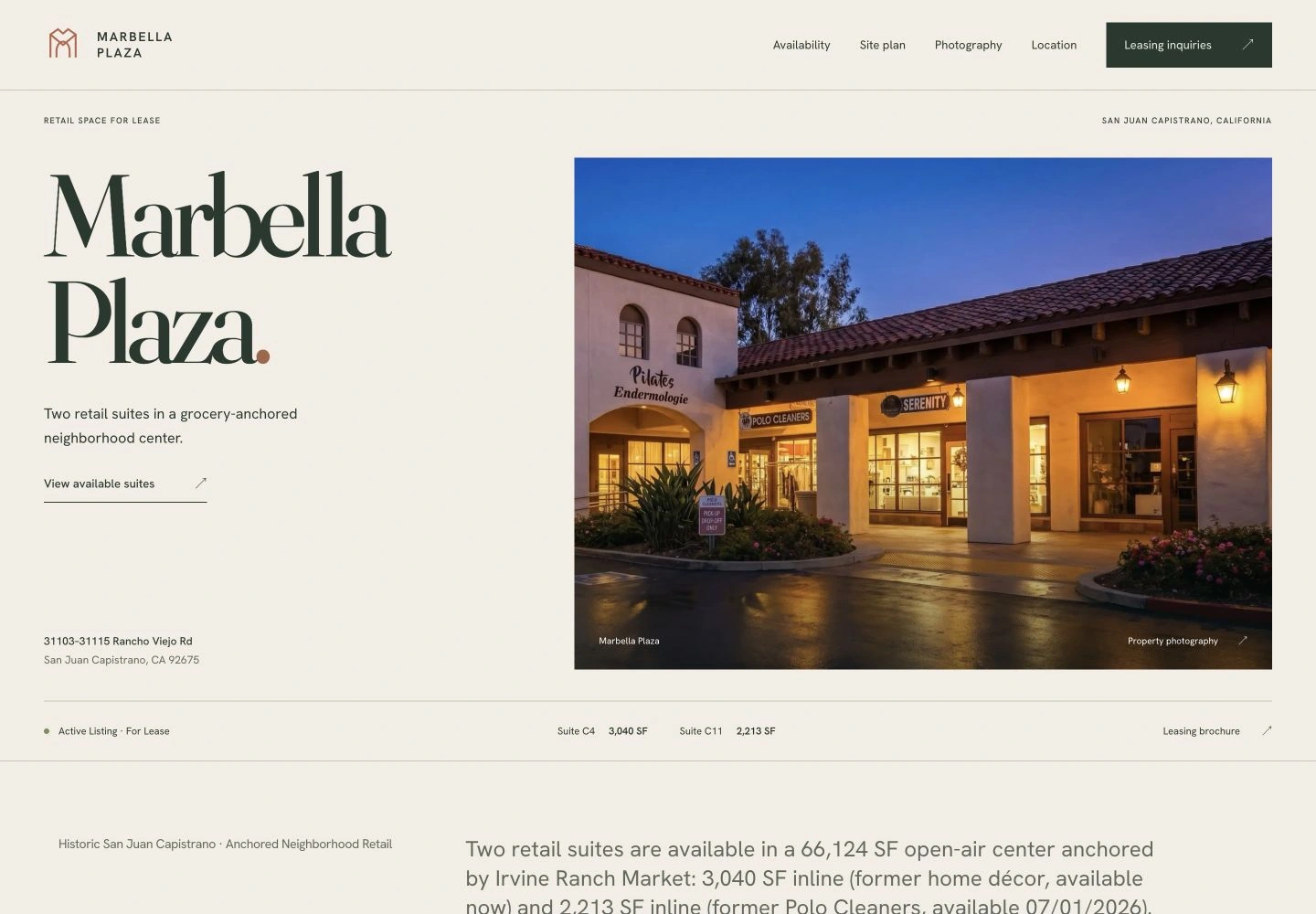
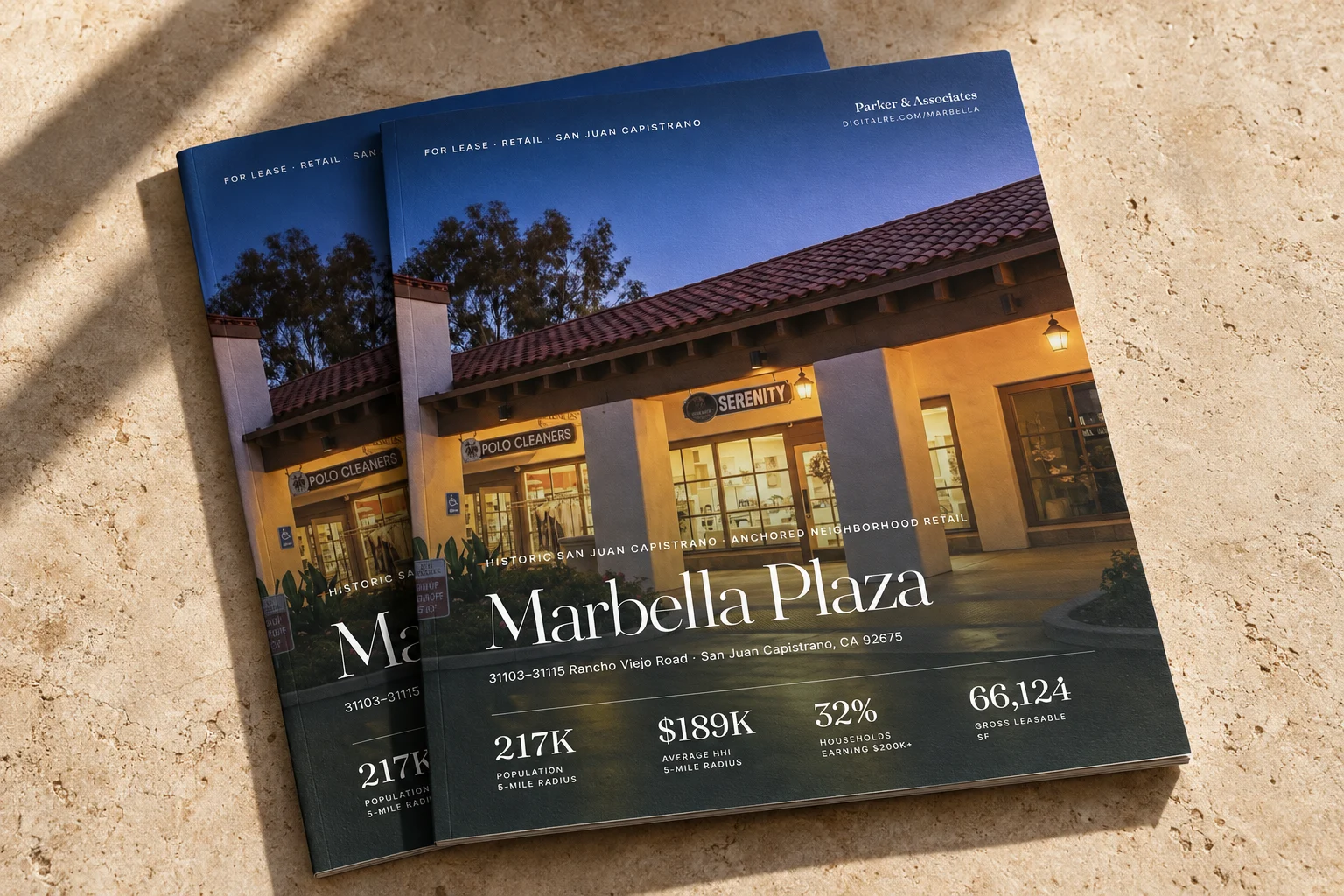
Our published work is leasing work, and the production standard transfers directly to a managed portfolio. For Marbella Plaza, a 66,124 square foot grocery-anchored center in San Juan Capistrano, the site is built so that every suite on the plan connects to its own square footage, status, and photography. That structure is the whole point: when a suite leases, one record changes and the site, the plan, and the availability list all move together. The Marbella case study covers how it is put together. A management firm publishing forty properties needs that same structure, because a hand-maintained vacancy list across forty assets is stale by definition.
The 5801 Lincoln case study is the small end of it: a 2,660 square foot corner suite in Buena Park taken from brief to live in three days, with a seven-page flyer generated from the page's own design system so the attachment and the link never disagree. For a management firm, that is the answer to the recurring problem of a new vacancy showing up mid-quarter. The template exists, the design system exists, and the new suite goes live the same week it is noticed rather than the month after. If you want that produced rather than administered, see what we build.
Speed and access, because of who is holding the phone
Tenants and vendors reach this site on mobile, often on a bad connection, often standing outside the building in question. Google's Core Web Vitals thresholds, published on web.dev, treat a Largest Contentful Paint of 2.5 seconds or less at the 75th percentile as good. You can measure yours this afternoon; the method is in page speed for property websites.
Accessibility is not optional on a site that carries a service request form. The W3C's Web Content Accessibility Guidelines set the contrast floor at 4.5 to 1 for normal text at level AA, and forms with real labels, a visible focus state, and keyboard operability cover most of the rest. A tenant using a screen reader has the same leak you do. Our working standard is in ADA and accessibility for commercial real estate websites.
One more piece of plumbing worth doing: each managed property deserves a claimed Google Business Profile with correct hours and photos, because the tenant's customers search for the center, not for your firm. That work is described in Google Business Profile for shopping centers, and it belongs in the management scope more naturally than in the leasing scope.
Two California details to build in, not bolt on
If your firm is licensed, California requires the responsible license identification on solicitation materials at first point of contact, under Business and Professions Code section 10140.6 and the Department of Real Estate's implementing regulation. That means it belongs in the footer template, on the manager bio pages, and on the flyer master, not pasted onto pages one at a time. The detail is covered in broker bios that win business.
The second is newer and worth a conversation with counsel rather than a paragraph from a designer. California's SB 1103, effective January 1, 2025, added notice, translation, and cost-recovery documentation obligations for tenancies involving qualified commercial tenants as the statute defines them. Whether it reaches any given tenancy is a legal question. The practical consequence for the website is simple: your notice templates and disclosure documents need a maintained home with version dates, because the day you need to prove what was in effect, a PDF in a sent folder is a bad answer.
A pass you can run this week
Open your own site on your phone, outside, and time yourself doing four things: file a service request, find the after-hours number, find the COI requirements, and find out whether the property at the corner of your busiest street has anything available. If any of those takes more than thirty seconds, that is the work, and it is smaller than a redesign.
Then check the vacancy list against your rent roll. If they disagree, the problem is not the list. It is that the site was built as a brochure and the portfolio is a living thing. The fix is structural, and it is the same fix whether you manage four properties or forty: one source of truth for availability, one design system for every deliverable that quotes it, and a page for every task somebody performs more than once a week.
Start a project
Managing a portfolio your website cannot keep up with?
Work with Endcap Design
Shopping center websites
We build shopping center websites that serve shoppers and prospective tenants: a tenant directory, available suites, plans, photos, and a leasing contact.
Included
- Tenant directory and leasing information on one site
- Mobile layout and a broker inquiry form
- Two revision rounds, with launch checks on every page and download
From $1,950 · Up to 5 pages, 20 tenant entries, and 10 availability entries · Hosting and updates quoted separately
We agree on the scope, timing, and price with you before work begins.
Get a quote for your center's websiteOr call or text (425) 233-0769
See the full service ↗Contact Endcap
START A
project.
A website, a brand, or a complete set of materials.
We’ll agree on the scope, timing, and price before starting.
Start a conversation or call or text (425) 233-0769