Marketing
When a listing stops getting calls, before you cut the rate.
Ninety days in, the phone is quiet and the owner wants to know why. The instinct is to reduce the asking rate, because it is the one lever everybody at the table can pull without admitting anything. It is also the most expensive lever, and it works on all four causes of a quiet listing equally well, which is another way of saying it tells you nothing. Here is the order we work the problem in.
A quiet listing is four different problems
Every deal runs the same short funnel: people have to see the listing, arrive at something that holds them, care enough to raise their hand, and then like the space once they stand in it. Failures at those four stages look identical from the broker's chair. The phone does not ring in any of them.
They are not equally expensive to fix, and they do not have the same answer. So the first job is not a strategy, it is a measurement: find the stage where the drop happens, and only then decide what to do about it. In practice we can usually place a listing at one of the four inside a half hour, because the data to do it already exists and nobody has looked at it.
- Exposure. Not enough of the right people ever see it.
- Presentation. They see it, arrive, and leave without reading.
- Qualification. They read the whole thing and still cannot tell whether the space works, so they do not call.
- Product. They call, they tour, and the space or the deal is genuinely not competitive.
Stage one: is anyone arriving?
Start with the raw count of people reaching the listing, from every source. Portal views, sessions on the property page, sign calls, clicks from the last email. If the total is small, nothing downstream matters and no amount of copywriting will save it.
Thin exposure usually has a boring cause. The portal record is incomplete or has drifted out of date, so it ranks and converts poorly. The listing exists on one portal and not the other. The property is syndicated under a slightly different address than the one people search, or a duplicate record from the prior listing agent is still live and splitting the traffic. We wrote the full checklist for that in portal listing hygiene, and it is the cheapest work on this page.
The other common gap is that the campaign never had a second channel. A sign and a portal slot is not a marketing plan for a space that has been available for a quarter. The broker email list, the tenant reps who actually place this use, the neighboring owners, the retailers already within two miles who are candidates for a second location: those are outbound moves, and they are the ones that get skipped because they take an afternoon and cannot be bought.
Stage two: they arrive and leave
If arrivals are healthy and nothing else is, the listing is losing people in the first few seconds. Two causes account for most of it.
The first is speed. A property page that takes six seconds to show anything on a phone, in a parking lot, on a mediocre connection, has already lost. Google's Core Web Vitals guidance, published on web.dev, sets the threshold for a good Largest Contentful Paint at 2.5 seconds or less, and it is measured on real visitors rather than a lab test. Most slow property pages are slow for the same reason: hero video and full-resolution photography shipped straight from the camera. That is fixable in a day, and we covered how in page speed for property websites.
The second is the first screen. Tenant reps triage. They open a listing to confirm four things, and if any of the four is missing they close it rather than hunt: what it is, how big, where exactly, and what it costs. "Rate on request" is a legitimate strategy on an investment sale and a leak on a lease listing, because the rep screening ten spaces for a client will not email you to find out whether you are in range. We say more about that in how to write a commercial listing.
Stage three: they read it all and still do not call
This is the most misread failure of the four, because engagement looks good. People are spending real time on the page. They are opening the flyer. And nothing comes in.
The pattern almost always means the listing answers the questions the owner cares about and skips the ones the tenant has to answer for their own underwriting. A restaurant operator needs to know the grease interceptor, the hood, the panel size, and whether the use is permitted by right or needs a hearing. An industrial user needs clear height, power, dock versus grade, and yard. A retailer needs the co-tenancy, the parking ratio, and the delivery condition in plain words: shell, second generation, or turnkey, and who pays for what.
The absence of those facts does not read as neutral. It reads as a risk, and a rep with nine other options does not spend a phone call resolving your ambiguity. Add the missing facts and the same audience that read quietly starts raising its hand, without a dollar of change to the rate.
A rate cut fixes every problem on this list. That is the trouble with it. It also charges you for the three you did not have.
Stage four: the tours happen and nothing lands
If reps are touring and passing, the marketing is doing its job and the answer is in the product or the deal. That is a harder conversation, and it is the one an owner is paying a broker to have honestly.
Sometimes it is the rate, and by this point you have earned the right to say so with evidence instead of instinct: here is what comparable space signed at in the last two quarters, here is the concession package that came with it. Sometimes it is not the rate at all. It is a delivery condition that hands the tenant a six-figure buildout, a tenant improvement allowance that does not match the market, or a term structure nobody wants. Sometimes the space is fine and the timing is not, because the category it suits is not opening stores this year, and no marketing changes that.
Reaching that conclusion in the right order matters. An owner who cuts the rate on day sixty and finds out on day one hundred and twenty that the real problem was an incomplete portal record has paid for the diagnosis twice.
What we watch on our own listings
We build and run complete listing campaigns, so the work itself becomes the place the diagnosis gets made. Two of ours are public.
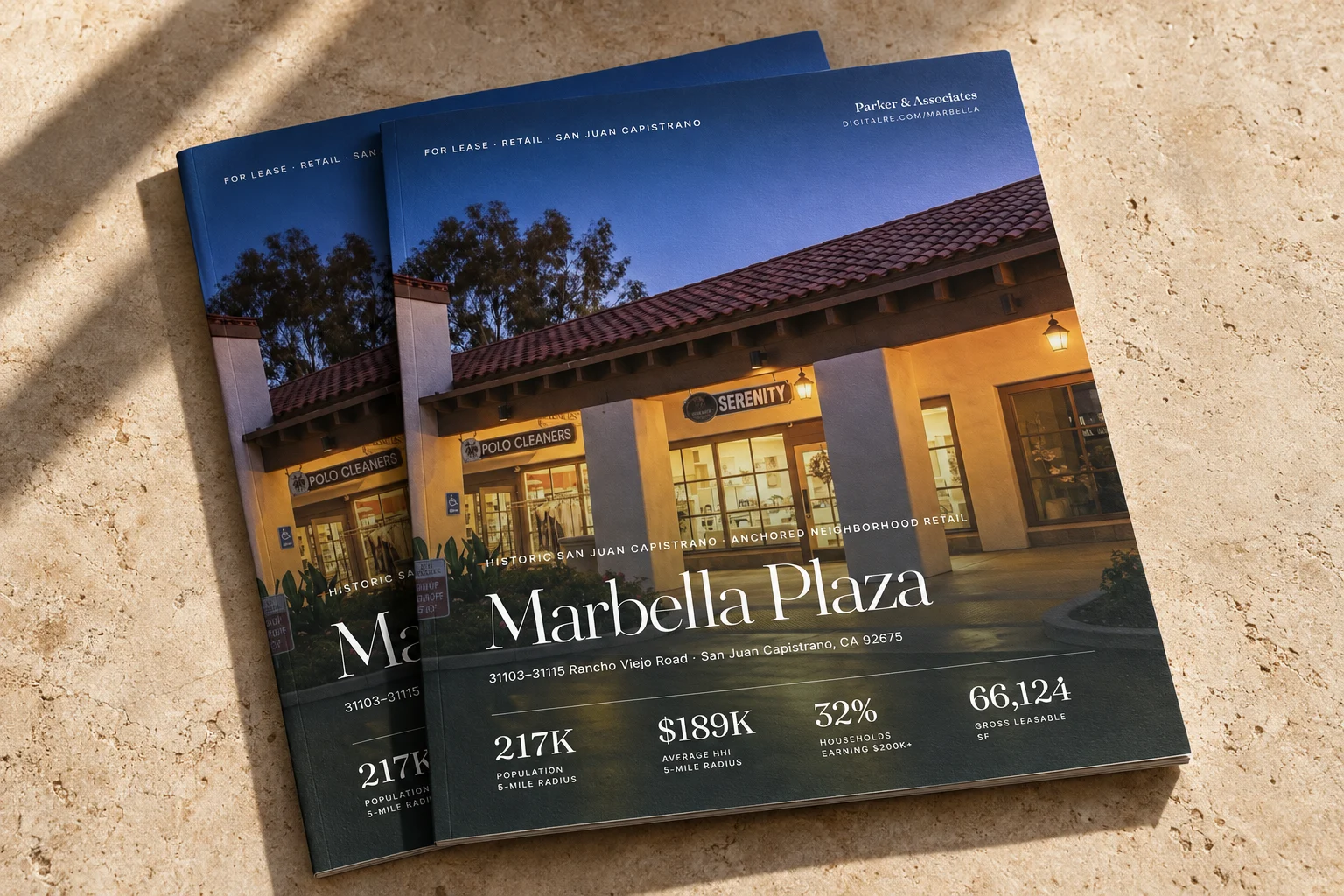
At Marbella Plaza, a 66,124 square foot grocery-anchored center in San Juan Capistrano, the site carries every suite in one place with an interactive plan. That structure is what makes stage three legible: when interest concentrates on one suite and skips another of similar size, that is a signal about the space rather than the campaign, and it arrives without anyone having to call and ask.
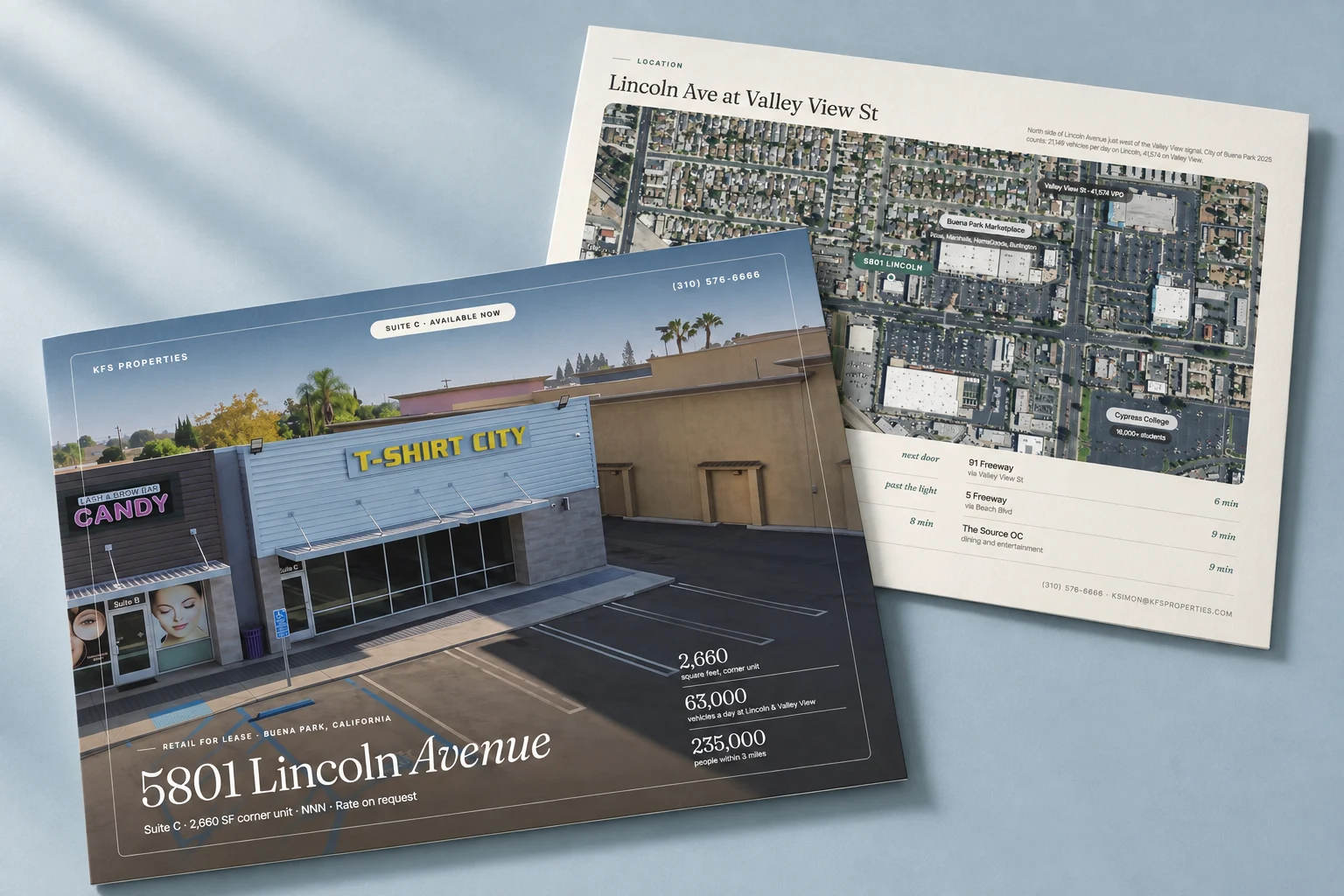
At 5801 Lincoln, a 2,660 square foot corner suite in Buena Park, we took the listing from brief to live in three days with a seven page flyer, and put the numbers a tenant underwrites on the page rather than behind an email. Traffic counts come from the City of Buena Park's published GIS layer, 21,149 vehicles a day on Lincoln Ave at the site and 41,574 on Valley View at the corner, each labeled with its source and year. Demographics are computed to true ring radii rather than reprinted. The point is not that the numbers are impressive. It is that a rep can finish their screen without contacting us, which means the calls we do get are from people who already cleared it. The build itself is written up in the three day timeline.
The reporting side matters as much as the build. Knowing which suite drew attention, which source sent the visit, and what share of sessions reached the flyer is what separates a diagnosis from a guess. We laid out the numbers worth asking for, and the ones that flatter everybody, in website analytics for listings.
The half hour version
Before the next owner call, run this. It is thirty minutes and it will usually tell you which of the four you have.
- Pull the arrival count from every source. Portal views, page sessions, sign calls, email clicks, for the last thirty days against the thirty before. If it is thin, stop here and fix exposure.
- Open your own listing on your phone, on cellular, away from the office. Time it. Read what is on the first screen without scrolling and see whether the four triage facts are there.
- Search the address the way a stranger would. Look for the duplicate record, the stale rate, the wrong square footage on a portal you forgot you were on.
- Write down the five questions a tenant for this use must answer to sign. Then find each one on the page. The ones you cannot find are your fix.
- Count tours, and separate them from inquiries. Tours without offers is a product conversation. Inquiries without tours is a qualification one.
None of this replaces judgment about price. It puts price back where it belongs, which is last, after the free fixes and the cheap ones have been made and the listing has had a fair run at the market it was built for. If the page carrying the campaign is the weak link, that is what we build, usually in days rather than weeks.
Work with Endcap Design
Listing marketing for a vacant space
We produce the photography, flyer, and website for a space, built around the material you already have.
Included
- Photography of the space and the storefront
- A lease flyer or brochure with the suite size, plan, and leasing contact
- A property website when the listing needs one
“The Flyer is all that I need and it is outstanding.”
Photography from $325 · Lease flyers from $175 · Property websites from $495
We agree on the scope, timing, and price with you before work begins.
Get a quote for your listingOr call or text (425) 233-0769
See the full service ↗Contact Endcap
START A
project.
A website, a brochure, or a complete set of materials.
We’ll agree on the scope, timing, and price before starting.
Start a conversation or call or text (425) 233-0769