Brochures & OMs
What is an offering memorandum in real estate?
An offering memorandum (OM) is the marketing document a listing broker prepares for a commercial property offered for sale. It puts the physical facts, tenancy, financial information, location, and sale process in one file so a prospective buyer can decide whether to underwrite the property. It is a presentation of information supplied by the seller, not a contract, and buyers still verify the underlying records during due diligence.
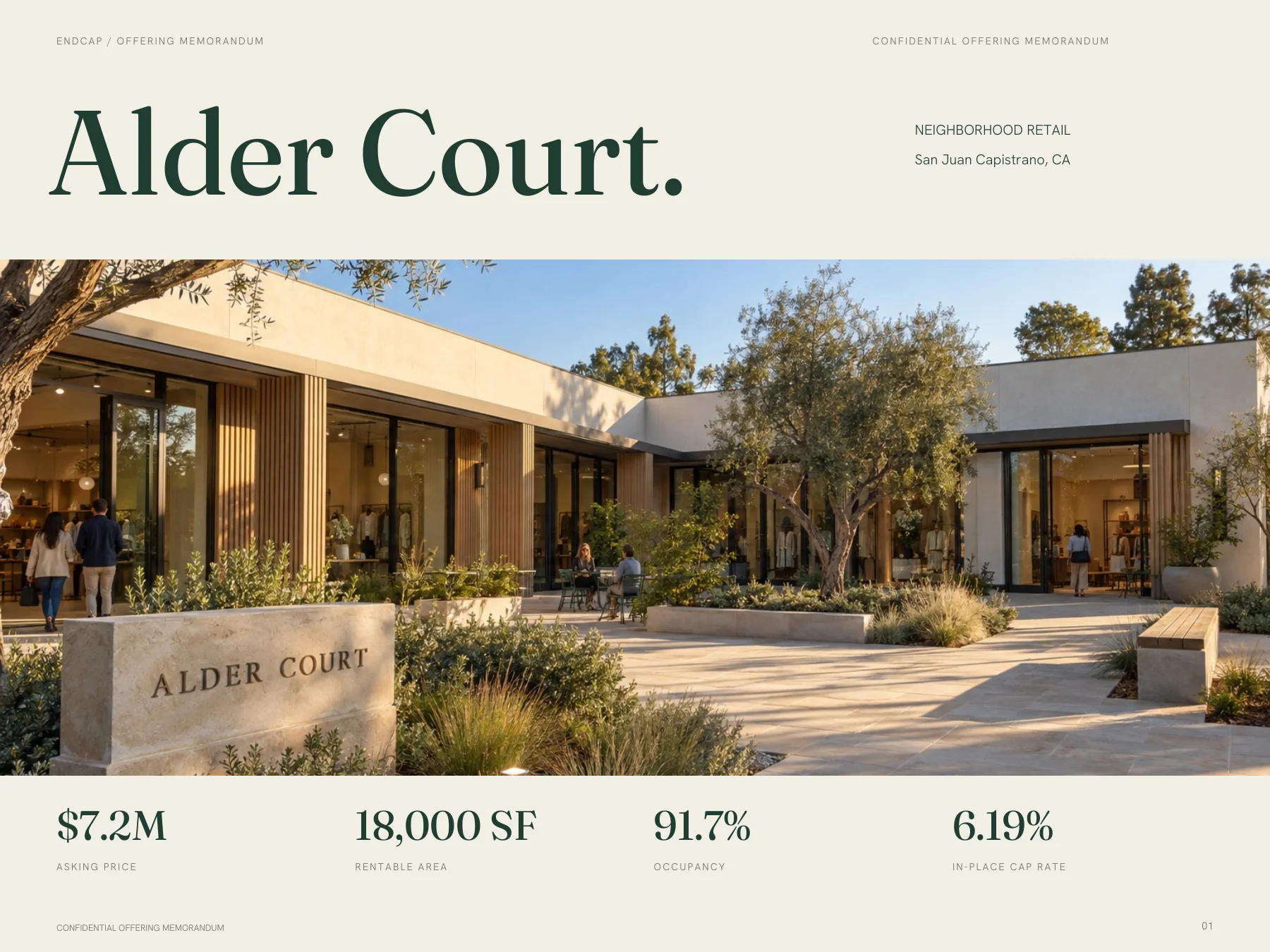
The examples below come from Endcap’s 12-page Alder Court sample.
Who prepares an OM and who receives it
The listing broker prepares the OM on behalf of the seller. The seller supplies and approves the records it is built from: leases, the rent roll, income and expense statements, plans, and property facts. At large brokerages an in-house marketing team usually lays out the document; at smaller firms an analyst or the broker assembles it, sometimes with an outside designer. Pricing guidance, underwriting, and legal language stay with the broker, the seller, and their advisors.
Software now produces first drafts. Crexi announced Crexi Create in May 2026, a tool that generates an editable OM draft from uploaded financials, leases, rent rolls, or a property address for Crexi Pro and Crexi Intelligence subscribers (Crexi announcement). A draft still needs the same checks against the approved records before it goes to buyers.
Because an OM usually contains the rent roll and operating figures, many sellers release it only after a prospective buyer signs a confidentiality agreement. AIR CRE, which publishes standardized commercial real estate contract forms, lists a Confidentiality Agreement (revised October 2020) that sellers give to potential buyers of commercial property; under it the seller provides information such as rent rolls, budgets, and leases, and the buyer agrees to keep that information confidential (AIR CRE contract list). A shorter teaser or flyer often circulates publicly first, and the full OM follows once the agreement is signed. The deal room guide explains how a property website can gate the file and record who received it.
What goes in an OM?
Most sale OMs follow a similar order, moving from the headline facts to the evidence behind them. The table lists the usual sections, what each contains, and a working page range. The ranges come from Endcap’s own layouts and are not an industry standard; a single-tenant net-lease OM can be much shorter, and a large multi-tenant center can be much longer. The last column shows where each section falls in the 12-page Alder Court sample.
| Section | What it contains | Typical length | Alder Court sample |
|---|---|---|---|
| Cover | Property name or address, principal image, offering type, approved headline figures, listing contact | 1 page | Page 1 |
| Confidentiality and disclaimer | Statement that the document is confidential and that its information comes from sources believed reliable but is not warranted; the wording comes from the broker or counsel | Part of a page, often inside the cover or at the back | Page 12 |
| Investment summary | Price or pricing guidance, area, occupancy, in-place income, and the specific reasons a buyer might look closer, each with a source and date | 1–2 pages | Page 2 |
| Property overview and site plan | Parcel and building facts, year built and renovated, access, parking, capital work, site and floor plans, with conceptual plans labeled | 1–3 pages | Pages 3–4 |
| Location and market | A map, access and nearby amenities, and demographic or traffic figures with their geography, source, and period | 1–3 pages | Page 5 |
| Tenancy | Tenant mix, rent roll with suite labels matching the plan, lease terms, options, vacancies, rent concentration, and expirations | 2–4 pages | Pages 6–8 |
| Financials and assumptions | Operating statement, historical and in-place figures kept separate from projections, lease-up assumptions, and price sensitivity with visible calculations | 2–4 pages | Pages 9–11 |
| Process and contact | How to request records, tour, ask questions, and submit an offer, plus the approved listing team contacts | 1 page | Page 12 |
The order and length depend on the property and the information available. A short single-tenant sale may need less explanation than a multi-tenant center. The document should answer the questions the property actually raises. The OM template and source checklist lists the records to request for each section.
Rent roll presentation
A table should show the same suite labels used on the site plan, with a clear date and units. Where a lease term or calculation is missing, mark it for review rather than filling the gap with a guess. The sample separates annual base rent from reimbursements and identifies its assumptions.
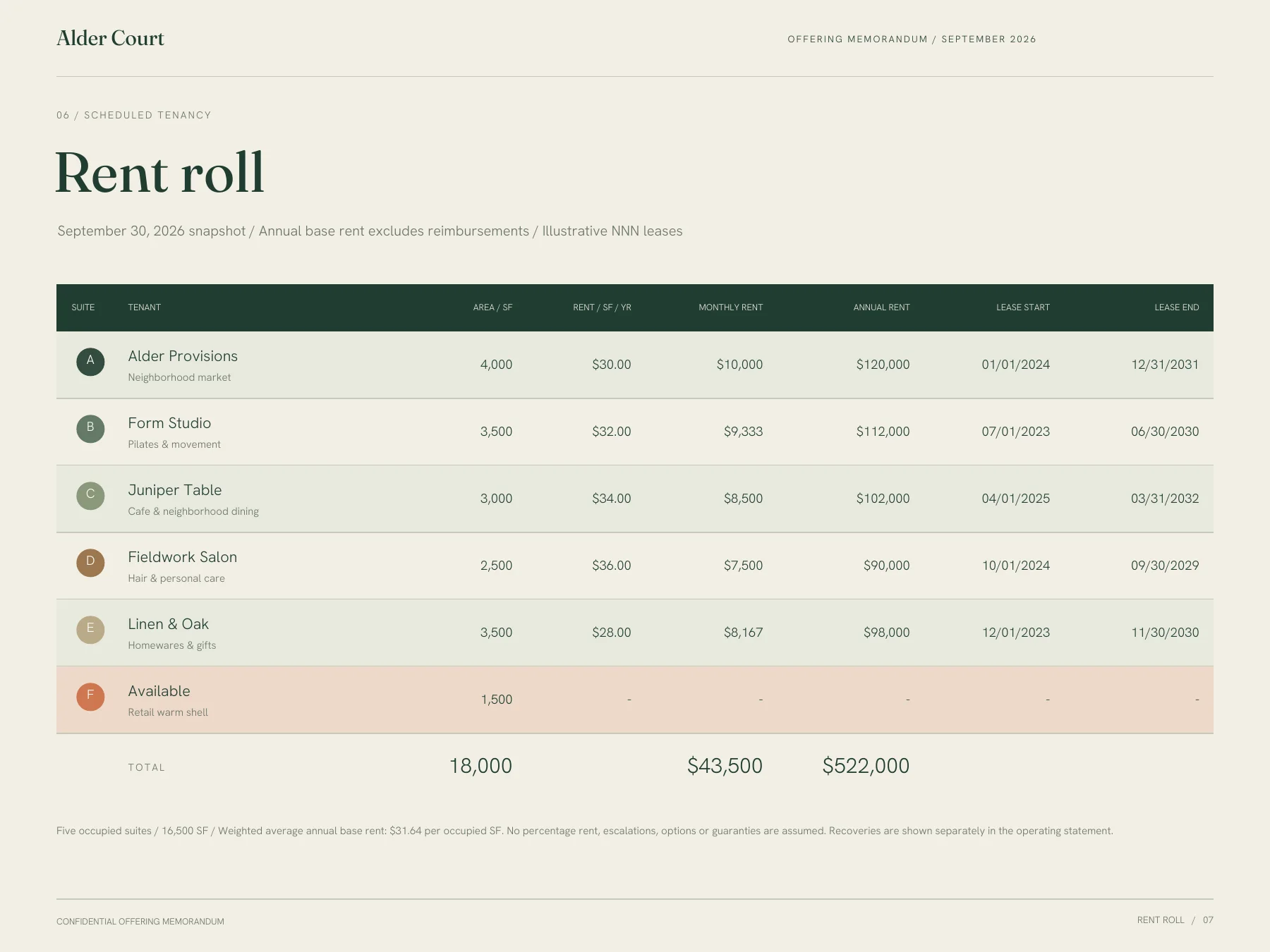
Consistency across pages matters more now that buyers read OMs with software. An article in the Summer 2026 issue of Development, the magazine of CREDA (the Commercial Real Estate Development Association, formerly NAIOP), describes investors using AI to pull financial data out of long offering memorandums and flag inconsistencies (CREDA, Summer 2026). A rent roll total that disagrees with the operating statement is now easy for a reader to find.
Where does the information come from?
The broker or owner supplies and approves property records, leases, rent roll, income and expense statements, plans, photography, and sale instructions. Depending on the agreed scope, Endcap can organize the material, write and design the pages, and prepare a readable digital and print file. We agree on those deliverables, the review process, timing, and price before work begins.
An OM is a presentation of supplied information. Buyers should verify material facts and assumptions against the underlying records. Legal language and transaction terms should come from the appropriate transaction professionals.
How an OM compares with a flyer, leasing package, and BOV
Four documents get confused in conversation. They have different readers and answer different decisions, so the right one depends on the transaction and the facts available rather than on a target page count.
| Document | Reader and decision | Usual contents | Guide |
|---|---|---|---|
| Offering memorandum (OM) | A buyer or their analyst deciding whether to underwrite a purchase | Property facts, tenancy, financials, assumptions, location, sale process | OM page by page |
| Lease flyer | A tenant or tenant rep deciding whether to tour one space | Suite, size, rate or “on request,” plan, location, contact; usually one or two pages | OM vs. flyer vs. brochure |
| Leasing package | Tenant reps and the broker community deciding whether a center fits a requirement | Availability across the property, site plan, trade area, co-tenancy, leasing contact | Leasing package vs. sale OM |
| Broker opinion of value (BOV) | An owner deciding whether to sell and at what price, usually before a listing is signed | The broker’s pricing opinion, comparable sales, market context, and a proposed marketing plan; it is not an appraisal | Valuation is the broker’s work; the design of an OM starts after the listing |
Offering memorandum in securities offerings
The same phrase has a different meaning when money is raised from investors. In a securities offering, the SEC’s Investor.gov bulletin on Regulation D describes a private placement memorandum or offering memorandum as a document an issuer may provide to introduce the investment and disclose information about the offering and the issuer. The bulletin notes that the document is not required and that such documents typically are not reviewed by any regulator (Investor.gov, Private Placements under Regulation D).
A real estate sale OM markets a property to buyers. A private placement memorandum discloses the terms and risks of a securities investment and is prepared with securities counsel. Both can appear in one transaction when a sponsor buys a building using the information in a sale OM and then raises equity for it with a PPM. Endcap designs sale and leasing documents; it does not prepare securities disclosure documents.
Before it goes out
- Confirm figures, dates, lease labels, and contact details against the approved source.
- Distinguish in-place income from projections; show the basis for each calculation.
- Give maps and demographic figures a source, geography, and period.
- Check the digital PDF on a phone and desktop. Keep text selectable and links working where possible.
- Decide who receives the full file and whether a confidentiality agreement comes first.
- Set a review owner and a process for replacing the file when approved facts change.
See all 12 Alder Court sample pages with explanations, read what an OM costs to produce, or see Endcap’s offering memorandum design service, which starts at $495 for up to 12 pages using your approved content.
Sources
- AIR CRE, list of contracts and forms (Confidentiality Agreement, revised 10/2020; list dated August 21, 2025). Accessed September 24, 2026.
- U.S. Securities and Exchange Commission, Investor.gov, Private Placements under Regulation D – Updated Investor Bulletin. Accessed September 24, 2026.
- Crexi, Crexi Create announcement, PR Newswire, May 2026 (public launch May 18, 2026).
- Buckelew, Ezzie, and Stephenson, “Structure Before Speed: A Framework for Meaningful AI Adoption in CRE”, Development, Summer 2026, CREDA (formerly NAIOP).
Work with Endcap Design
Offering memorandum design
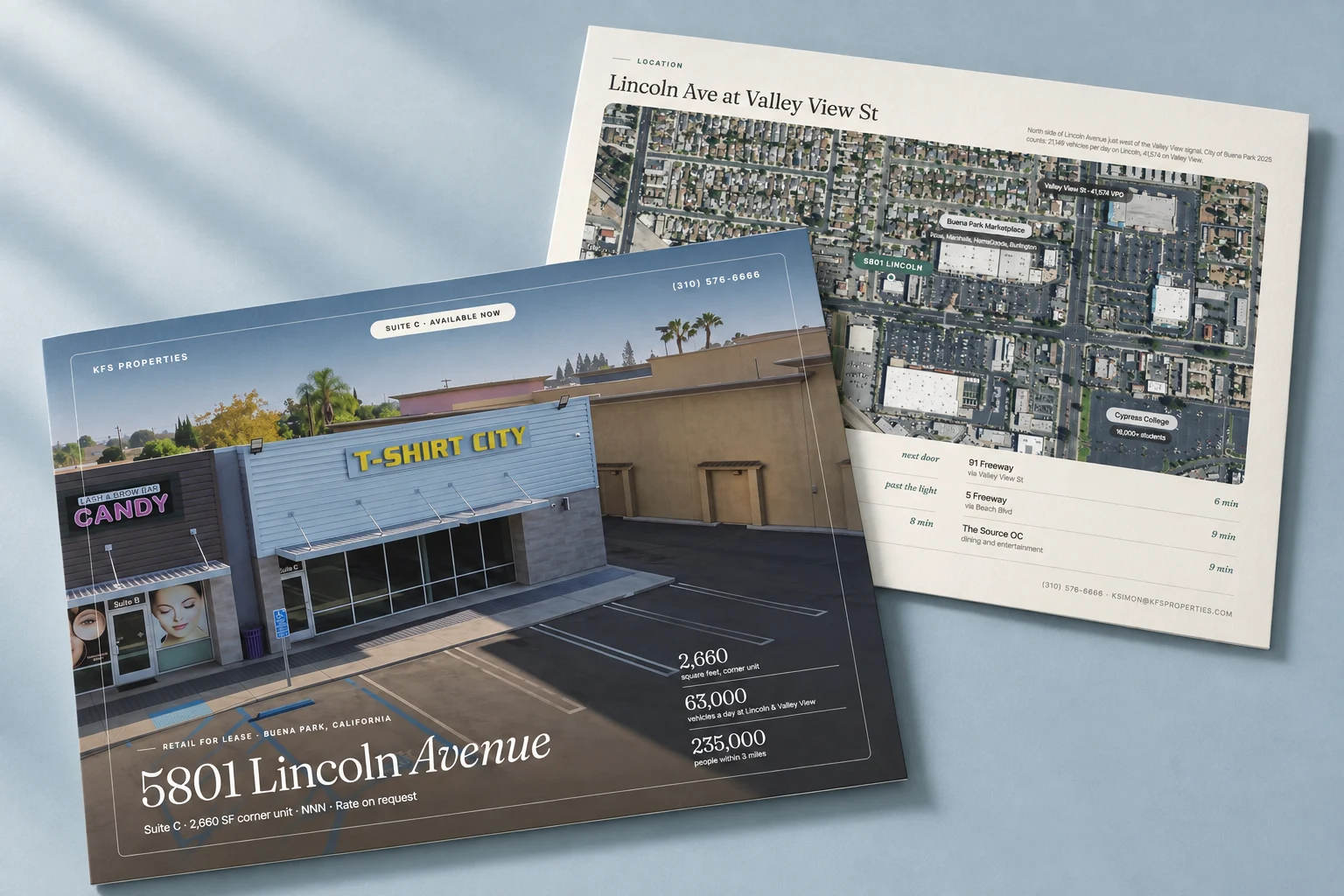
We design offering memorandums, property brochures, and lease flyers from your approved text, photos, plans, rent roll, and financials.
Included
- Up to 12 pages using your approved text, photos, tables, and financials
- Two revision rounds
- Digital and print-ready PDFs
“The Flyer is all that I need and it is outstanding.”
Offering memorandums from $495 for up to 12 pages · Brochures from $350 · Lease flyers from $175
We agree on the scope, timing, and price with you before work begins.
Get a quote for your OMOr call or text (425) 233-0769
See the full service ↗Contact Endcap
START A
project.
A website, a brochure, or a complete set of materials.
We’ll agree on the scope, timing, and price before starting.
Start a conversation or call or text (425) 233-0769