Documents
Offering memorandum, flyer, or brochure: which does your listing need?
These three documents get used interchangeably in conversation and they should not be. An offering memorandum sells a building to an investor. A lease flyer sells a suite to a tenant. A leasing brochure sells a whole center to a broker community. Different readers, different decisions, different lengths. Producing the wrong one is the most common and most expensive waste in property marketing, because it usually is not discovered until the responses do not come.
Start with who is reading it
Every question about which document to produce resolves into one prior question: who is on the other end, and what decision are they making?
An investor is deciding whether to underwrite a purchase. They care about income, durability of that income, and what happens at rollover. An tenant or tenant rep is deciding whether to tour a space. They care about size, rate, configuration, visibility, parking, and neighbors. A broker community is deciding whether to bring a client. They care about what is available, at what rate, and how easy you are to work with.
Those are three different documents. Attempting one that serves all three produces something that serves none of them, which is a fair description of a lot of what circulates.
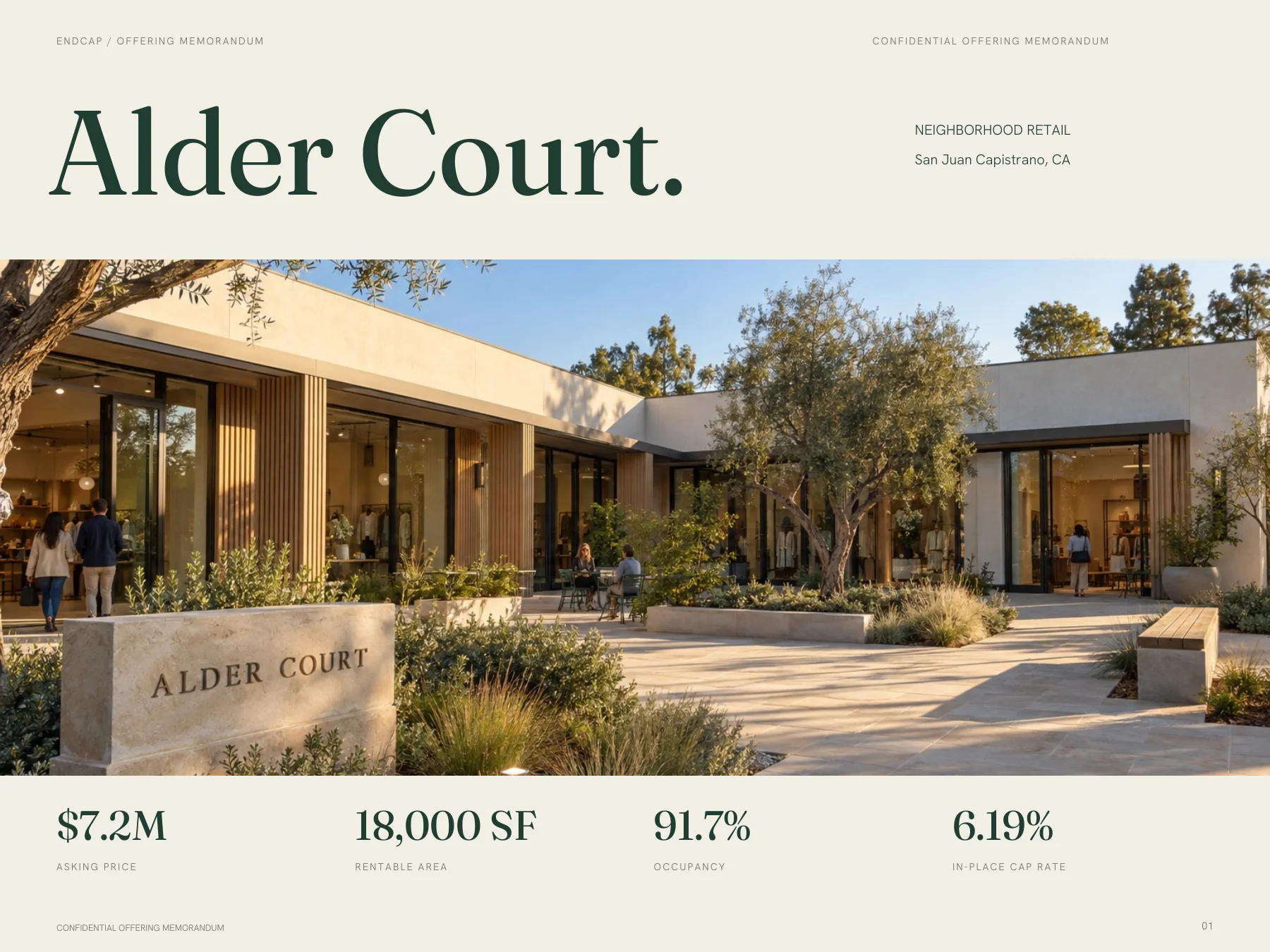
The offering memorandum
Reader: a buyer or their analyst. Decision: whether to underwrite. Length: eight to forty pages depending on complexity.
The OM is for a disposition — you are selling the asset. It carries the rent roll, the trailing financials, a pro forma, the trade area, and the terms of the offering process. It is the longest of the three by a wide margin because the decision it supports is the largest, and because a buyer will not move to diligence on a summary.
Use one when the asset is going to market for sale and the buyer pool is wider than a handful of people you already know. On a genuinely off-market trade between two parties who understand the asset, a rent roll and a one-page summary often does the job, and the OM is ceremony.
The lease flyer
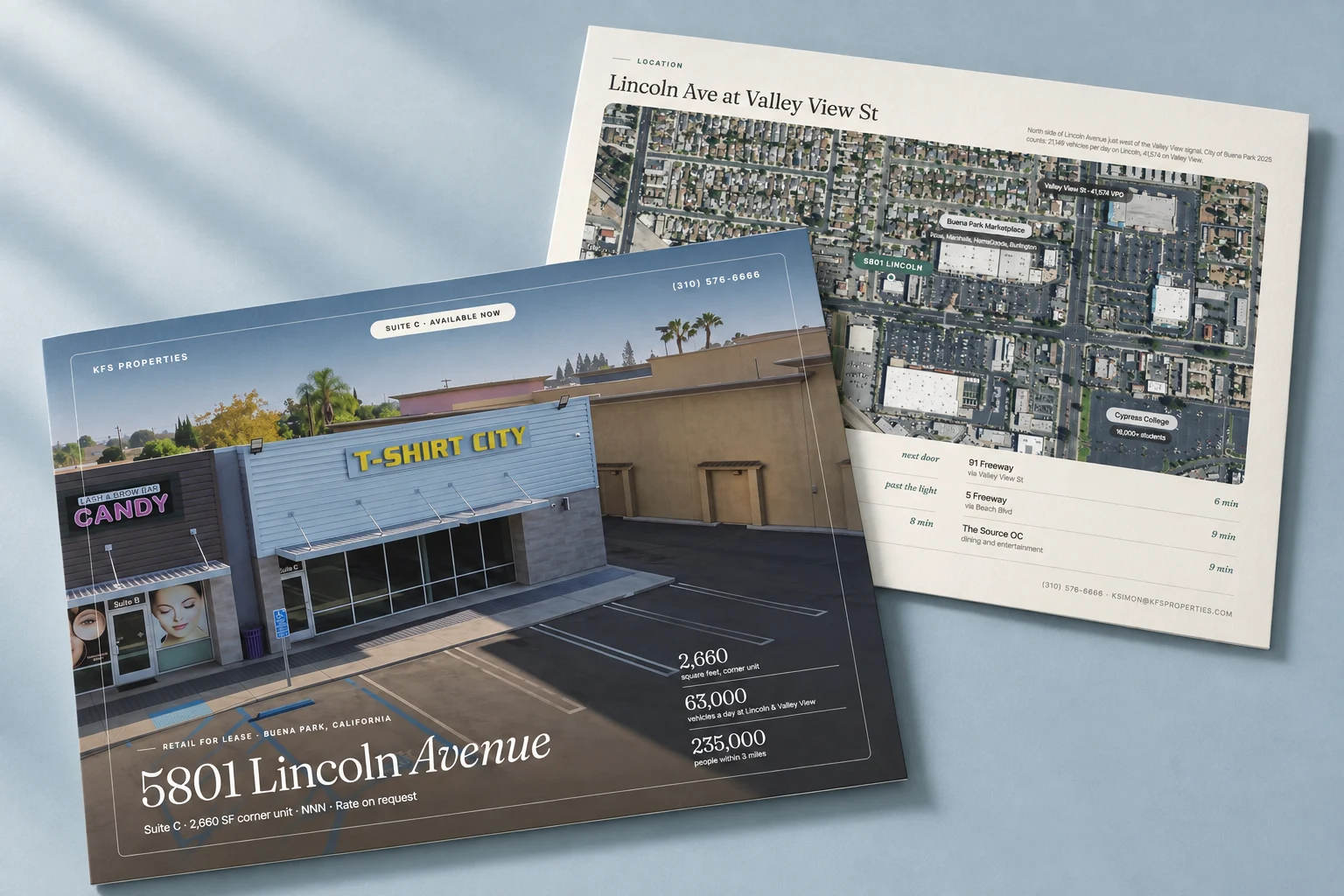
Reader: a tenant or a tenant rep. Decision: whether to tour. Length: one page, occasionally two.
This is the workhorse and it is the one most often done badly. A flyer covers one availability: the suite, the square footage, the asking rate and structure, a floor plan, a photograph of the actual space, the co-tenancy, parking, and how to reach you. That is the whole list.
The failure mode is length. A tenant rep screening space for a client is looking at a dozen options and will spend perhaps fifteen seconds on each. Anything past the first page is not read. If the suite is 2,400 square feet at $2.35 NNN with a grease interceptor already in place, those facts need to be findable in about three seconds, and the grease interceptor may be the single most important word on the page.
One flyer per availability. Not one flyer listing six suites — that forces every reader to hunt for the one that might fit, and most will not bother.
The leasing brochure
Reader: the brokerage community and prospective tenants for a whole property. Decision: whether this center is worth bringing clients to. Length: four to twelve pages.
A brochure is for a center or a portfolio rather than a single space. It carries the site plan with suites marked, the availability schedule, the co-tenancy and anchor lineup, trade-area detail, and the positioning of the property as a place. It is the document that goes out at ICSC and sits on the table.
The site plan is the centerpiece and it is worth spending real time on. A legible plan showing which suites are available, at what size, with the anchors labeled, answers more questions in one page than six pages of prose.
The overlap that causes trouble
Two situations genuinely blur.
A center for sale with vacancy. The buyer is underwriting lease-up, so the OM needs to make the leasing case as well as the investment case. The right move is an OM with the availability schedule and a strong trade-area section folded in — not two documents stapled together, and not a leasing brochure with financials bolted onto the back.
A single-tenant building available for either sale or lease. Here you genuinely need both, because the two readers want opposite things. The investor wants the lease; the user wants the building. Produce two documents from one shoot and one set of drawings, which costs far less than producing them separately.
What they share
All three are built from the same underlying assets: photography, a site plan or floor plan, the numbers, and the trade-area data. That is why producing them together is dramatically cheaper than producing them one at a time six months apart. The photography is the expensive part, and it is the part that carries into every document, the portal listings, and the property website.
If you are going to need a flyer in the spring and an OM in the fall, shoot once.
A rough decision rule
- Selling the asset, wide buyer pool offering memorandum
- One suite available, marketing to tenants lease flyer
- Multiple suites in one property, marketing to the brokerage community leasing brochure
- Selling a property with meaningful vacancy OM with the leasing case built in
- Available for sale or lease both, produced from one shoot
Common questions
What is the difference between an offering memorandum and a flyer?
An offering memorandum markets a property for sale to investors and runs eight to forty pages, carrying the rent roll, financials, and offering terms. A lease flyer markets a single available suite to tenants and their brokers, and should fit on one page. Different reader, different decision, different length.
Can one document work for both leasing and sale?
Rarely, and only in one case: a property with meaningful vacancy being sold, where the buyer is underwriting lease-up. Then the offering memorandum should carry the availability schedule and trade-area case inside it. For a building available for either sale or lease, produce two documents from one photo shoot.
How long should a lease flyer be?
One page. Occasionally two if a floor plan needs its own. A tenant rep screening a dozen options spends roughly fifteen seconds per flyer, and anything past the first page is not read.
Should each available suite get its own flyer?
Yes. A single flyer listing six availabilities forces every reader to hunt for the one that might fit, and most will not. One flyer per availability, sharing a common format so they read as a set.
Work with Endcap Design
Offering memorandum design
We design offering memorandums, property brochures, and lease flyers from your approved text, photos, plans, rent roll, and financials.
Included
- Up to 12 pages using your approved text, photos, tables, and financials
- Two revision rounds
- Digital and print-ready PDFs
“The Flyer is all that I need and it is outstanding.”
Offering memorandums from $495 for up to 12 pages · Brochures from $350 · Lease flyers from $175
We agree on the scope, timing, and price with you before work begins.
Get a quote for your OMOr call or text (425) 233-0769
See the full service ↗Contact Endcap
START A
project.
A website, a brochure, or a complete set of materials.
We’ll agree on the scope, timing, and price before starting.
Start a conversation or call or text (425) 233-0769