Production
A leasing package is not a sale OM. Stop copying one.
Sale software treats an offering memorandum and a brochure as two depths of the same investment deal. A lease listing has a different reader and a different job — and the sale pages brokers keep pasting into it are why tenant-reps throw the PDF out.
Two readers, two jobs
A buyer is underwriting income, term, and risk behind an NDA. They will rebuild your model. We walked that document in A commercial real estate offering memorandum, page by page. This is not that walk.
A tenant-rep is eliminating. Twenty seconds, often on a phone, often without signing anything. They have a requirement sheet — size, clear height, docks, power, available date, exclusive-use, shell — and they are looking for a reason to cut you.
What the document is doing: answering the filter so a real requirement survives it. What the reader is doing: deciding whether this space is even in the set. Where packages lose it: treating the tenant-rep like a junior buyer. Investment highlights, a cap rate, a seller thesis, a call-for-offers date. Those pages tell a leasing reader you listed the wrong product.
The industry talks about OM versus brochure as if the only split is teaser versus CIM for the same sale. That confusion is real, and it is sale-side. Leasing is not a shorter version of that pair. Marketing a commercial property for sale is a list, a gate, and a diligence set. A lease campaign is a working file a rep can forward without a lawyer.
What a leasing package actually is
Not a compressed offering memorandum. A package a tenant-rep can use. Public by default.
- A flyer that can be forwarded in one tap. Page anatomy is in Commercial real estate flyer design.
- An availability or spec sheet. The numbers the requirement is screened on, in a table, with units.
- A site plan with the vacant suite marked — labeled the way the rent roll labels it, tenant names on the occupied boxes, the empty one obvious. Why that drawing exists is in Site plans that lease space.
- Photographs that prove the spec block, not a beauty set of the front elevation.
- For retail: a restrictions and co-tenancy page. Who is there, what the exclusives are, what remaining term the anchor has.
- TI and shell stated honestly — vanilla, second-generation, cold — so a user knows what they are touring.
- An available date you can stand behind.
- How to tour: who holds the keys, how much notice, whether the suite is occupied.
Gating is the exception. A confidential lease can sit behind a form. That is unusual. The default for a vacant bay in Orange County is public. The people who fill vacant bays do not execute NDAs to learn the clear height.
Portal copy still starts with the facts a rep scans — see How to write a commercial listing that gets inquiries. The package is where those facts get a plan, a matching photo, and a restrictions page the portal will not hold.
What does not belong in a leasing package
Leave these out. They are sale pages. On a lease listing they leak tenant economics, confuse the user, and make the space look like a disposition.
- NOI
- Cap rate
- A full rent roll with in-place rents
- A seller thesis
- A bid process, call-for-offers date, or best-and-final language
- Debt assumptions
- Trailing-twelve operating statements
What the tenant-rep is doing when they hit a rent roll of in-place rents: closing the file. Their client is not buying the income. Publishing what the nail salon and the dry cleaner pay is a gift to every competing landlord on the corridor and a problem for every tenant who has not been told the center is being shopped.
A CIM is a liability package for a buyer. A leasing package is a filter for a user. Using the first for the second does not make the listing look thorough. It makes it look like you are selling the building.
Aggregates can stay — occupancy, a named co-tenancy roster, parking ratio, a CAM range. The line is tenant-level economics. Cross it and you have published a sale.
The industrial spec block
A logistics tenant with 32-foot racking cannot be talked into a 22-foot building. The physical facts do the qualifying, which is why they belong in a block a broker can copy — not on page four of a PDF that has to be requested. The campaign around that block is Marketing an industrial building for lease. Copy this:
- Building SF
- Office SF / percent of the building
- Clear height, under the lowest obstruction — sprinkler main, duct, or light, not the eave
- Dock-high count, with levelers or not; drive-in count and opening size
- Power: amps, volts, phase, and whether that service is at the panel today or is what the utility says can be brought in
- Sprinkler: type and density. If it is ESFR, say ESFR. If it is an older wet system, say that.
- Column spacing
- Truck court depth
- Yard: fenced, paved, trailer stalls, shared or exclusive
- Available date — the date the space is deliverable, not the date you listed it
- Divisible to
- Zoning / permitted use, with the designation, not a paragraph about "flexible industrial"
Photographs have to prove each line.
A composite, not a closed deal: 18,400 square feet in Tustin, 2,200 office (12%), 24 feet under the sprinkler main, two dock-high with levelers, one 12-by-14 grade-level, 200A 277/480V three-phase at the panel, ESFR, 40-by-40 columns, 120-foot truck court, no fenced yard, available October 1, not divisible, M-1. That block, on one page, with photos that match it, is the package. The thesis paragraph is optional. The block is not.
Rate can stay on request. Clear height cannot.
The retail restrictions page
Publishing the constraints early wins the reps worth having. That is the argument on a dark box in Marketing a vacant anchor space. It belongs in the leasing package for inline space too — one page, not a data room.
- Exclusive-use list, named. Grocery, pharmacy, dollar, nail, dry cleaner, QSR — whoever still has paper.
- Remaining term on the anchor, if there is one. "Grocery-anchored" with three years left is a different center than one with twelve.
- CAM as a range, not a fake precision. $0.85–$1.10 NNN is honest. $0.93 is a number you will walk back when the reconciliation lands.
- Parking ratio, and whether a high-turnover user can actually have it.
- Hours in the REA or the rules and regs.
- Liquor and health path if a food or beverage user is plausible: whether a license is even available, whether a CUP is required, whether a grease interceptor exists.
What the tenant-rep is doing with this page: taking it to the client without a follow-up call. A rep who has to email you to learn the grocery exclusive blocks their concept will not email you twice.
Where packages lose it: holding the list back on the theory that constraints scare tenants off. The tenants worth having disqualify themselves in week one instead of week six. Co-tenancy is the other half of the same page; see Shopping center marketing. Restrictions are the part most flyers skip.
A composite neighborhood strip in Garden Grove: 2,150 square feet inline, grocery exclusive with four years remaining, CAM in the $0.85–$1.10 range, parking 4.1 per thousand, hours 7 a.m. to 10 p.m. in the REA, no second liquor exclusive because the center already granted one. Print that. The user who needs a beer-and-wine path is gone in twenty seconds, which is cheaper than a tour.
When the square footage does not match
This is the credibility killer on tour.
The flyer says 3,240 square feet. LoopNet says 3,400. The site plan labels Suite B-2 at 3,180. CoStar still has last year's 3,600 because nobody updated the record after a demise. The tenant-rep prints the flyer, walks the suite with a laser, and the conversation is no longer about the space. It is about whether any other number you published is true.
Sale OMs die on occupancy that does not reconcile across pages. Leasing dies on area. Flyer, portal, plan, and floor are allowed to be one suite. They are often four.
Reconcile before you launch. The same SF on the flyer, the spec sheet, the site plan, the listing site, and every portal record. If BOMA and the assessor disagree, pick the number you will lease to and say which it is. Date the plan. When a demise closes, change all five surfaces the same afternoon. A 220-foot lie in the header does not survive a tape measure.
What an address will fill in for you
Crexi Create went public on May 18, 2026. Feed it an address and it will draft a sale offering memorandum: thesis bullets, cap-rate fields, scraped demographics, investment highlights. That is what the template asks for. Generic sale-OM how-tos are now free. Do not paste one onto a for-lease assignment.
What the tool will not ask: exclusive-use, TI versus shell, divisible-to, how to tour, whether the sprinkler is ESFR, whether the grocery has four years left. Those are leasing facts. They do not live in a tax-assessor record or a stale three-mile ring.
What it will invent: a seller story, because a CIM without a thesis looks unfinished. A leasing package with a seller story looks like a disposition. Scraped demographics without a year and a source are decoration. An address will not tell you the space is a cold shell. You still have to walk the suite.
Common questions
Should a leasing package be gated behind an NDA?
Almost never. A confidential lease can sit behind a form. That is unusual. The default for a vacant bay in Orange County is public. The people who fill vacant bays do not execute NDAs to learn the clear height.
How long should a leasing package be?
Long enough to survive the filter: a flyer a rep can forward in one tap, a spec sheet with units, a site plan with the vacant suite marked, photographs that prove the spec, and for retail a restrictions page. The thesis paragraph is optional. The block is not.
Can one document serve a sale and a lease on the same asset?
No. A buyer is underwriting income behind an NDA. A tenant-rep is eliminating on specs in twenty seconds. Sale pages — NOI, cap rate, a rent roll with in-place rents, a seller thesis, a bid process — leak tenant economics and make the space look like a disposition. Using a CIM for a lease listing does not make it look thorough. It makes it look like you are selling the building.
What is the first thing to fix if reps are touring and passing?
Reconcile the numbers. Flyer, portal, plan, and floor are allowed to be one suite. They are often four. Put the same SF on the flyer, the spec sheet, the site plan, the listing site, and every portal record. If BOMA and the assessor disagree, pick the number you will lease to and say which it is.
Start a project
Need a leasing package a tenant-rep can actually use?
Work with Endcap Design
Offering memorandum design
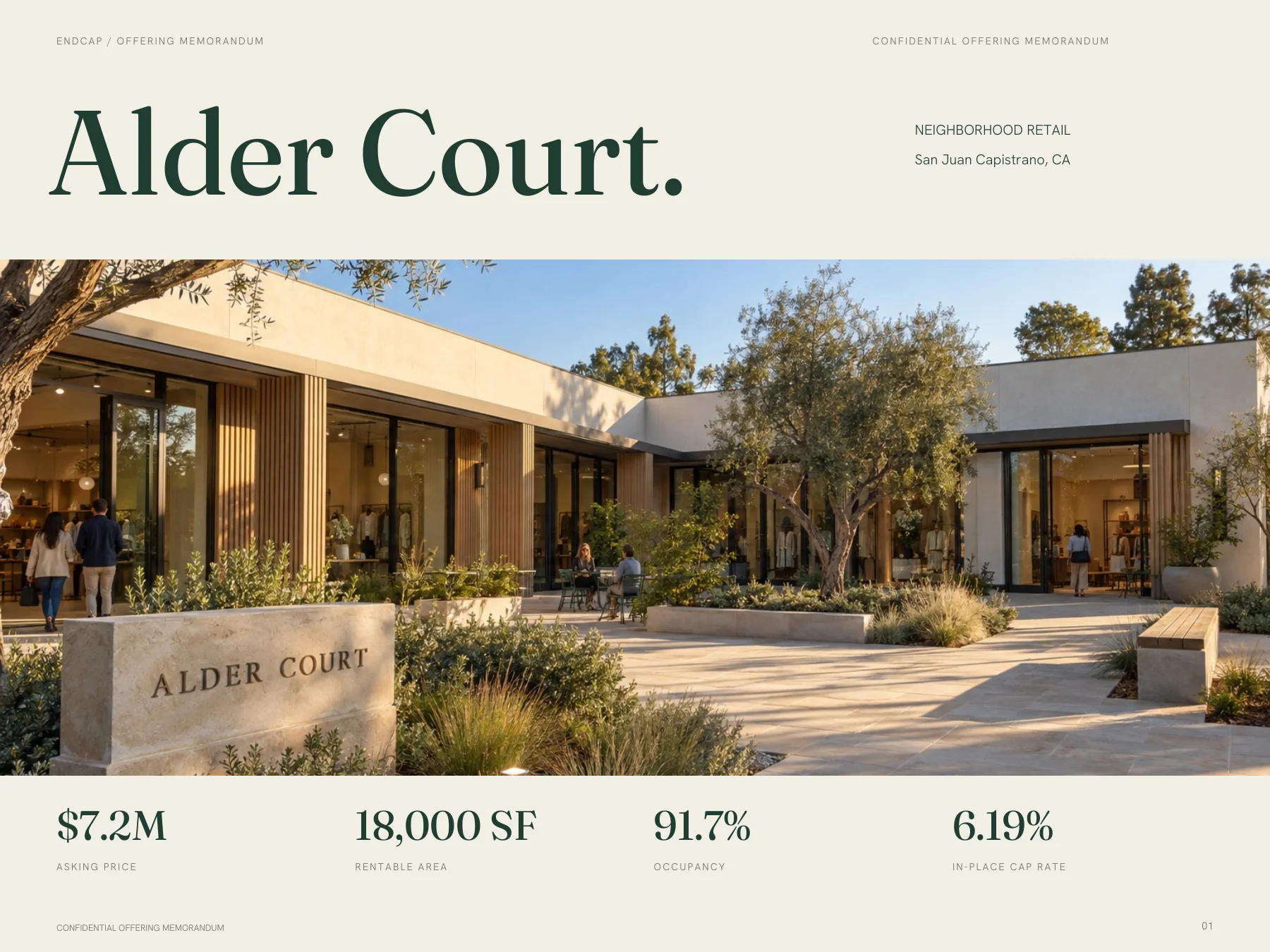
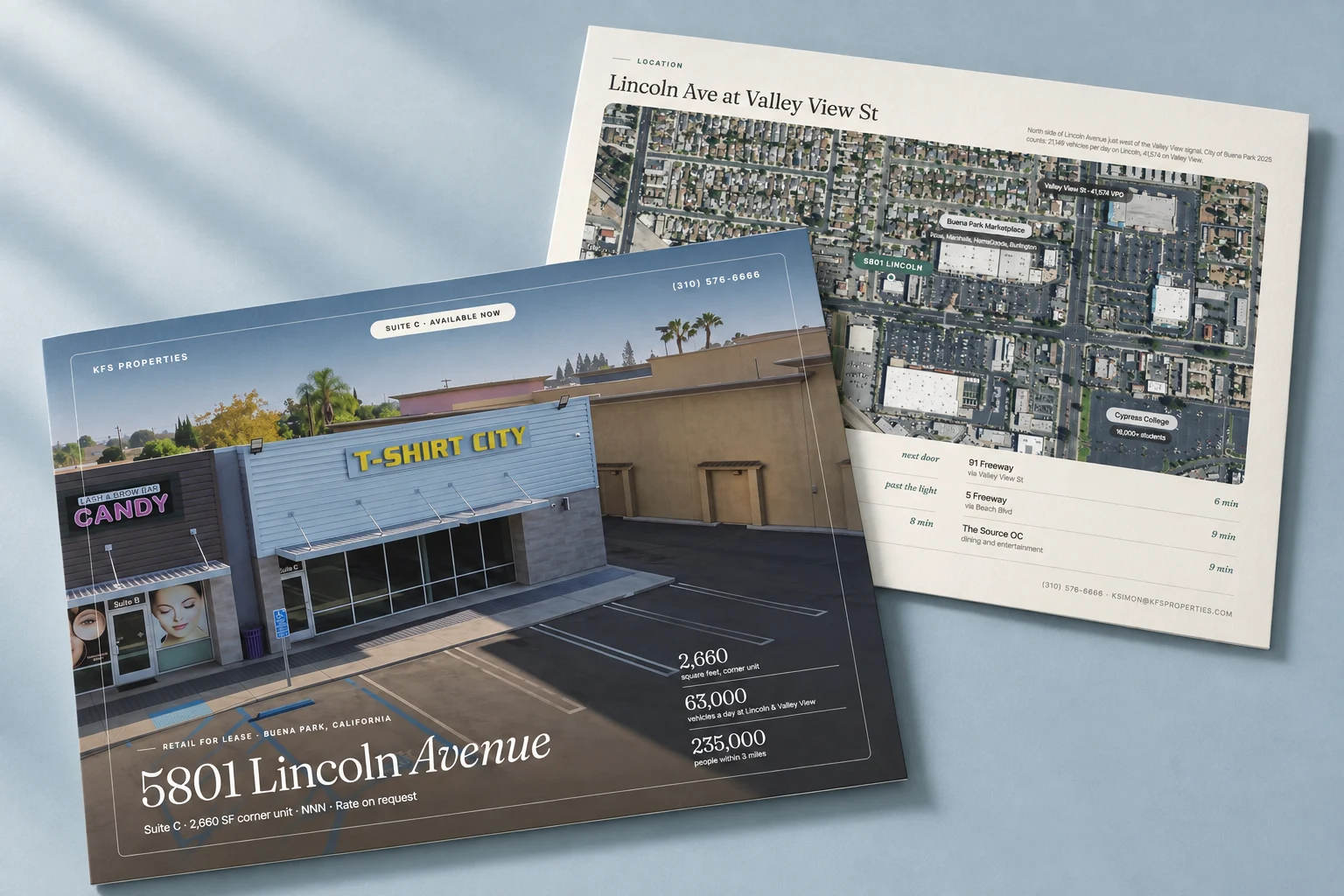
We design offering memorandums, property brochures, and lease flyers from your approved text, photos, plans, rent roll, and financials.
Included
- Up to 12 pages using your approved text, photos, tables, and financials
- Two revision rounds
- Digital and print-ready PDFs
“The Flyer is all that I need and it is outstanding.”
Quoted per document · Offering memorandums, brochures, and lease flyers
We reply within an hour during business hours, and we only use your details to answer you.
Get a quote for your OMOr call or text Noah at (425) 233-0769
See the full service ↗Contact Endcap
START A
project.
A website, a brand, or a complete set of materials.
We reply within an hour during business hours, and we only use your details to answer you.
Start a conversation or call or text Noah at (425) 233-0769