Brochures & OMs
Offering memorandum template: sections and source checklist
Use this outline to plan an OM before laying out pages. Each section names the information to request and what to check. You can also open the complete 12-page Alder Court sample to see one finished approach.
Free offering memorandum template for PowerPoint
The download is a 12-page editable PowerPoint file that follows the order in the table below: cover, investment summary, property overview, site plan, location and demographics, tenant mix, rent roll, lease expirations, operating statement, pricing and assumptions, vacancy and lease-up, and contact and disclosures. Every figure and name is a bracketed placeholder, such as [Property name] or [Asking price]. The rent roll and operating statement are editable tables, and photos, maps and plans have labeled boxes where your own images go.
Each page has speaker notes that explain what belongs on it, which records to request from the seller or property manager, and which figures to reconcile before the file is shared. The template uses Georgia and Arial, which are available in PowerPoint, Keynote and Google Slides. The PDF shows the same 12 pages for review or printing.
- Download the offering memorandum template (PowerPoint .pptx, 12 pages, 68 KB)
- Open the template as a PDF (12 pages, 218 KB)
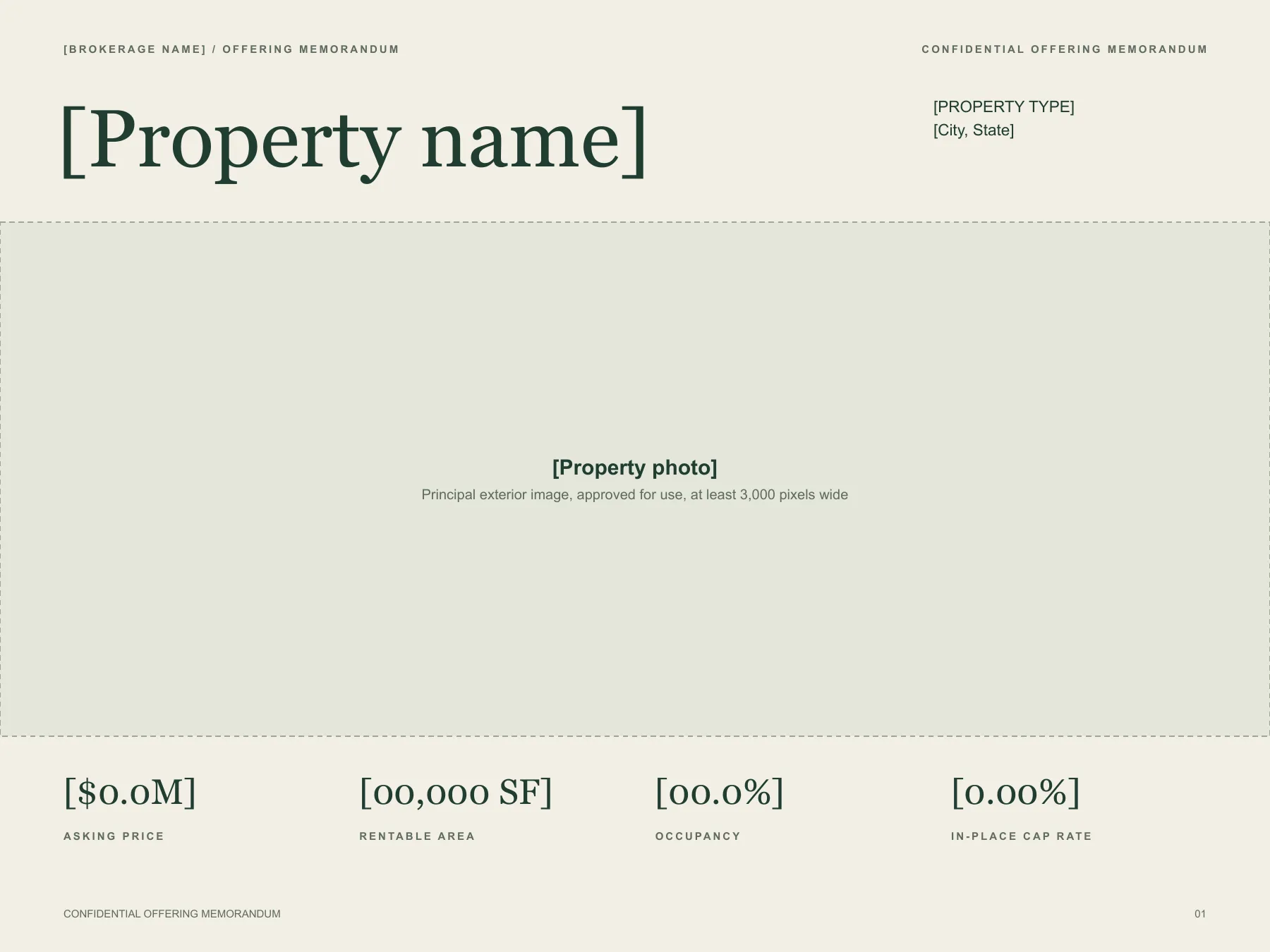
Cover
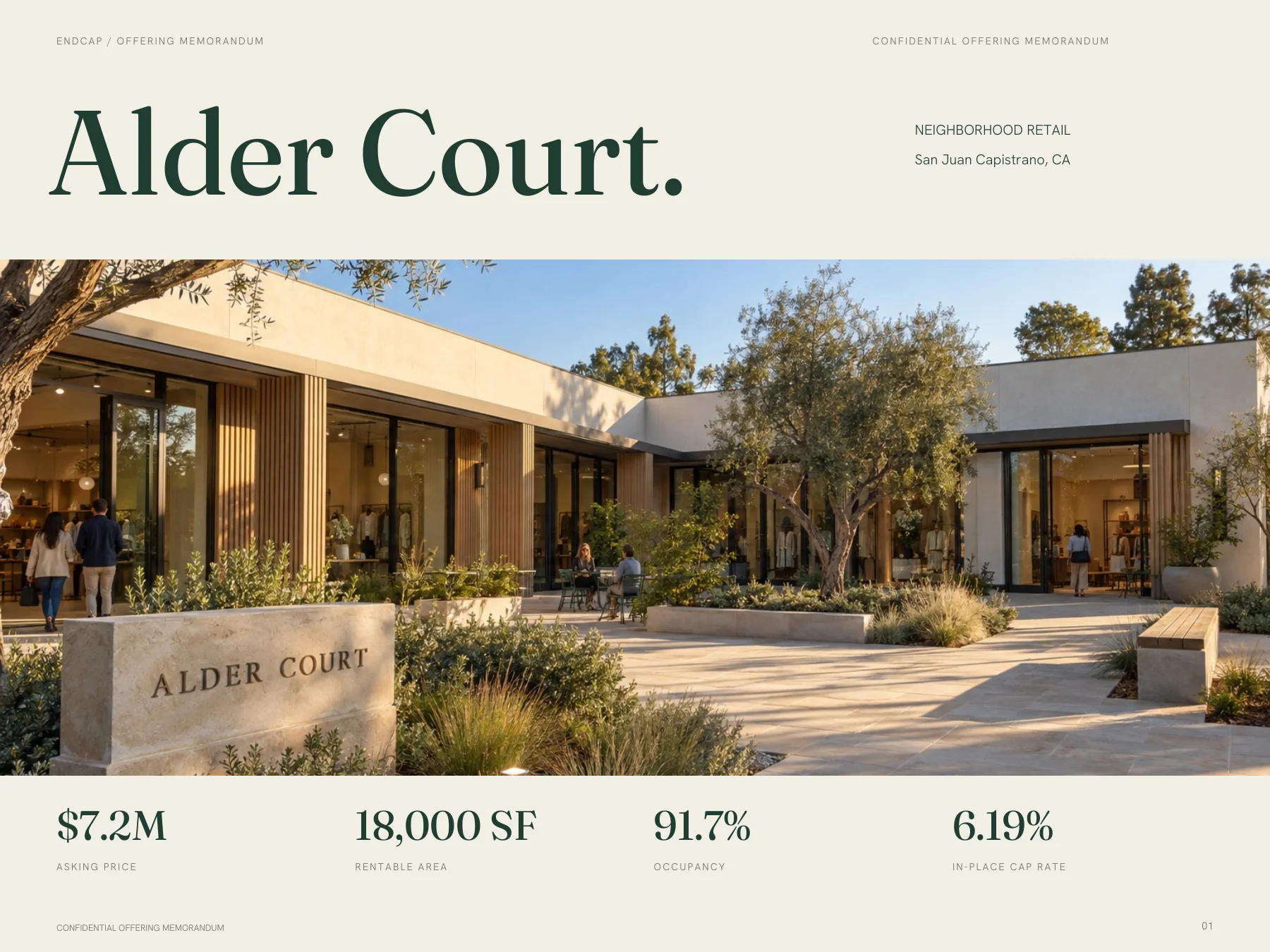
The property name, location, principal photo and four headline figures.
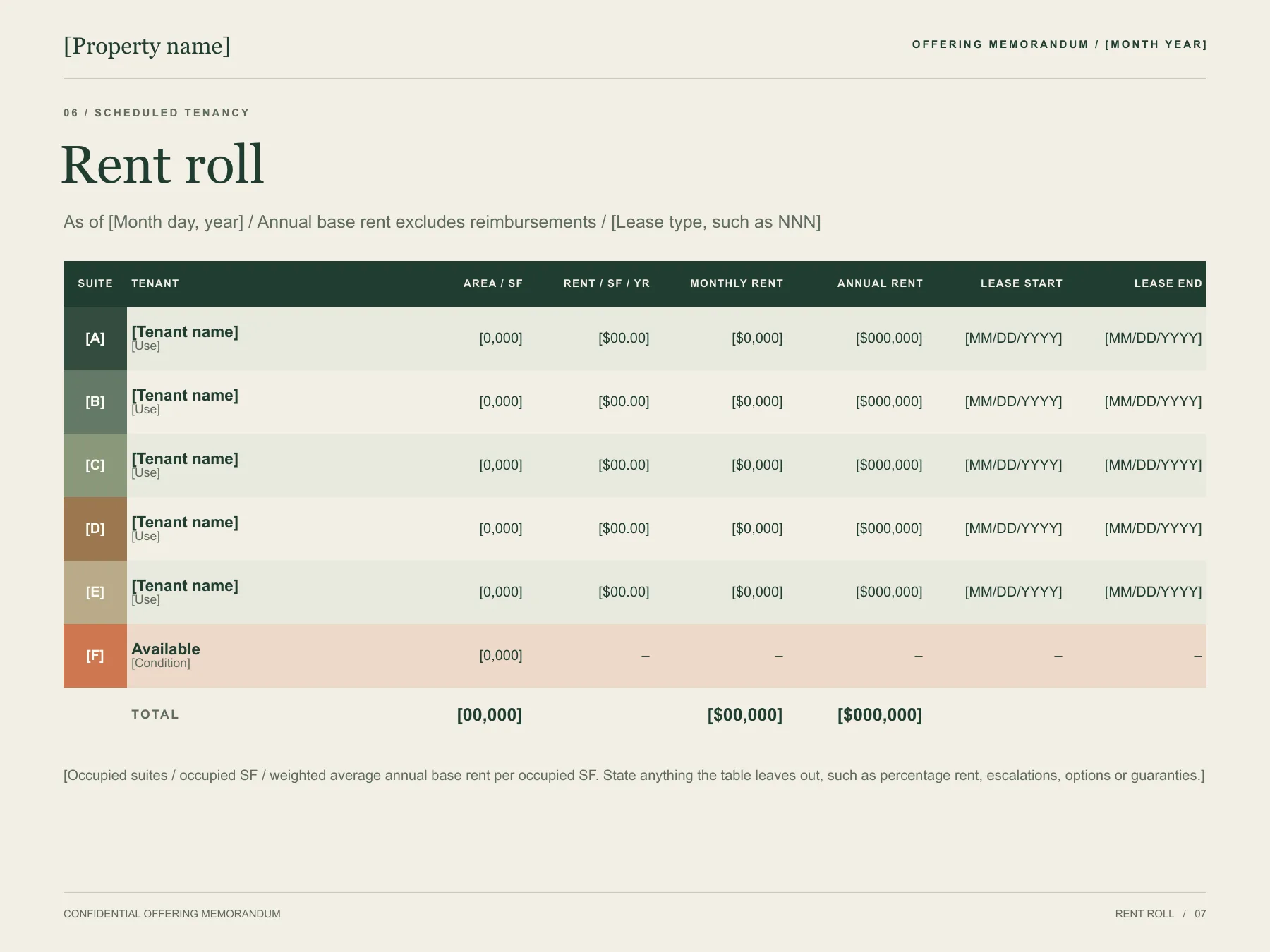
Rent roll
One row per suite, including vacant space, with a total row and an as-of date.
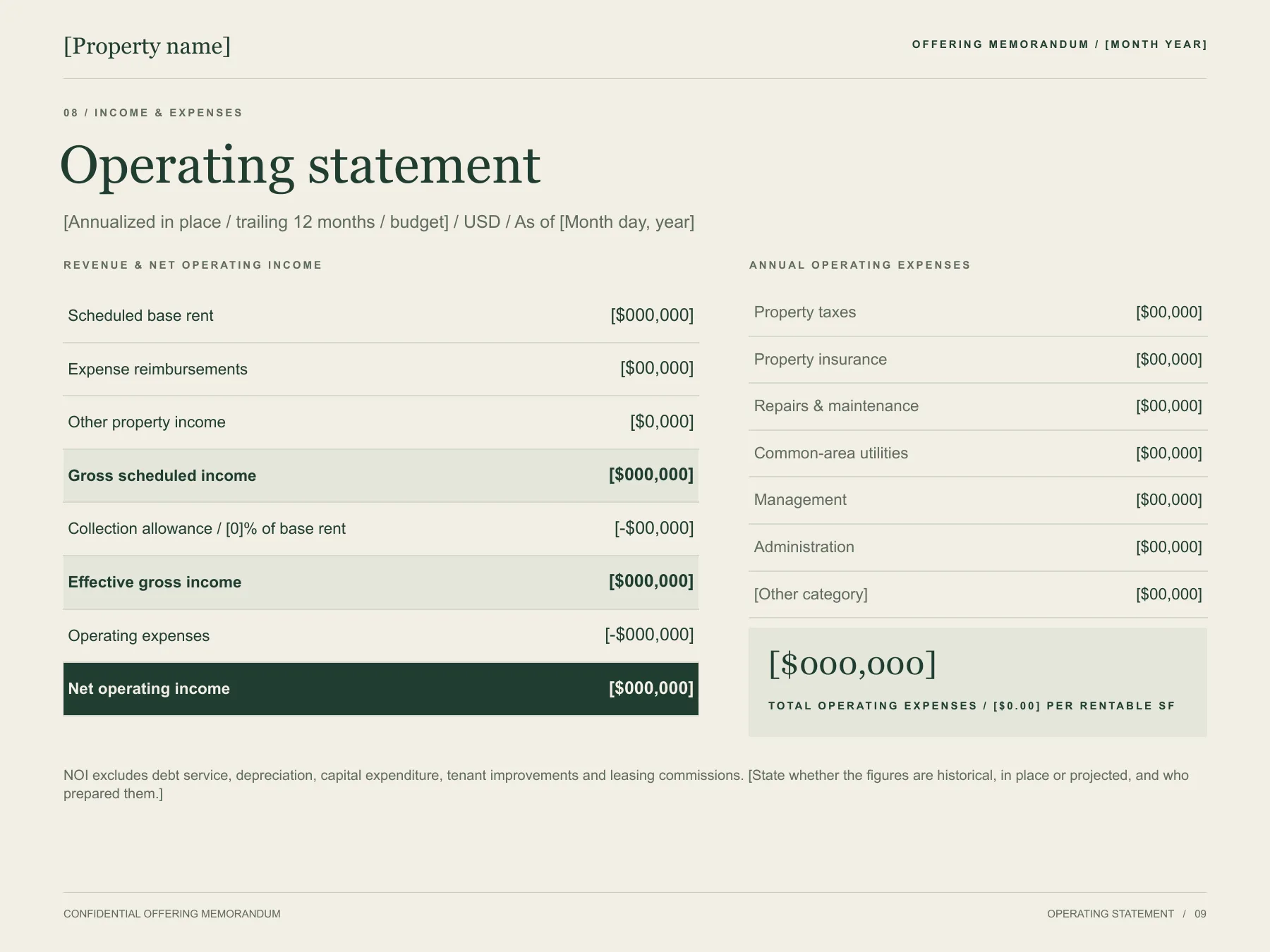
Operating statement
Income, expenses and net operating income, with the basis of the figures stated.
The template gives you the structure; the finished document depends on the photography, plans and verified figures that go into it. If you would rather have the OM designed for you, see offering memorandum design. We agree on scope, timing and pricing before work begins.
Section-by-section template
An OM usually runs in the order below, from the headline facts to the evidence behind them. For each section the table names what to include, the records to request from the seller or broker, and the check to make before layout. The Alder Court sample uses this order across 12 pages.
| Section | What to include | Records to request | Check before layout |
|---|---|---|---|
| 1. Cover | Property name or address, location, offering type, principal image, approved headline facts, listing contact | Approved photography, legal or marketing name, listing team details | Name and address match the title records and the listing |
| 2. Confidentiality and disclaimer | Confidentiality statement and disclaimer wording | Language supplied by the listing brokerage or its counsel | Wording is approved, not drafted by the designer |
| 3. Investment summary | Price or guidance, area, occupancy, in-place figures, and the specific reasons a buyer might look closer | Seller’s pricing instruction, current rent roll, operating statement | Every number has a source and an as-of date |
| 4. Property overview and plans | Parcel and building facts, site access, parking, capital work, floor and site plans | Site plan, floor plans, parcel data, capital expenditure history | Suite labels on the plan match the rent roll; conceptual plans are labeled |
| 5. Location | Map with the subject site marked, access, nearby amenities, market figures | Verified site location, sourced demographic and traffic data | Each figure states its geography and period |
| 6. Tenancy | Tenant mix, rent roll, lease terms, options, vacancies, reimbursements, expirations | Approved rent roll, lease abstracts, estoppels where available | Areas and rents reconcile with the leases; units are stated |
| 7. Financials and assumptions | Income, expenses, net operating income, lease-up and price sensitivity with visible calculations | Trailing statements, budget, analyst’s assumptions | Historical, in-place, and projected figures are kept separate |
| 8. Process and contact | Sale instructions, how to request more records, tour and offer process, contacts | Seller’s approved instructions, confidentiality agreement if used | Contact details and dates are current |
Some properties need more detail; others need fewer pages. Remove sections that add no information and expand the ones a buyer needs to evaluate the particular asset.
OM source checklist
Request these items before design starts. Anything missing becomes a separate task, such as a photo shoot or a redrawn plan, so it is better to find the gaps first.
- Property name, address, parcel number, and the offering type approved by the seller
- Current photography, with rights for the OM, listing portals, and a property website
- Site plan and floor plans in the latest version, preferably as vector or CAD files
- Rent roll with an as-of date, and lease abstracts for each tenant
- Trailing income and expense statements and the current budget
- The analyst’s assumptions for any projection, lease-up, or price sensitivity
- Sourced market data, with the geography and period for each figure
- Disclaimer and confidentiality language from the listing brokerage
- Sale instructions, call-for-offers date if any, and approved contacts
- The names of the people who approve facts, figures, and the final file
Rent roll review
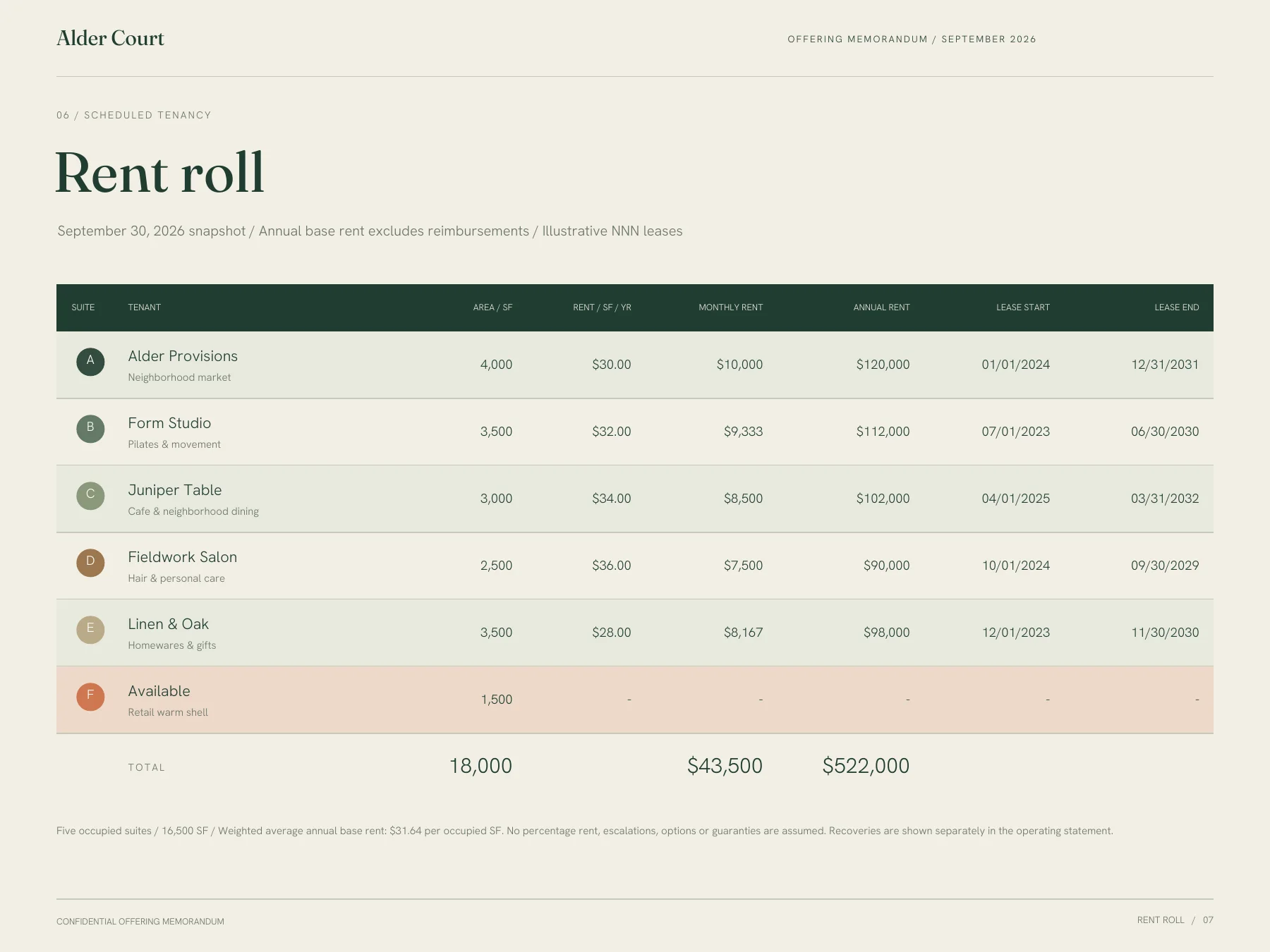
For every row, reconcile the suite label, area, lease dates, and rent units with the source. Keep annual base rent distinct from monthly rent and reimbursements. Put the date and assumptions on the page so the numbers can be read without guessing.
Maps and market data
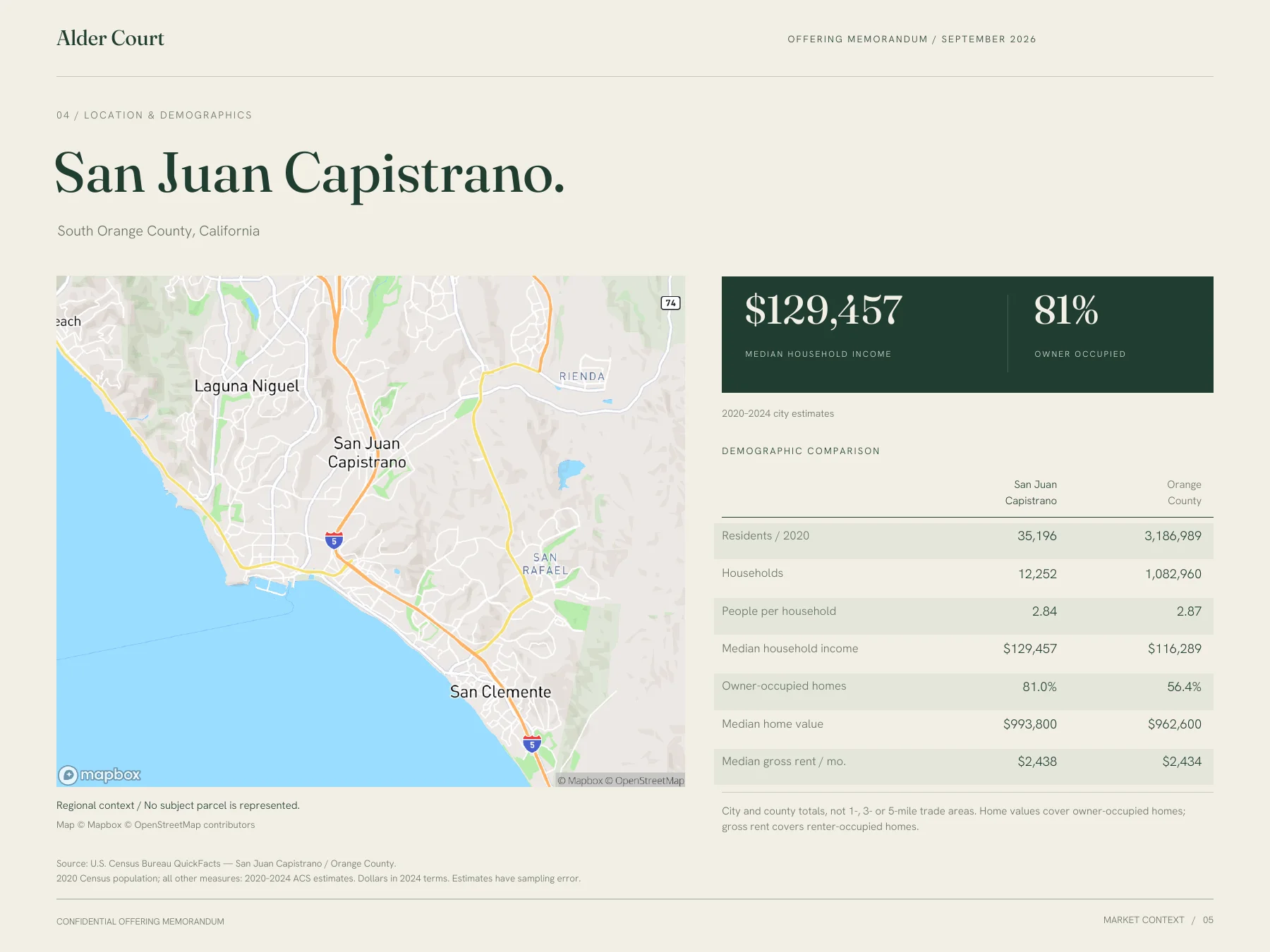
City and county figures can describe a market, but they are not measurements of a property’s one-, three-, or five-mile trade area. If the subject parcel or radius data has not been verified, do not draw a precise ring around a guessed location. The Alder Court sample shows San Juan Capistrano and Orange County as reference geographies and names its Census sources.
Before design begins
Collect
Request approved plans, photography, rent roll, financials, property facts, and sale instructions.
Reconcile
Match suite labels and figures across the plan, tenancy, financial pages, and website.
Approve
Name the people who sign off on facts, assumptions, disclosures, and the final file.
For the definition of an OM and how it compares with a flyer or leasing package, see what an offering memorandum is; for budgeting, see what an OM costs to produce.
Walk through the finished sample page by page. If you have source documents ready, tell us what needs to be prepared; we’ll agree on scope and pricing before starting.
Work with Endcap Design
Offering memorandum design
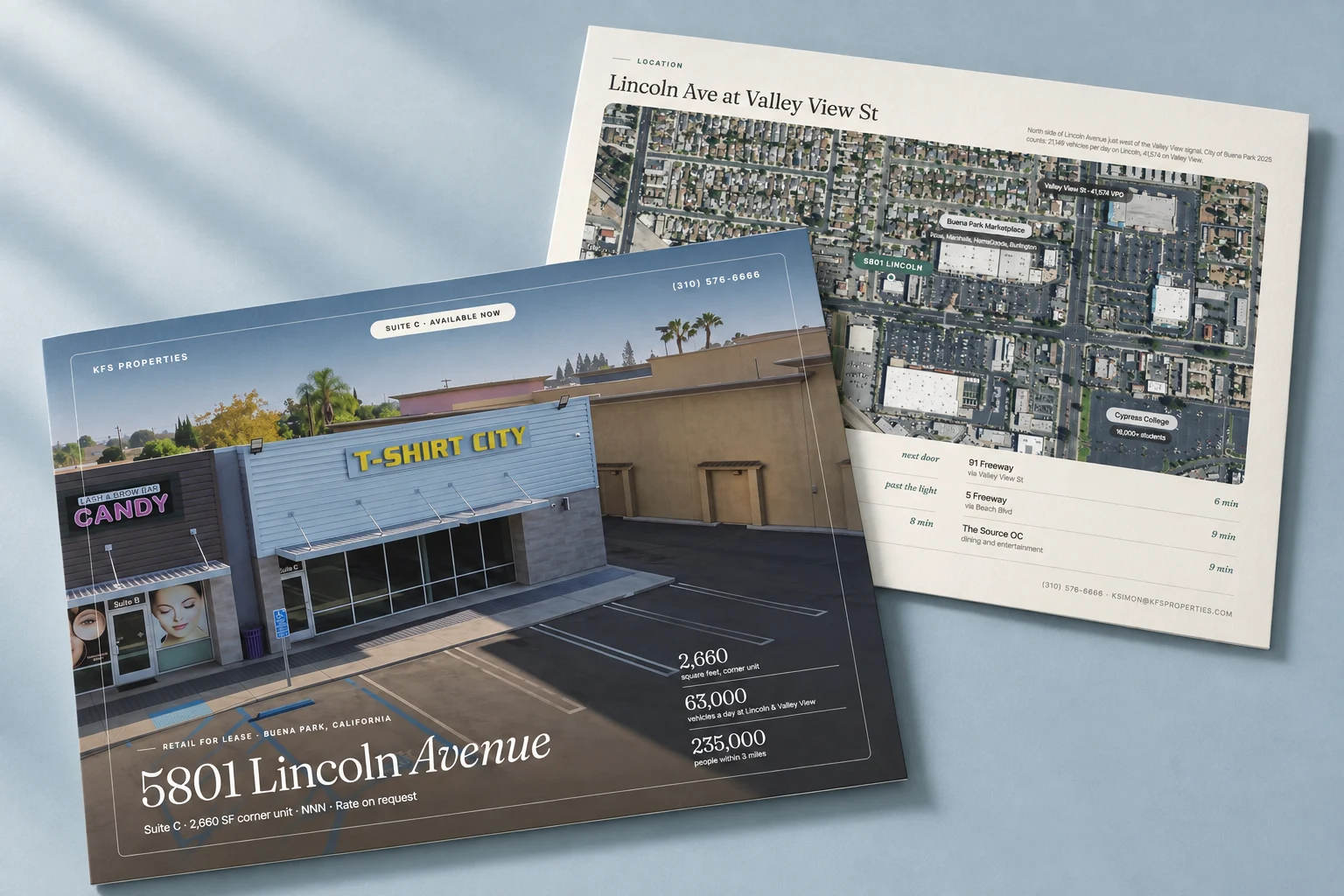
We design offering memorandums, property brochures, and lease flyers from your approved text, photos, plans, rent roll, and financials.
Included
- Up to 12 pages using your approved text, photos, tables, and financials
- Two revision rounds
- Digital and print-ready PDFs
“The Flyer is all that I need and it is outstanding.”
Offering memorandums from $495 for up to 12 pages · Brochures from $350 · Lease flyers from $175
We agree on the scope, timing, and price with you before work begins.
Get a quote for your OMOr call or text (425) 233-0769
See the full service ↗Contact Endcap
START A
project.
A website, a brochure, or a complete set of materials.
We’ll agree on the scope, timing, and price before starting.
Start a conversation or call or text (425) 233-0769