Documents
How to present a rent roll so buyers can read it.
In every offering memorandum for a multi-tenant asset, the rent roll is the page buyers spend the most time on. It is also, with striking consistency, the least legible page in the document — a screenshot of a spreadsheet, pasted at whatever size it landed, unreadable on the device where most first reads happen. This is a solvable problem and almost nobody solves it.
Why it goes wrong
The rent roll starts life in Excel or in the property management system. It has thirty columns because accounting needs thirty columns. Somebody exports it, screenshots it, and drops the image into the layout. It is now an image of a spreadsheet built for a different purpose, scaled to fit a page it was never designed for.
Nobody decided to do this. It is what happens when no one decides anything.
What a buyer actually needs
Far fewer columns than the export contains. For a screening decision:
- Suite — so it can be matched to the site plan
- Tenant — name as the market knows it
- Square feet
- Lease start and expiration
- Current rent, per square foot per month or per year — pick one convention and hold it
- Escalations — the actual mechanic, not "per lease"
- Options — remaining, and at what rent
- Reimbursement — NNN, MG, FSG, gross
That is eight columns and it fits. Security deposits, lease document dates, billing codes, and internal notes belong in the data room, not on this page.
The typesetting rules that matter
Right-align every number, left-align every word. Columns of figures are compared vertically; misaligned decimals make that impossible and the reader stops trusting the page.
Use one convention for rent and label it. $/SF/month and $/SF/year differ by a factor of twelve, and mixing them — or leaving it ambiguous — is the single most common cause of a buyer's model being wrong. Label the column header explicitly.
Set it in a font whose numbers line up. Tabular figures, not proportional. Most typefaces default to proportional numerals, where a 1 is narrower than an 8, and columns wobble.
Let the table breathe. Row spacing generous enough to track across twelve columns without losing the line. Alternating row shading if the roll runs past about fifteen tenants.
Total the bottom. Total square footage, total current rent, occupancy percentage. Buyers check your arithmetic; make it easy and make sure it is right.
Mark the vacancies plainly
Vacant suites belong in the roll, listed with their square footage and no rent — not omitted, and not hidden in a footnote. Occupancy is one of the first three numbers a buyer looks for, and a roll that quietly excludes vacancies reads as an attempt to obscure it, even when nothing was intended.
The expiration schedule is not optional
A simple bar chart of square footage expiring in each of the next five to seven years. It takes very little space and answers the question the rent roll raises but does not resolve: when does the story actually happen?
If your thesis is mark-to-market on rollover, this chart is the proof. If the below-market leases do not roll inside a normal hold period, a buyer will discover that here — and it is better they discover it here than after you have spent three weeks in diligence together.
Make it survive the phone
A meaningful share of first reads happen on a phone, in a car, between tours. Set the type large enough to survive that, and if the roll genuinely cannot fit legibly on one page, break it across two rather than shrinking it into illegibility. Two readable pages beat one unreadable page every time.
An hour well spent
Typesetting a rent roll properly takes about an hour once, and produces a reusable table style that every subsequent document inherits. It is the least glamorous hour in producing an offering memorandum and, page for page, the highest-value one.
Common questions
What columns should a rent roll show in an offering memorandum?
Suite, tenant, square feet, lease start and expiration, current rent, escalations, remaining options, and reimbursement structure. Security deposits, billing codes, and internal notes belong in the data room rather than the marketing document.
Should vacant suites be shown on the rent roll?
Yes, listed with square footage and no rent. Occupancy is among the first figures a buyer looks for, and a roll that omits vacancies reads as evasive even when nothing was intended by it.
Should rent be shown per month or per year?
Either, but pick one and label the column explicitly. The two differ by a factor of twelve, and ambiguity here is the most common cause of a buyer building their model wrong.
Why does the rent roll need a lease expiration chart?
The rent roll shows what leases exist; the expiration schedule shows when they roll. If the investment thesis is marking rents to market at rollover, that chart is what proves the story happens inside a buyer's hold period.
Work with Endcap Design
Offering memorandum design
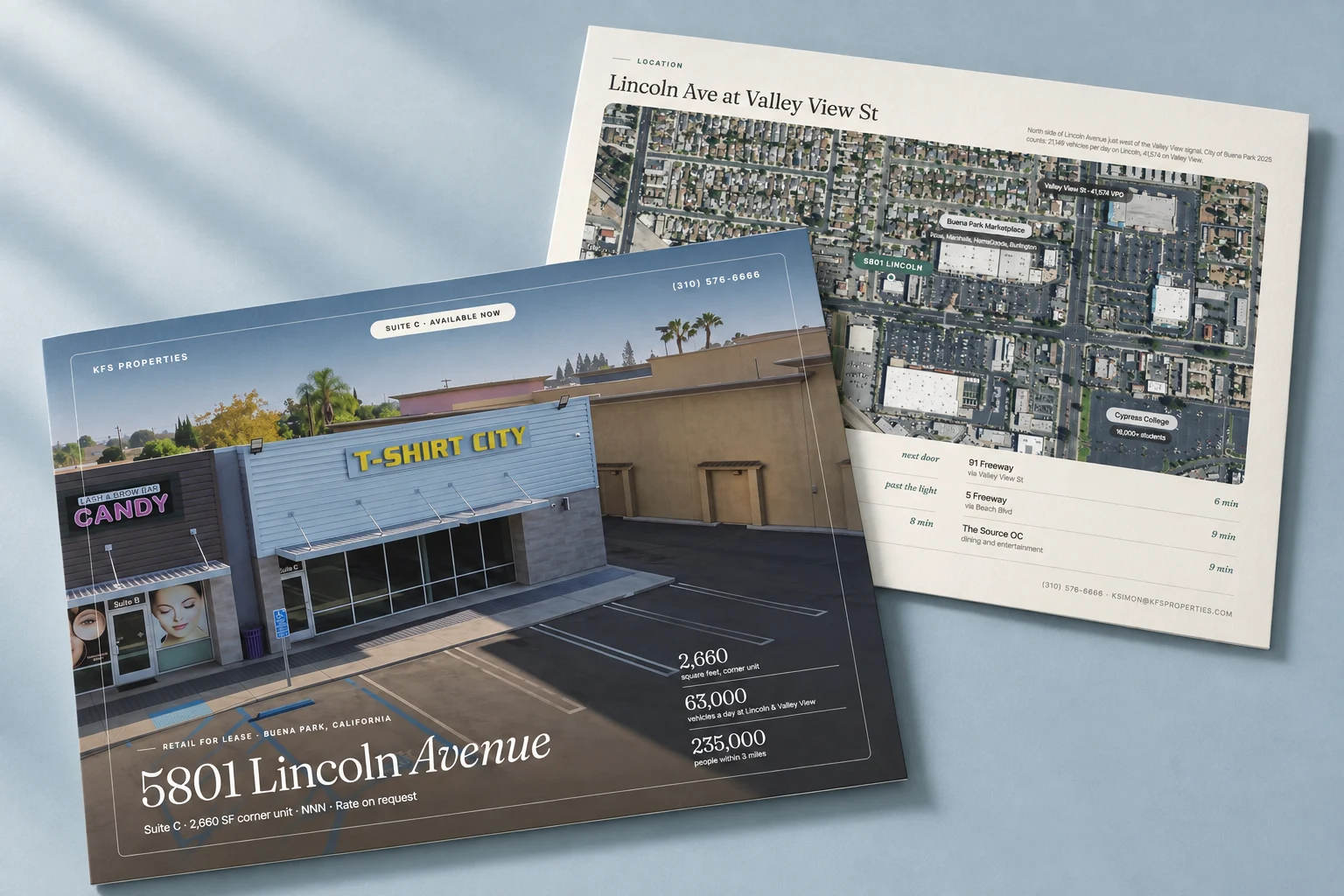
We design offering memorandums, property brochures, and lease flyers from your approved text, photos, plans, rent roll, and financials.

Included
- Up to 12 pages using your approved text, photos, tables, and financials
- Two revision rounds
- Digital and print-ready PDFs
“The Flyer is all that I need and it is outstanding.”
Offering memorandums from $495 for up to 12 pages · Brochures from $350 · Lease flyers from $175
We agree on the scope, timing, and price with you before work begins.
Get a quote for your OMOr call or text (425) 233-0769
See the full service ↗Contact Endcap
START A
project.
A website, a brochure, or a complete set of materials.
We’ll agree on the scope, timing, and price before starting.
Start a conversation or call or text (425) 233-0769