Marketing
Marketing a commercial property for sale.
Leasing marketing sells a space to someone who needs one. Sale marketing sells a cash flow to someone comparing it against every other place their money could sit this quarter. The photography looks similar. Almost nothing else about the job is the same.
The audience is small, known, and already busy
A leasing campaign is a net. You do not know which restaurant group is expanding into the corridor, so you cast wide and wait. A disposition is a list. For a private-capital retail or industrial deal in Southern California, the buyer pool that will actually close is countable: local operators who already own on the same street, family offices with a standing box, exchange buyers with a clock running, and a handful of funds whose criteria your asset either fits or does not.
That changes what you build. You are not trying to be discovered by a stranger. You are trying to be forwarded by someone who already knows the broker's name, then read in full by a principal who gave the email about nine seconds before deciding whether it earns nine minutes. The campaign needs three things that survive that pass: something forwardable, something defensible, and something callable. A link, a numbers package that holds up under a buyer's own underwriting, and a phone number a human answers.
What goes public, and what stays behind the form
The hardest decision in a sale campaign is not design. It is where to draw the line between the public page and the diligence set. Draw it too tight and nobody can underwrite enough to get interested. Draw it too loose and you have published your seller's rent roll to every competitor and every tenant in the center.
What we would put on the open page:
- The asset facts. Address, building area, land area, year built and renovated, parking ratio, zoning, and the anchor or co-tenancy that frames the deal.
- Aggregate performance. Occupancy, weighted average lease term, tenant mix by category, and the share of income from national or credit tenants. Aggregates let a buyer size the deal without exposing any single tenant's economics.
- The trade area. Population, incomes, and traffic counts with their sources and years named on the page, the same way we handle them for leasing in trade area analysis.
- Photography and a site plan. A buyer is judging the physical asset from a screen before deciding whether to spend a Tuesday driving it.
- The process. How offers are being taken and by when.
What stays behind a form and, where the seller wants it, a confidentiality agreement: the full rent roll with names and rates, leases and amendments, CAM reconciliations, the trailing twelve months of operating statements, service contracts, and any environmental or property condition reports. The gate is not only caution. It is the best lead capture in this business, because a buyer will hand over a real name, a real firm, and a real phone number to see a rent roll, when the same person would never fill out a contact form.
One rule we hold to regardless of instructions: assume a tenant will find the listing page, because one always does. If the seller has not told the tenants that the property is on the market, that fact should shape every word on the public page, not get discovered the week escrow opens.
The offering memorandum is still the document. The link is what travels.
The OM is not going away, and it should not. It gets attached to emails, printed for an investment committee, and marked up in the margins by a buyer's analyst. It is the artifact that says the seller is serious. But a PDF is a snapshot of what was true the day it was exported, and disposition campaigns run for months. A tenant renews. An anchor exercises an option. Guidance moves. The OM in forty inboxes is now quietly wrong, and nobody who has it will know.
A PDF is what was true the day you exported it. A link is what is true this morning.
So build both, from one design system, and let the link carry the current truth. The offering memorandum covers the narrative, the layout of the deal, and the exhibits that print well. The deal site carries the same story in a form that updates: a live availability and rent roll summary, the diligence request, the process dates, and the photography at full size instead of compressed into a 14 MB attachment. When the two are designed together the buyer never notices the seam, which is the point. We have written up how we approach the document side in flyer and brochure design, and the same production discipline applies at OM length.
Price, and the process around it
Publishing a number filters the pool and costs you the buyers who would have talked themselves into more. Withholding it generates calls and keeps the market honest, at the cost of some serious buyers who will not spend underwriting hours without a range. Both are defensible. What is not defensible is drifting into one by accident.
Whichever you choose, publish the process. "Offers due Thursday, October 15, by 5:00 p.m. Pacific" is real information, and for any buyer who has to convene a committee it is more useful than the asking price. Committees calendar backward from a date. If your marketing does not give them one, you are asking them to guess, and guessing usually resolves as waiting.
The clock belongs to the buyer
The single most useful thing to understand about sale marketing is that your best prospect may be on a timer you did not set. Under the IRS rules for like-kind exchanges, a buyer has 45 days from closing their sale to identify replacement property and 180 days to close, as set out in the IRS instructions for Form 8824. An exchange buyer who identifies your property is spending one of a small number of slots on it.
That has a direct production consequence: the diligence set has to exist before launch, not after the first letter of intent. When a buyer inside an identification window asks for leases on a Friday, "let me check with the seller Monday" is not a delay, it is a lost buyer. Assembling operating statements, leases, and reports is unglamorous work that nobody wants to do in week one, and it is the difference between a campaign that converts interest and one that watches it expire.
Buyer counsel will also arrive with questions the marketing should already anticipate. On small-tenant California retail, expect diligence on SB 1103, in effect since January 1, 2025, which added notice, translation, and cost-disclosure requirements for qualified commercial tenants. Knowing where the leases stand on that before a buyer's attorney asks is worth more than another rendering.
What carries over from the property sites we build
Both of the property sites in our portfolio were leasing assignments, so we will be specific about what transfers rather than claim a disposition record we do not have. Marbella Plaza, a 66,124 SF grocery-anchored center in San Juan Capistrano, is built around an interactive site plan, suite-level availability, and trade-area data presented as something a tenant would underwrite. Point that same spine at a sale and the emphasis rotates: the site plan becomes a rent roll map, availability becomes lease-up upside, and the trade area stops being a leasing argument and becomes the growth case for holding the asset ten years.
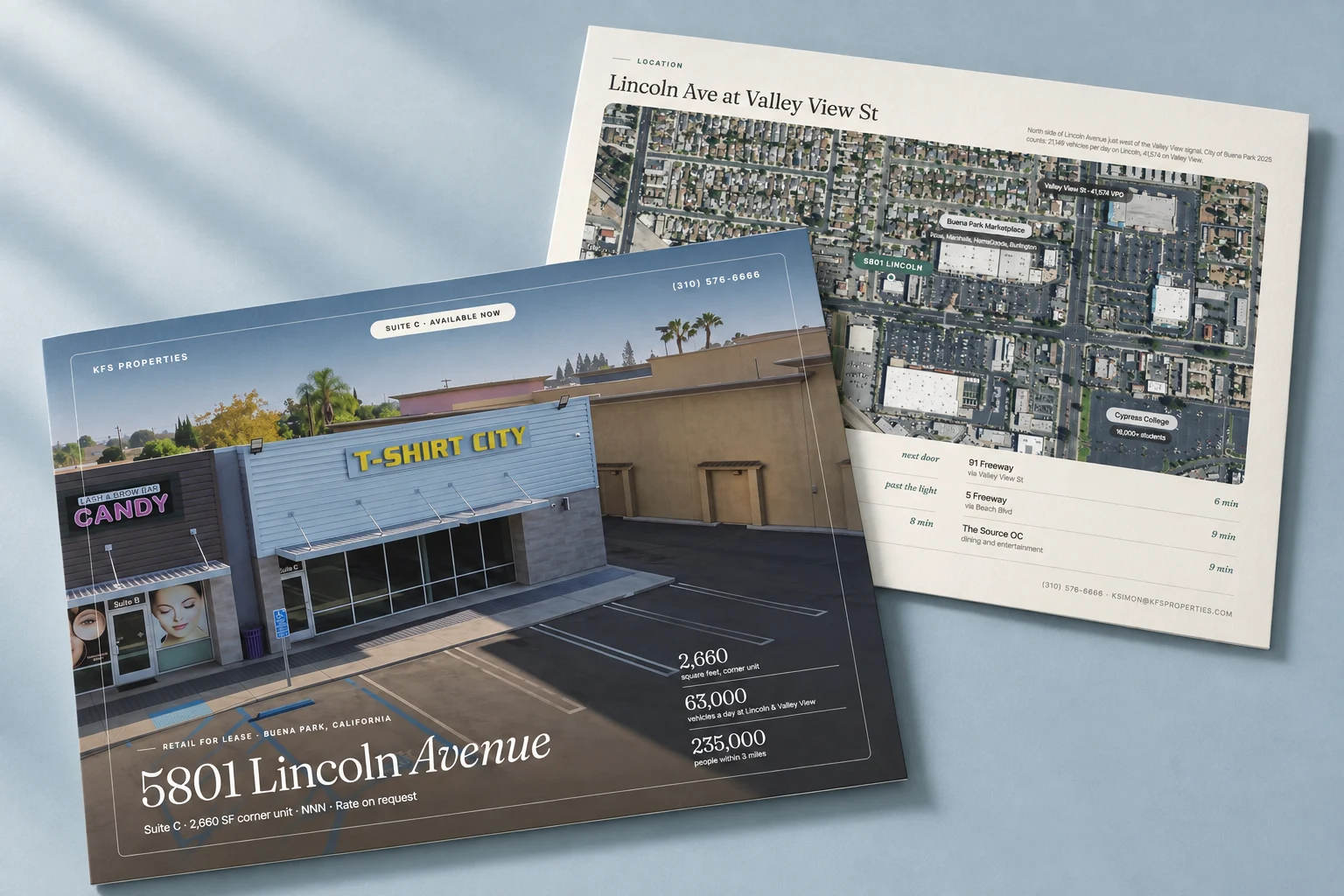
The second one is about speed. 5801 Lincoln, a 2,660 SF corner suite in Buena Park, went from brief to live in three days with a seven-page flyer, the timeline for which is written up in its own case note. Two things there matter for dispositions. First, the package can be produced inside the first week of a listing agreement, which is when momentum is worth the most. Second, the flyer and site share one design system and identify Ken Simon at KFS Properties as the listing contact. The property details and contact information stay consistent across the package.
Launch week, in order
The sequence matters more than any single piece:
- Assemble the diligence set first. Nothing else launches until the folder is real.
- Build the page and the OM together. One design system, one set of numbers, one place they are edited.
- Call the top of the list before anything is public. The twenty-five buyers most likely to close should hear it from the broker, not from a portal alert.
- Then broadcast. The list email and the portals go out on the same day, so the campaign has one visible start date. Our notes on both are in email that gets opened and portal listing hygiene.
- Watch what the page tells you. Which buyers came back three times, which document got downloaded, which day the traffic died. That is campaign intelligence a portal will never hand over, and it is the argument for owning the page at all, which we make at greater length in single-property websites.
A disposition package is not a bigger flyer. It is a small, well-briefed audience, a defensible set of numbers, a gate that does real work, and a link that stays true for as long as the deal takes. If you have an asset going to market this fall, that is the kind of project we scope as one flat number before work starts. See what we build.
Work with Endcap Design
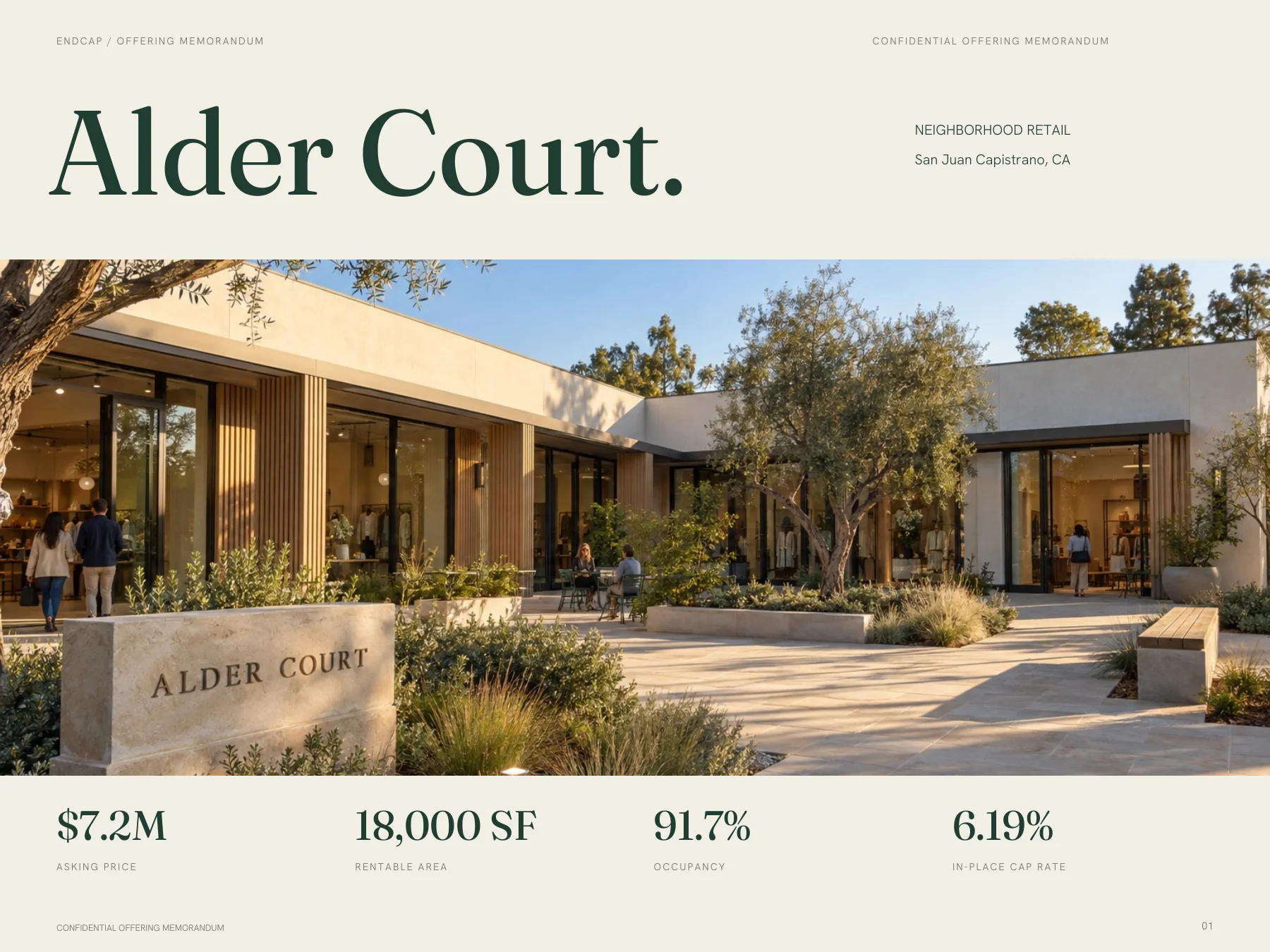
Offering memorandum design
We design offering memorandums, property brochures, and lease flyers from your approved text, photos, plans, rent roll, and financials.
Included
- Up to 12 pages using your approved text, photos, tables, and financials
- Two revision rounds
- Digital and print-ready PDFs
“The Flyer is all that I need and it is outstanding.”
Offering memorandums from $495 for up to 12 pages · Brochures from $350 · Lease flyers from $175
We agree on the scope, timing, and price with you before work begins.
Get a quote for your OMOr call or text (425) 233-0769
See the full service ↗Contact Endcap
START A
project.
A website, a brochure, or a complete set of materials.
We’ll agree on the scope, timing, and price before starting.
Start a conversation or call or text (425) 233-0769