Production
The tour book: what a client carries out the door.
Six stops in a day, four hours in a car, and the client goes home with a bag of landlord flyers printed by six different marketing departments. By Thursday those flyers are interchangeable, and the third stop, which was the good one, has blurred into the fifth. The tour book is the fix. It is the only document from the day organized around the client's decision instead of around six separate listings.
What a tour book is
A tour book is a document a broker assembles for one client and one day: a route, a fixed spread for each building, a comparison page, and room to write. It is produced by the side representing the user, and it exists because the landlord material cannot do this job. Every flyer in that bag was written to make one space look like the answer. None of them were written to help someone choose among six.
That is the difference worth holding onto. A landlord's leasing package answers what is this space, and it should, which is a document we have walked in detail in leasing package vs sale OM. A tour book answers which of these, and why, in a form the client can defend to somebody who was not in the car.
There is a landlord-side version too. When a large user tours a single building with several available floors or suites, the leasing team builds the same architecture around one asset: a route through the building, a spread per suite, a comparison of the options. The parts do not change.
The book is organized around the day, not the buildings
The most-used page in a tour book is not a building page. It is page two, the route. Numbered stops on one map, addresses, arrival windows, drive times between them, who is meeting you at each door with their name and firm, where to park, and any access condition worth knowing before you are standing in a lobby: badge required, escort required, hard hat and closed-toe shoes on the shell floor, tenant in place so no photos.
Two habits from running these days. Number the stops rather than calling one first and another last, because a landlord contact will move a window the morning of and the printed book has to survive it. And order the day so the strongest candidate does not land in the first slot, when the client has no basis for comparison, or in the last, when everyone is tired and thinking about traffic. That is judgment, not a rule, but the sequencing is part of the product and it belongs to the broker who built the list.
One spread per stop, and the same spread every time
Consistency is the whole design problem. If the fields move around from stop to stop, the client cannot compare without re-reading, and the book quietly becomes six flyers in a nicer cover. Fix the order and hold it.
- Address, suite, floor. The way the landlord labels it and the way the rent roll labels it, if those differ.
- Size, with the standard named. Rentable and usable are not the same number. In office space, say which measurement standard the landlord is quoting, ANSI/BOMA Z65.1 being the common one, and carry the load factor so the client understands why two 10,000 square foot suites are not the same 10,000 feet.
- Rate and structure. The number, the period, and the lease type in the same line. Full service, modified gross, and NNN quotes do not belong in a column together without their labels.
- Operating expenses or CAM. The current figure, with the year it comes from.
- Condition and improvement allowance. Shell, second generation, vanilla. What the landlord says they will do and what the client would be paying for.
- Available date and the term the landlord wants. Deliverable date, not listed date.
- Parking. Ratio, whether stalls are reserved, and what they cost.
- One plan and two photographs. The plan marked with the space in question, the way we argue for in site plans that lease space. Photographs of the entry and the actual space, not the tallest angle of the building.
- Blank ruled space. The client writes on the page while standing in the suite. If there is nowhere to write, they write on the flyer you were trying to replace.
When a field is unavailable, print the words requested, not provided rather than guessing or leaving a gap. That line is honest, and it tells the client something real about how each landlord is going to behave for the next five years.
The comparison page is the reason the book exists
One page, stops as columns, decision fields as rows. This is the page that gets photographed, forwarded, and argued over, so build it to be read by someone who never took the tour.
Normalizing is the work. Put every rate on the same period and mark the lease type, then show an estimated annual occupancy cost per stop with the assumptions stated in a footnote: the CAM figure used and its year, the parking count assumed, the escalation assumed, the term assumed. An estimate with visible assumptions is useful and correctable. A single blended number with no footnote is a number the client's CFO will not trust twice.
Do not rank the stops. Set the fields side by side, keep the weighting in the conversation where it belongs, and if the client has asked you for a recommendation, give it in a signed paragraph rather than by quietly bolding one column. Put the date, your name, your license number, and your contact on that page. It will be separated from the book within a week.
The tour book is the only thing from tour day that leaves with the client. Everything else that happened was conversation.
What makes a stop page fast, and what makes it slow
Layout is not the bottleneck. Chasing facts is. Six stops means six listing brokers, six file conventions, and at least one plan that arrives as a photo of a printout. What decides whether a book takes an afternoon or three days is how much of the source material was produced properly on the listing side in the first place.
Two of our own projects show what that looks like from the other direction, and neither of them is a tour book. They are the listing-side production a tour book gets assembled from. At Marbella Plaza, a 66,124 square foot grocery-anchored center in San Juan Capistrano, the work included the listing site and the flyer: a labeled site plan with the vacancies marked, the co-tenancy named rather than described, and trade-area figures published with their source on the same page, 217,166 residents and $188,995 average household income within five miles, sourced there to the US Census ACS 5-Year 2018 to 2022. A tenant rep can lift any of that into a stop page without a phone call and without inheriting a claim they cannot defend. The Marbella case study covers what shipped.
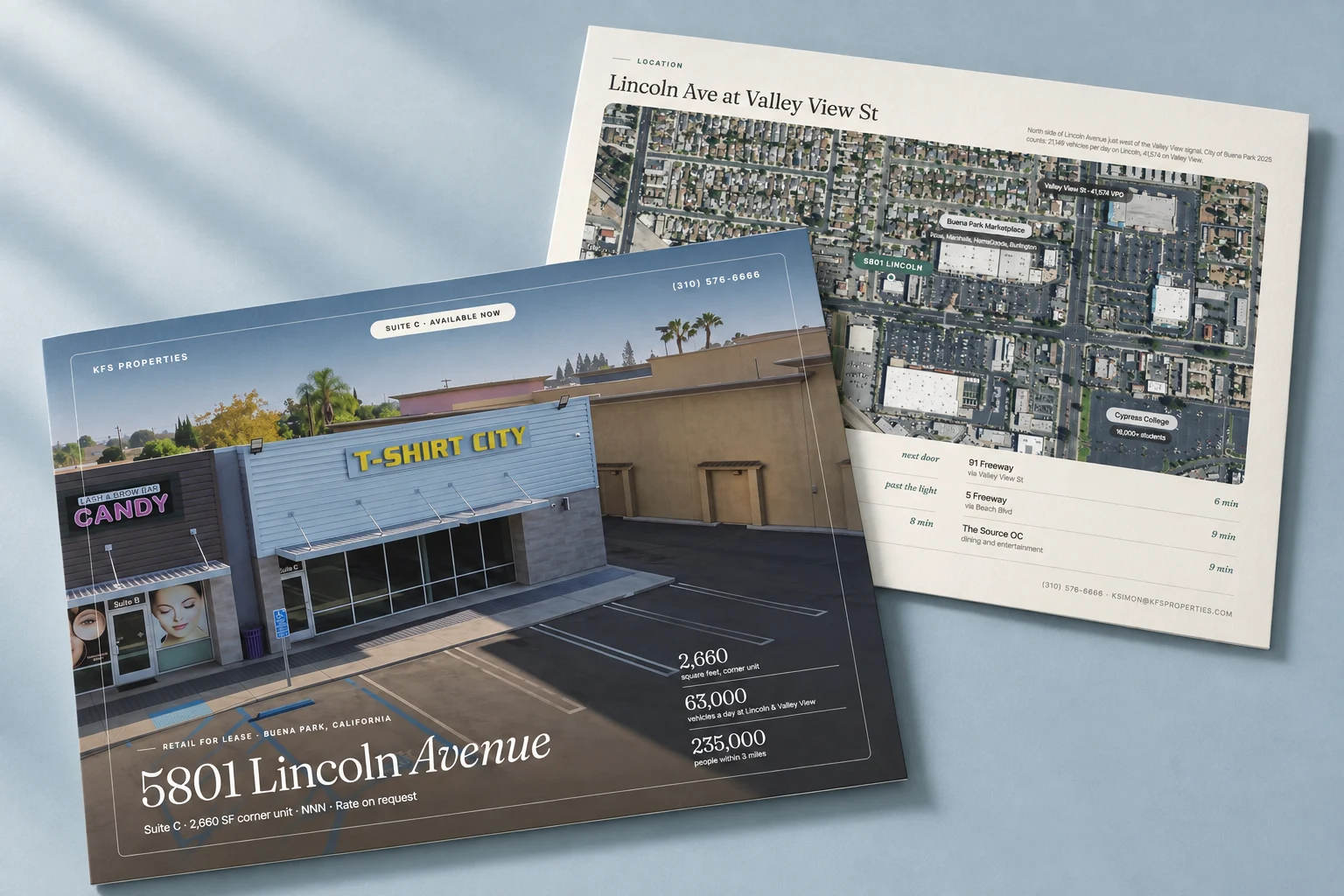
At 5801 Lincoln Ave in Buena Park, a 2,660 square foot corner suite, we went from brief to live in three days with a seven-page flyer built on the same design system as the site. Traffic counts on that listing carry their origin, 21,149 vehicles a day on Lincoln Ave and 41,574 on Valley View at the corner, from the City of Buena Park published GIS traffic layer, and every retouched photograph is disclosed as retouched. The Lincoln case study and the three-day build note walk it. Sourced facts and a plan that reads at half size are what a stop page needs. When the landlord side produces them, the tour book takes an afternoon.
The digital half
Print earns its place on tour day for one reason, which is the blank space for notes. Everything else is better as a link. Give the book a companion page holding the same stops, current availability, the plans at full size, and the PDF of the book itself. Put a QR code on each spread that opens that stop, so the client can pull the space up in the car between buildings and forward it that night without asking you to resend anything. The mechanics of a page built for one property are in single-property websites.
The link also tells you something the paper cannot. Which stop got reopened three times after the tour is a real signal about where the client's head is, and it usually arrives before they say anything out loud. What to ask for and what to ignore is in website analytics for listings.
What to leave out
Landlord adjectives. Every flyer in the bag says premier and prime; carrying that language into a client-facing book costs you the neutrality the book is for. Investment pages, cap rates, and NOI, which belong to a sale and tell a user you pulled the wrong file. Demographics with no source, which are worse than none. Competitor commentary of any kind, including about the buildings you did not include.
Also leave out the filler stop. Padding a shortlist to six buildings so the day looks thorough burns four hours of a client's time and teaches them that your list is not really a list. Five real options and an honest note about what was screened out and why is a stronger document.
Producing one under deadline
Keep a standing template with the fields locked, so a book is an assembly job rather than a design job. Send one request email to every listing broker at once with a named deadline and an explicit list: plan file, rentable and usable size, rate and lease type, current CAM or operating expenses with year, condition and allowance, available date, parking ratio and cost, and two photographs. Whatever arrives, arrives. Whatever does not gets the requested, not provided line, and the book ships on time.
Then keep the file. The next tour in that submarket reuses two thirds of what you built, and a broker who has been keeping stop pages for a year has something closer to a private market survey than a folder of old PDFs. How we scope document and site production is on our services, quoted as one number before work starts.
Work with Endcap
Have a tour day that deserves a real document?
Work with Endcap Design
Offering memorandum design
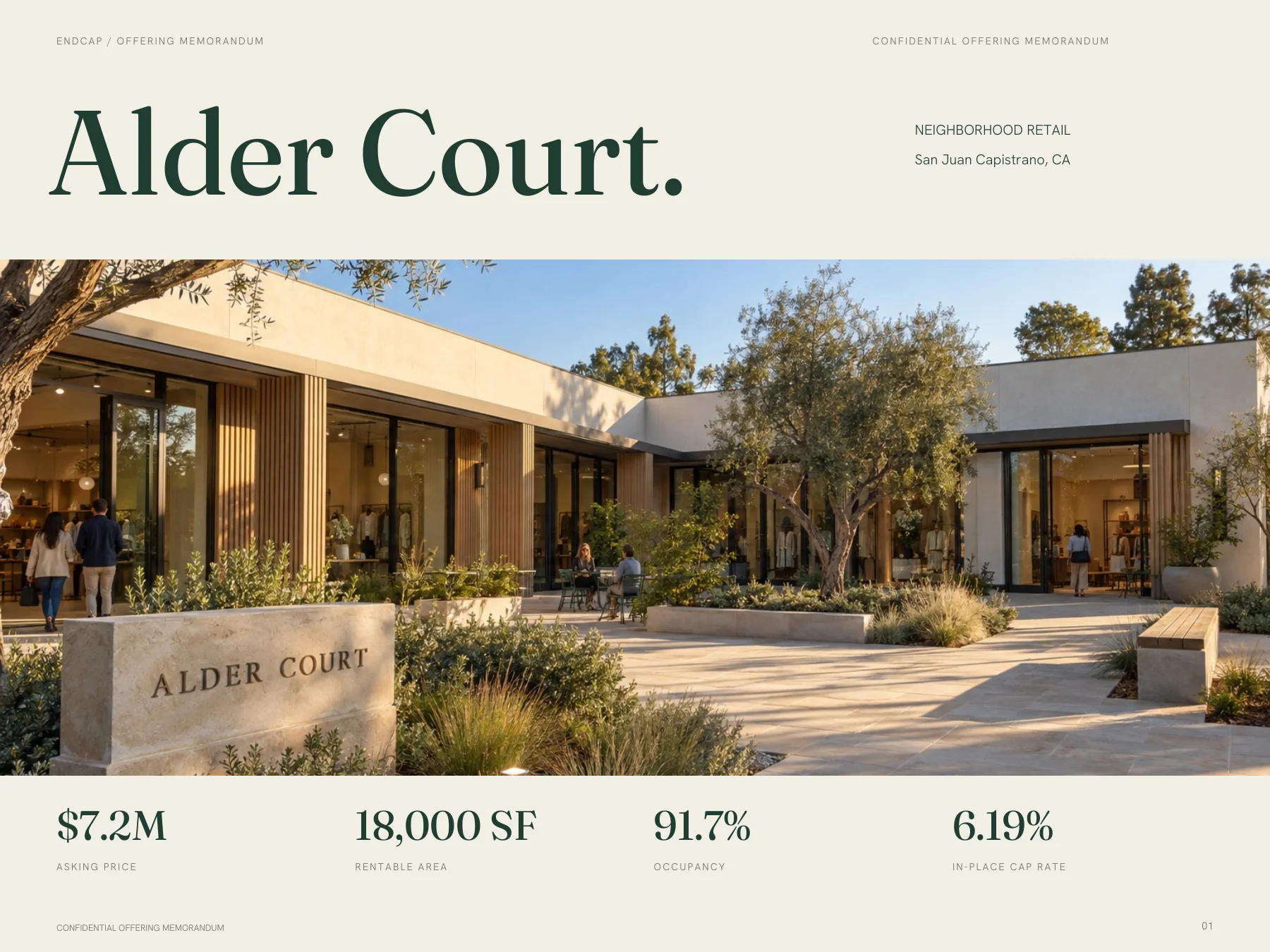
We design offering memorandums, property brochures, and lease flyers from your approved text, photos, plans, rent roll, and financials.
Included
- Up to 12 pages using your approved text, photos, tables, and financials
- Two revision rounds
- Digital and print-ready PDFs
“The Flyer is all that I need and it is outstanding.”
Quoted per document · Offering memorandums, brochures, and lease flyers
We reply within an hour during business hours, and we only use your details to answer you.
Get a quote for your OMOr email Noah at hello@endcap.design
See the full service ↗Contact Endcap
LET’S
talk.
A website, a brand, or a complete set of materials.
We reply within an hour during business hours, and we only use your details to answer you.
Let’s talk or email Noah at hello@endcap.design