Property websites
The deal room: sharing an offering memorandum without losing track of it.
Every disposition arrives at the same moment. Someone you have never met emails at 4:40 on a Thursday and asks for the rent roll. What usually happens next is an attachment, and from that second forward the document is out of your hands and out of your knowledge. A deal room is the alternative: the gated half of the listing website, where the confidential file gets handed over, the recipient gets recorded, and the version stays current after the facts move.
What a deal room is, and what it is not
The phrase gets used for two different things, and confusing them leads to buying the wrong tool. A virtual data room in the institutional sense is a diligence platform: hundreds of files, folder-level permissions, redaction workflows, and an audit trail built to survive a dispute. That belongs to the period after a purchase and sale agreement is signed, and on large or portfolio transactions it is worth every dollar it costs.
What we are describing here is the marketing-stage version, and it is much simpler. It is a page on the property's own website, gated by a short form, that delivers the offering memorandum and the supporting financials to a qualified party. It has one job before the deal is under contract: get the real documents to real principals quickly, and know who has them. Most owners do not need a diligence platform in month one. They need to stop sending attachments.
The distinction matters for scope, too. A marketing deal room is a section of a site you are already building, not a separate subscription with its own login your buyers will resent. If you are still deciding whether the listing warrants a dedicated site at all, that question comes first: see single-property websites for where the line usually falls.
What sits in front of the gate, and what sits behind it
The public page has to do the selling. It carries the address, the positioning, the photography, the site plan, the unit mix, the trade area, the process, and the brokers' names and numbers. Nobody signs a confidentiality agreement to find out whether a property is worth a second look, and a gate placed too early costs you the buyer who was browsing on their phone between meetings.
Behind the gate goes the material that is genuinely sensitive: the full rent roll with tenant names and rates, leases and amendments, CAM reconciliations, the trailing twelve months, service contracts, and any environmental or property condition report. We covered the sorting exercise in more depth in marketing a commercial property for sale, so the short version here is the one that gets forgotten: the gate is not only caution. It is the best lead capture in this business. A buyer will hand over a real name, a real firm, and a real phone number to see a rent roll when that same person would never fill out a contact form.
One category deserves its own decision: the flyer or the leasing package. Gate that and you have gated the top of the funnel. On a leasing assignment it should almost always stay open. On a disposition, a light public teaser with the confidential OM behind the form is the arrangement that has held up best for us.
The confidentiality agreement, handled plainly
Two mechanics exist. A click-through acceptance, where the visitor checks a box next to the agreement text and gets the file immediately. Or a countersigned agreement, where the visitor completes an e-signature and a person releases the documents after reviewing who asked. The first converts far better. The second is what some sellers and their counsel will insist on, particularly where tenants have not been told the property is on the market.
Our position on the legal text is simple: the seller's attorney writes it, not the design studio and not the broker. What we own is the record. Whatever the mechanism, the system should capture the accepting party's name, firm, role, email, phone, the timestamp, the IP address, and the exact version of the agreement text that was on screen at that moment. That last item is the one people skip, and it is the one that matters if the text ever gets revised mid-campaign. Keep the log exportable. A record you cannot hand to counsel as a spreadsheet is not really a record.
A gate does not keep a document private. It tells you exactly who has it, which is a different thing and a more useful one.
Be honest with the owner about that. Anyone who downloads a PDF can forward it, and no watermark, expiring link, or disabled right-click changes the underlying fact. Watermarking each download with the recipient's name is still worth doing, not because it prevents forwarding but because it discourages the casual kind and makes the source obvious when a file surfaces somewhere it should not have.
What this looks like in our work
We should be straight about scope here. The two case studies on this site are leasing assignments, where the entire point is reach, so neither one gates its documents. On Marbella Plaza, a 66,124 square foot grocery-anchored center, availability, the site plan, and the trade area numbers are all public, because a tenant rep comparing centers should not have to ask permission to compare. The form there does the opposite of gating: it captures which suite the visitor was looking at when they inquired and routes that to the listing broker.
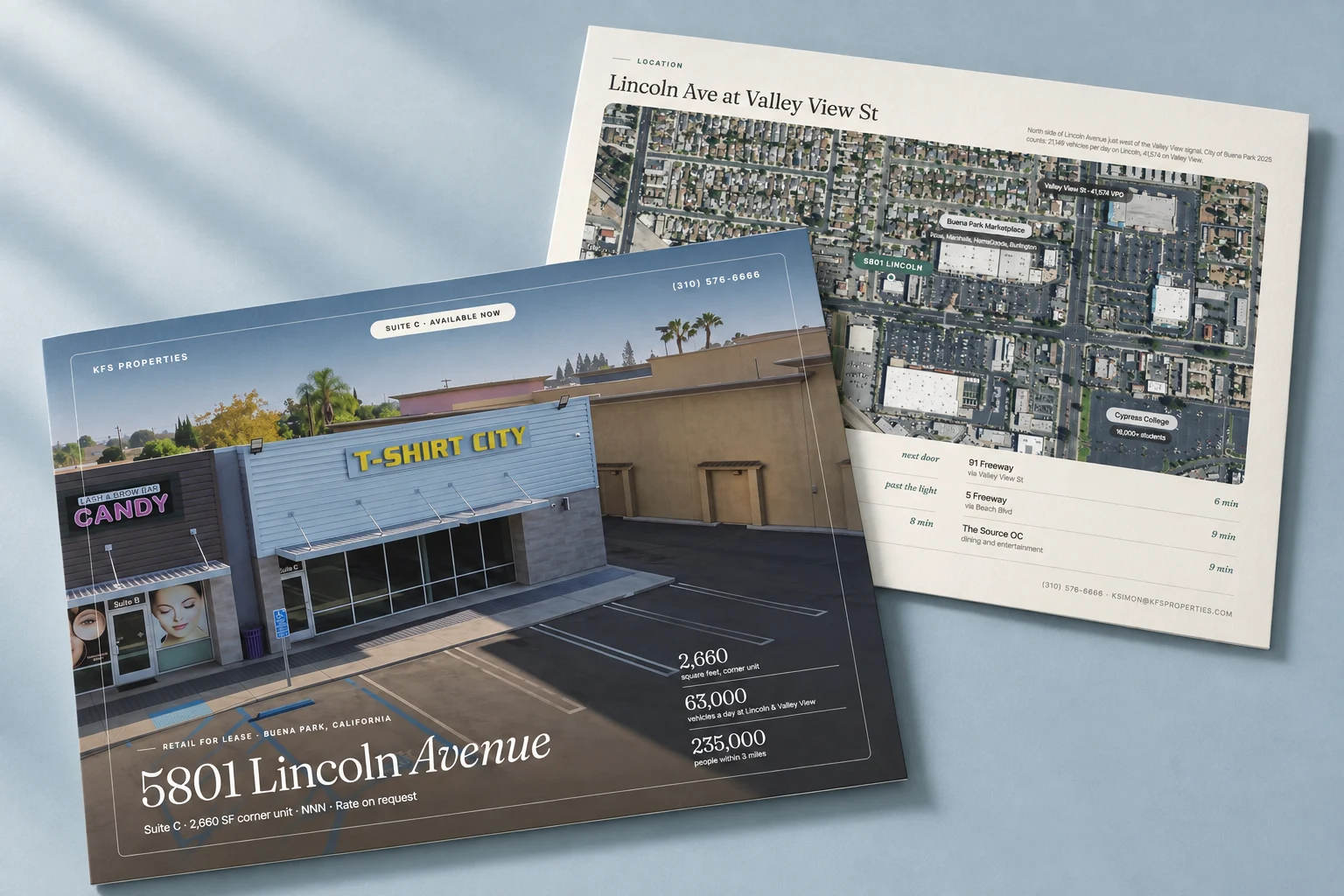
On 5801 Lincoln, a 2,660 square foot corner suite we took from brief to live in three days, the seven-page flyer we produced lives at a stable link on the listing site rather than as an attachment. That is the mechanic that carries directly into a deal room, minus the form. The document has one permanent address that we control. When a rate changes or a suite leases, we update the file at that address and everyone who saved the link now has the current version. The forty people holding an emailed attachment from March are holding March.
That is the argument for the whole approach, and it has nothing to do with secrecy. A disposition campaign runs for months. A tenant renews, an anchor exercises an option, guidance moves. A PDF is a snapshot of the day it was exported. A link is not.
The reporting that makes the gate worth having
If you are going to ask a buyer for their information, you owe the owner something in return for it. The weekly report we would want as a broker is short and specific: who registered, at what firm, in what role, which documents they opened, how many times, and how they arrived at the site. That last field is the campaign question, and it is the one that tells you whether the email blast or the portal listing is producing the principals rather than the tire kickers.
The behavioral signal is more useful than the count. One registration followed by three visits to the financials in a week is a live party, and the broker should know that before the follow-up call, not after. A hundred registrations with no second visit is a well-marketed property with a pricing problem. We wrote about the general shape of listing reporting in website analytics for listings, and everything there applies here with one addition: on a gated page the visitors have names, so the report stops being traffic and starts being a call list.
Search, and why gating does not hurt you
Owners sometimes worry that putting documents behind a form will damage the listing's visibility. It does not, provided the public page is the one doing the work. Google's Search Central documentation on paywalled and subscription content is clear that Googlebot indexes what it can fetch without credentials, which is exactly the arrangement you want: the public page carries the address, the positioning, and the photography, and it is what ranks. Mark the delivery page itself noindex so a stray confidential URL never enters an index in the first place, and never rely on an unguessable URL as the only protection.
Two adjacent failure modes are worth naming, because we have watched both happen. The first is the download link that never expires, gets forwarded, and is still live eighteen months later. Sign the links and give them a short window. The second is the form notification that quietly lands in a spam folder for two weeks, which is a broker's nightmare dressed as a technical detail. Send the alert from a domain aligned for authentication, log every submission on the server independently of email, and test the path with a real inbox before going to market. A lead capture you have not tested is decoration.
Planning the ending
The last thing almost nobody scopes: what happens to the deal room when the property sells. The correct answer is decided at the start, in one line of the marketing agreement. Usually it is to close the gate, replace the page with a short sold notice that preserves the broker's credit for the transaction, and stop serving the documents entirely. Sometimes the buyer wants the site handed over, in which case the domain question needs an answer before anyone registers anything, and we work through that in domain names for property websites.
What should not happen is the quiet default: an abandoned page still serving a confidential rent roll to anyone who checks a box, for a property the seller no longer owns. It is an easy thing to forget and an embarrassing thing to explain. Put the sunset date on the calendar the day the campaign launches.
Scoping one of these is not a separate line item so much as a decision about the property website you were already building. If you want to talk through where the gate belongs on a specific assignment, that is what our services page is for. Every project is quoted as one flat number before work starts, deal room included.
Work with Endcap
Have a disposition that needs somewhere to send the documents?
Work with Endcap Design
Offering memorandum design
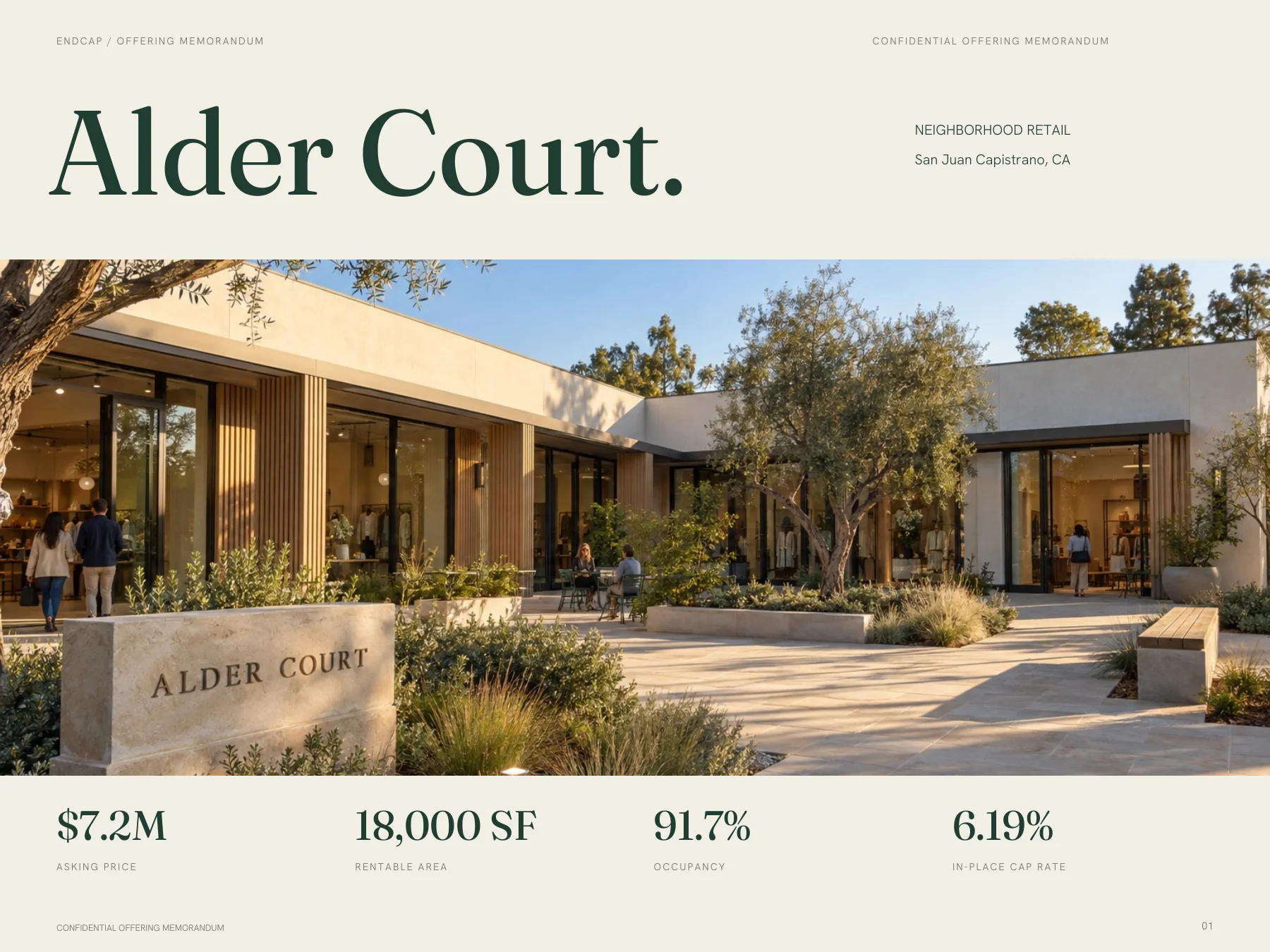
We design offering memorandums, property brochures, and lease flyers from your approved text, photos, plans, rent roll, and financials.
Included
- Up to 12 pages using your approved text, photos, tables, and financials
- Two revision rounds
- Digital and print-ready PDFs
“The Flyer is all that I need and it is outstanding.”
Quoted per document · Offering memorandums, brochures, and lease flyers
We reply within an hour during business hours, and we only use your details to answer you.
Get a quote for your OMOr email Noah at hello@endcap.design
See the full service ↗Contact Endcap
LET’S
talk.
A website, a brand, or a complete set of materials.
We reply within an hour during business hours, and we only use your details to answer you.
Let’s talk or email Noah at hello@endcap.design