Marketing
Winning the listing: what belongs in the pitch.
Three brokers walk the same owner through the same corridor comps in the same week. All three know the market, all three quote a rate within a nickel of each other, and two of them present a deck. The one who gets the assignment usually brought something the owner could open, keep, and check later. Here is how we would build a listing presentation, from the research that happens before you are hired to the reporting promise that decides whether you keep the assignment next year.
What the owner is actually choosing between
Market knowledge is the entry fee, not the differentiator. By the time an owner is taking meetings, everyone in the running knows the corridor, the vacancy, and roughly where the rate lands. What the owner cannot know is the thing they most want to buy: how much attention their asset will actually get once the listing agreement is signed and the broker's phone starts ringing about someone else's deal.
So they buy evidence instead. Three questions sit under almost every listing presentation, and owners rarely ask them out loud:
- How much of your week does my property get? Most presentations answer this with adjectives. Aggressive. Proactive. Hands on.
- What will exist that does not exist today? Photography, a page, a flyer, a plan a tenant rep can read. Not channels, artifacts.
- How will I know it is working before a lease shows up? Leasing cycles run months. An owner who cannot see progress assumes there is none.
A presentation built to answer those three, in that order, beats one built to prove you know the submarket.
Do the work before you are hired
The strongest move in a listing pitch is to arrive having already done a visible piece of the job. Not a sample of your capabilities, a piece of the actual assignment:
- Pull the trade area yourself. Population, income, and daytime employment computed to true radii from the front door, with the source and the vintage on every figure. Portal-reprinted demographics get caught by anyone who works the corridor. The numbers a retail tenant actually underwrites are covered in our trade area guide.
- Price the vacancy with comps you can name. Including the two that hurt your case. An owner who has been pitched three times can tell within a minute who is quoting a rate to win the listing rather than to lease the space.
- Redraw the plan. One page, north up, suites labeled, vacancies obvious, parking and access legible. The architect's sheet is not a leasing document. We wrote about why in site plans that lease space.
- Read the rent roll like an owner. Expirations inside twenty four months, options, exclusives, co-tenancy language. Bring one observation the owner has not heard from the other two brokers.
The objection to this is obvious: you are giving away work you might not get paid for. In practice the research costs a day and it disqualifies fast. If a property will not support the effort of one day of unpaid analysis, it will not support a year of marketing either.
Four documents beat forty slides
Owners do not re-read decks. They forward documents. Build the leave-behind as four short pieces, each of which survives being sent to a partner who was not in the room:
- A one-page positioning and rate memo. What the space is, who takes it, what it should ask, and why.
- The marketing plan in build order, so the owner sees sequence rather than a menu. Our version of that document is here.
- A calendar with real dates. Photography week one, page live week two, first email week three, portal refresh monthly. Dates make a plan falsifiable, which is the point.
- A sample report, pulled from a live assignment with the identifying details removed, showing exactly what the owner will receive and how often.
Show the deliverable, not the description
This is where a presentation stops sounding like every other presentation. Describing a marketing program is abstract. Handing an owner a phone with a finished property site on it is not.
An owner cannot picture a marketing plan. They can open a link.
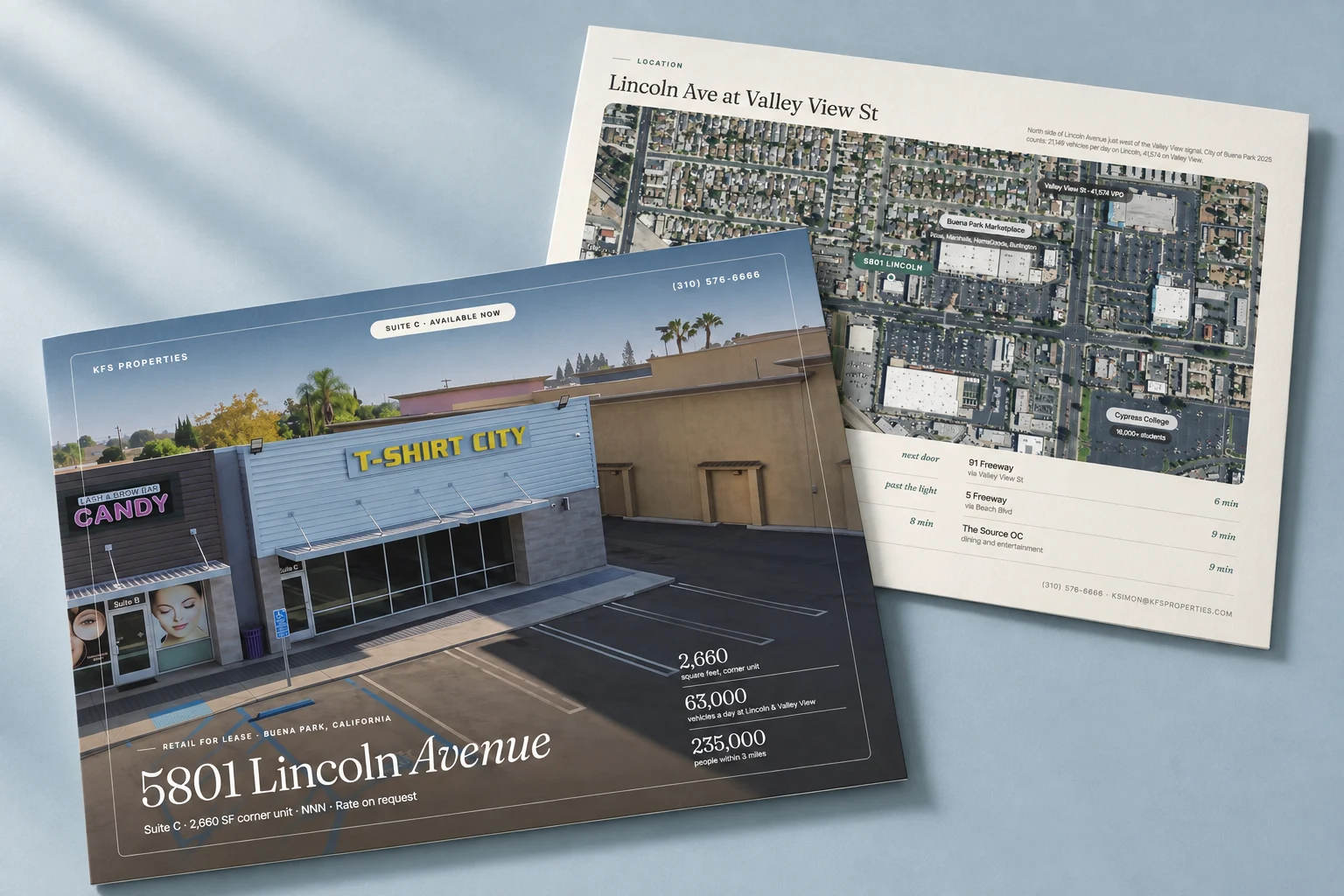
Two pieces of our own work do that job in a meeting. Marbella Plaza is a 66,124 SF grocery-anchored center in San Juan Capistrano with a site built around availability, an interactive plan, and trade-area data with sources attached; the build is written up in the Marbella case study. Suite C at 5801 Lincoln Ave in Buena Park is the other end of the range: a 2,660 SF corner suite in a three-tenant strip that went from a brief to a live site and a seven-page flyer in three days, using raw drone files rather than a shoot day. Its traffic counts came from the City of Buena Park's published 2025 GIS traffic layer, 21,149 vehicles a day on Lincoln Ave and 41,574 on Valley View St at the corner, cited that way on the page itself. The Lincoln case study and the day-by-day writeup cover how it came together.
The lesson for a broker is not that every listing needs a website. It is that the small suite got the same treatment as the anchored center, and an owner can see that in about eight seconds on a phone. If you show a live page in a pitch, be ready to produce one inside the campaign's first two weeks. Promising a property site and delivering a portal listing is worse than never raising it, and the site has to be fast enough to survive a parking lot: Google's Core Web Vitals guidance treats a largest contentful paint of 2.5 seconds or less as good, which is a bar most template property pages miss. We wrote about what actually makes them slow in page speed for property websites, and about when a listing justifies its own site in single-property websites.
Put the boring parts in writing
The terms conversation is where a confident presentation either lands or unravels. Say the structure plainly rather than letting the owner discover it in a form:
- Exclusive right to sell or lease versus exclusive agency, in one sentence each, with the practical difference stated: who gets paid if the owner produces the tenant.
- A definite termination date. California's Business and Professions Code section 10176(f) makes claiming compensation under an exclusive listing that carries no specified date of final and complete termination grounds for discipline against the license. Put the date in the document and point at it.
- Compensation, stated as negotiable, because it is. No law and no association sets it. Owners respect a broker who says the number out loud and explains what it buys.
- Ownership of the marketing assets. This one gets skipped constantly. Who holds the domain registration, who owns the photography and the drone files, and what happens to the property site if the listing expires and the owner hires someone else. Our answer is that the owner keeps everything, which is also how we scope client work under services. Settle it at the pitch, not at expiration.
California's statute of frauds already requires a written agreement for a broker's compensation on real property, so the paperwork is happening regardless. Treating it as part of the presentation instead of an afterthought signals how the rest of the assignment will be run.
Reporting is where the renewal is won
Most listings are lost quietly, twelve months in, by a broker who did good work and never showed it. The fix is a report that arrives on the same day every month whether or not there is news, in the same shape every time: traffic to the property page and where it came from, which suite drew the interest, inquiries split by type, tours held, proposals out, and one paragraph on what changed and what you are doing next. Two months of that and the owner stops asking for updates, which is the actual goal. What belongs in it, and what an owner should insist on, is in website analytics for listings.
Commit to the report in the pitch, with a date. It is the cheapest promise in the presentation and the one most likely to be remembered.
The 48 hours after the meeting
Send the follow-up the same day, and make it produced rather than promised. One short email, the four documents attached as one PDF, and a link to something real. If you have a page for the asset, even a single honest teaser page, that link outperforms every paragraph you could write about your process. Recap the three commitments you made and the dates attached to them. Owners compare brokers on memory, and memory favors whoever put something concrete in their hands first.
A pass to run before your next presentation
- Every number in the deck has a source and a year printed next to it.
- The plan is one page and readable on a phone.
- There is at least one thing the owner can open, not just look at.
- The calendar has dates, not phases.
- Asset ownership and the termination date are addressed out loud.
- The reporting sample is real, and you are prepared to send that exact document twelve times.
None of this requires a bigger marketing budget than the broker sitting in the lobby waiting for their turn. It requires deciding, before the meeting, that the assignment starts now rather than at signature.
Start a project
Pitching an owner and want something real to show?
Work with Endcap Design
Offering memorandum design
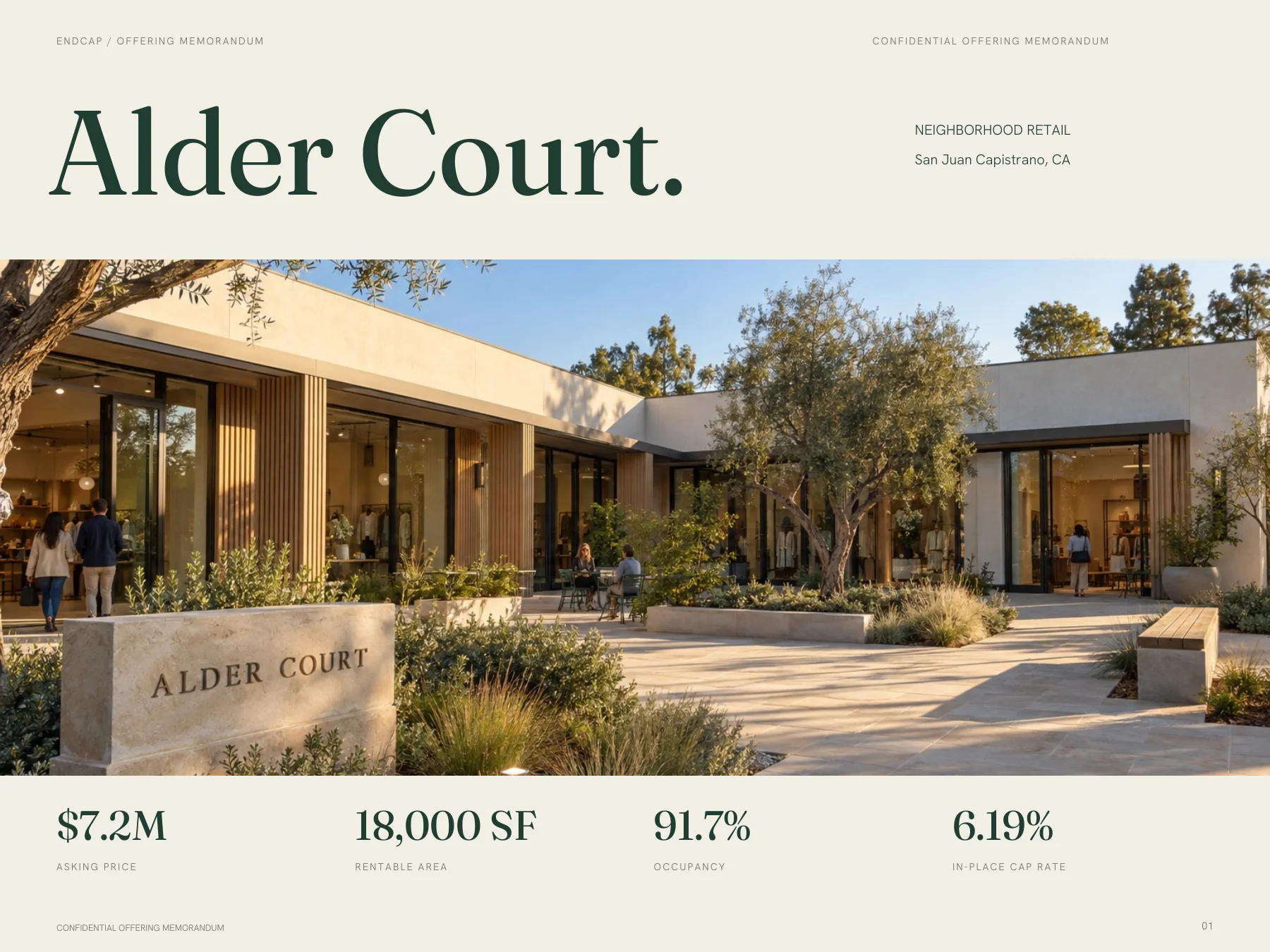
We design offering memorandums, property brochures, and lease flyers from your approved text, photos, plans, rent roll, and financials.
Included
- Up to 12 pages using your approved text, photos, tables, and financials
- Two revision rounds
- Digital and print-ready PDFs
“The Flyer is all that I need and it is outstanding.”
Offering memorandums from $495 for up to 12 pages · Brochures from $350 · Lease flyers from $175
We agree on the scope, timing, and price with you before work begins.
Get a quote for your OMOr call or text (425) 233-0769
See the full service ↗Contact Endcap
START A
project.
A website, a brochure, or a complete set of materials.
We’ll agree on the scope, timing, and price before starting.
Start a conversation or call or text (425) 233-0769