Documents
What an offering memorandum costs to produce
An offering memorandum can be a design assignment using finished content, or a larger project that includes photography, plans, and research. The scope, and above all whether the content already exists, determines the cost.
Endcap OM design starts at $495 for one property and up to 12 pages using your approved copy, photography, tables, and financials. Two revision rounds and digital and print-ready PDFs are included. Additional pages, new photography, research, underwriting, and printing are quoted separately before work begins. See the scope and OM sample
What sets the price of an OM
Three factors set most of the cost, in descending order of impact.
1. Whether the content exists. If the property has usable photography, a drawn site plan, a clean rent roll, and trailing financials in a readable format, producing an OM is mainly layout and typesetting. If those pieces are missing, which is common on smaller private deals, someone has to photograph the property, redraw a plan from an old scan, and reconcile a rent roll that disagrees with the trailing twelve months. That work takes days and usually costs more than the layout.
2. Complexity of the asset. A single-tenant net-leased building with a long remaining term is a short document with one lease to summarize. A twenty-tenant center with vacancies, percentage-rent tenants, a ground lease, and a reciprocal easement agreement needs many more tables and explanations. Its rent roll alone can take a day to typeset and check.
3. How many review rounds the seller wants. Two rounds is a common starting scope. Agree on the number before work begins, because open-ended revision is where budgets grow.
Cost drivers at a glance
The table below compares the lower-cost and higher-cost version of each factor. It describes scope rather than dollar amounts, because the same factor can be priced differently by different producers.
| Driver | Lower-cost case | Higher-cost case | Why it matters |
|---|---|---|---|
| Photography | Current professional exterior and interior photos supplied | No usable images; a shoot, aerials, or retouching is needed | Production time and a separate photographer or pilot fee |
| Plans | Clean site and floor plans supplied as vector files | Plans must be redrawn from scans or field notes | Redrawing is detailed work, and suite labels must match the rent roll |
| Rent roll and financials | One approved rent roll and operating statement that agree | Several versions that disagree, or missing lease data | Reconciliation must be done by the seller or analyst before design can finish |
| Tenant count | One or a few tenants | Many tenants, options, percentage rent, or ground leases | More tables, notes, and checking per page |
| Written copy | Approved property description and highlights supplied | Copy must be written from records and interviews | Writing and fact review add a separate stage |
| Market and location data | Sourced demographics and maps supplied, or none needed | New maps, trade-area research, or traffic data | Each figure needs a source, geography, and period |
| Page count | Fits a standard page range | Many additional pages or appendices | Once content exists, extra pages add less time than missing content does |
| Review rounds | Two agreed rounds with one approver | Open-ended rounds with several approvers | Each round repeats checking across every linked figure |
| Brand system | An existing brokerage template is supplied | A new layout system is designed for the first document | A reusable format lowers the cost of later documents |
Published prices in the market
Few producers publish OM prices, and the ones that do sell different things: software subscriptions, templates, freelance gigs, and studio design. The table lists the prices we could verify from public pages on September 24, 2026. The listed prices do not cover the same scope, so read the “what it covers” column before comparing numbers.
| Option | Published price | What it covers | Source |
|---|---|---|---|
| Template subscription (CREOP) | $89 a month on the monthly plan; $864 a year on the yearly plan, which works out to $72 a month | Unlimited offering memorandums, BOVs and proposals, and flyers built in the software; the user supplies and assembles the content | CREOP pricing |
| Purchased template (BTS Brands) | $295 one time | An editable OM template file; custom OM design is quoted on request | BTS Brands |
| Freelance marketplace (Fiverr) | Gig starting prices from $30 to $600 in a search for “commercial real estate offering memorandum” | Starting packages that vary by seller in page count, revisions, and what the buyer must supply | Fiverr search |
| AI drafting (Crexi Create) | No separate price published; available to Crexi Pro and Crexi Intelligence subscribers | An editable OM draft generated from uploaded financials, leases, rent rolls, or an address, launched May 18, 2026 | Crexi announcement |
| Studio design (Endcap) | From $495 | One property, up to 12 pages using supplied and approved content, two revision rounds, digital and print-ready PDFs; extra pages, photography, research, underwriting, and printing quoted separately | OM design service |
Institutional brokerages usually produce OMs with in-house marketing staff, so there is no public per-document price to compare. An in-house analyst has no invoice but does have a time cost, and for simple assets with an established house format that is often a sensible choice.
Low quotes and supplied content
A quote that comes in far below the others usually assumes supplied content. The line reads “design and layout of client-provided materials,” which works until the rent roll turns out to be a photograph of a printout and the only exterior image is poor.
At that point the timeline slips while someone sources content, the scope is renegotiated, or the document goes out with the material that exists. The last outcome costs the most, because a weak document can affect how buyers respond to the property.
When comparing quotes, ask each producer what happens if the photography or plans are not usable. The answers show which assumptions each price depends on.
Document cost relative to deal size
As an illustration, a $2,400 difference in document cost on a $6 million sale is 0.04 percent of the price, or four basis points. A presentation problem that reduced the price by half a percent would cost $30,000. The document needs to be good enough that presentation is not the reason a buyer passes. Beyond that point, additional design spending is hard to justify.
How to make the next OM cheaper
Build a house format once: a defined type hierarchy, a rent roll table that stays legible as it grows, a map style, and a cover that works with a horizontal or vertical photograph. The first document carries the cost of setting up the system, and later documents are assembled within it.
Plan photography for every use at once. The images in the OM can also serve the LoopNet and Crexi listings, the lease flyers, and a property website when the photographer’s license allows it. Commissioning those separately, months apart, usually costs more.
Endcap’s approach
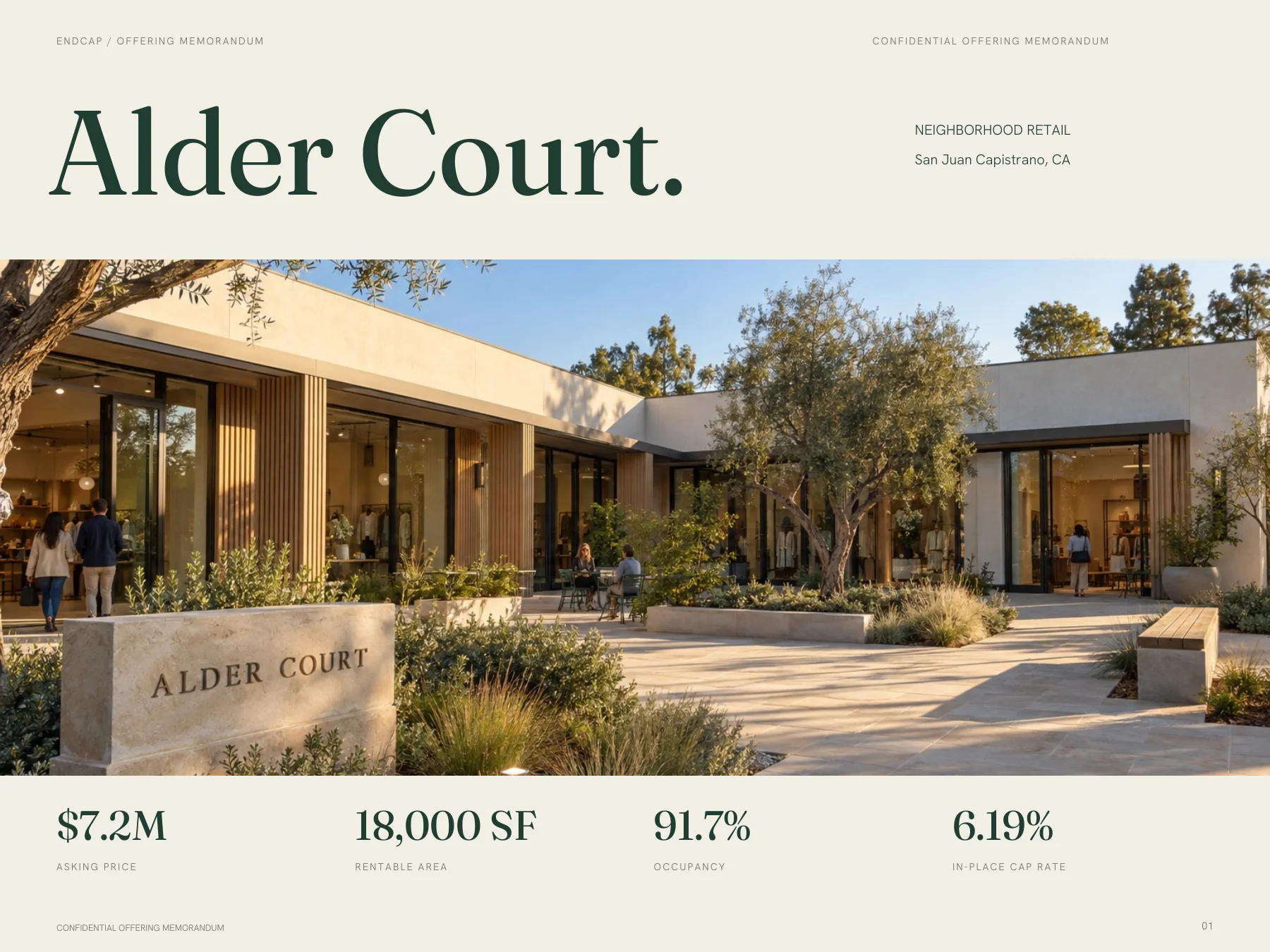
Endcap prices documents by scope and publishes starting prices: a lease flyer from $175 for up to two pages, a property brochure from $350 for up to four pages, and an offering memorandum from $495 for up to 12 pages. Each assumes you supply and approve the text, photos, plans, and financials. We identify missing material before starting, and your quote confirms the deliverables, schedule, and total before work begins. Underwriting and pricing remain with your team. The Alder Court sample shows a complete 12-page layout.
Common questions
How much does an offering memorandum cost?
Published prices on September 24, 2026 ranged from an $89-a-month template subscription (CREOP) and $30–$600 freelance gig starting prices to studio design from $495 at Endcap. The real cost depends on whether photography, plans, and a reconciled rent roll already exist; producing that content usually costs more than the layout.
Does page count drive the price?
Less than content readiness does. Most producers set a page range for a base price, and extra pages are quoted separately. Once a format exists and content is in hand, adding pages takes less time than creating missing photography or plans.
Why do quotes for the same OM vary so widely?
Low quotes usually assume client-supplied content. When the photography turns out to be unusable or the rent roll arrives as a scan, the scope changes. Ask each bidder what happens if the photography is not usable.
Can AI write an offering memorandum?
AI tools such as Crexi Create generate an editable draft from uploaded documents. The draft still needs the seller’s approved figures, a check that suite labels and totals agree across pages, and review by the listing broker before it goes to buyers.
Is it worth paying for an offering memorandum on a small deal?
Compare it with the asset. On a $6 million sale, a few thousand dollars is a few basis points, while a presentation problem that costs half a point of pricing costs $30,000. Small or off-market deals often trade on a one-page summary and a rent roll, which can be enough when the buyer pool is narrow.
Sources
- CREOP pricing page, accessed September 24, 2026.
- BTS Brands offering memorandums page, accessed September 24, 2026.
- Fiverr gig search results, starting prices shown September 24, 2026; listings change daily.
- Crexi, Crexi Create announcement, PR Newswire, May 2026.
Work with Endcap Design
Offering memorandum design
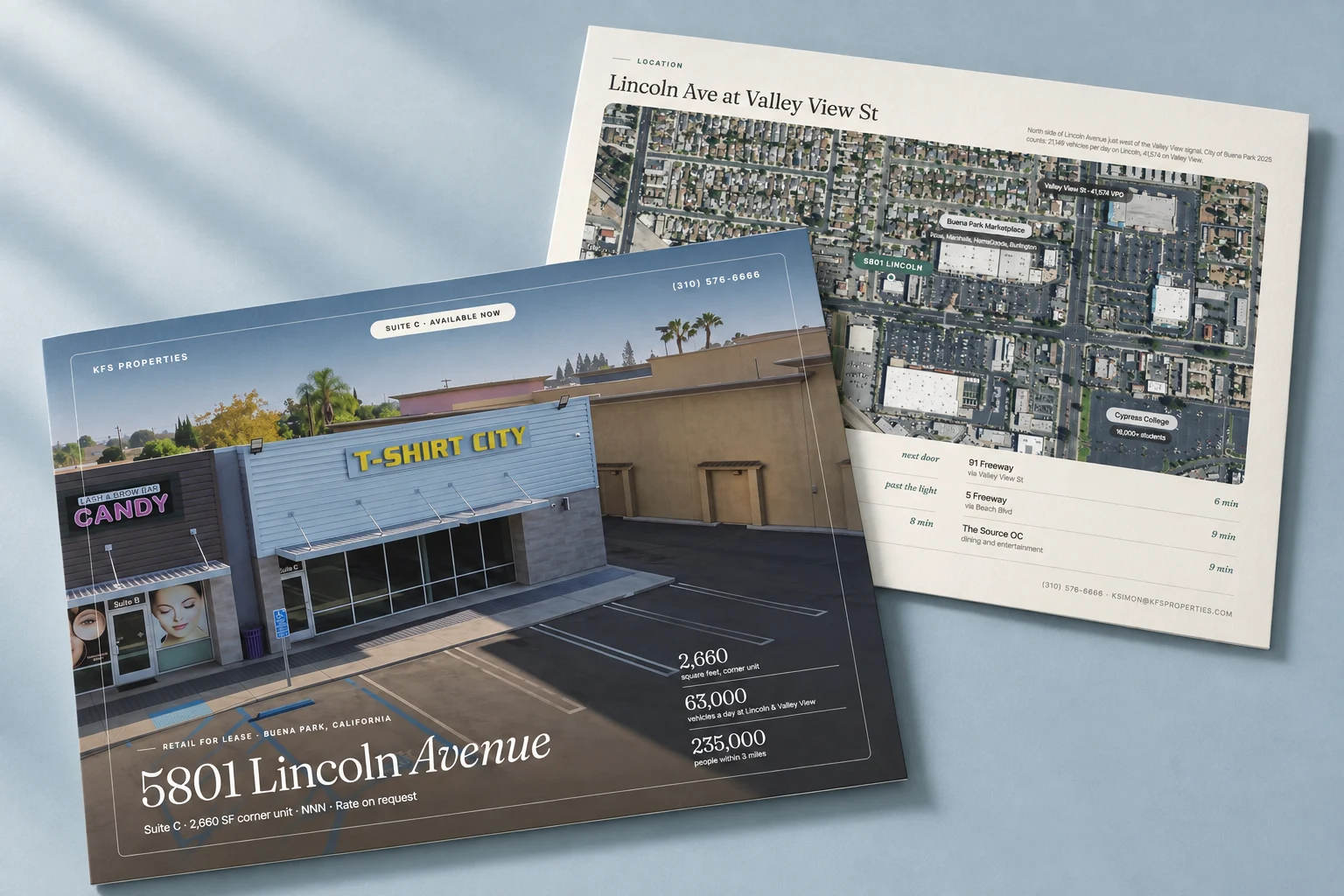
We design offering memorandums, property brochures, and lease flyers from your approved text, photos, plans, rent roll, and financials.
Included
- Up to 12 pages using your approved text, photos, tables, and financials
- Two revision rounds
- Digital and print-ready PDFs
“The Flyer is all that I need and it is outstanding.”
Offering memorandums from $495 for up to 12 pages · Brochures from $350 · Lease flyers from $175
We agree on the scope, timing, and price with you before work begins.
Get a quote for your OMOr call or text (425) 233-0769
See the full service ↗Contact Endcap
START A
project.
A website, a brochure, or a complete set of materials.
We’ll agree on the scope, timing, and price before starting.
Start a conversation or call or text (425) 233-0769