Retail centers
Marketing a vacant anchor space: backfilling the box.
When the anchor goes dark, the assignment stops being a leasing problem and becomes a re-underwriting problem, conducted in public, in front of an audience that already knows the box is empty. The marketing has to answer questions the inline suites never raise: what the building can physically become, what the existing leases will allow, and what the city will approve. Here is how we would assemble that package.
The vacancy is not the only thing you are selling
A dark box is read by more people than the tenant reps who might fill it. The inline tenants read it as a forecast, and many of them have language in their leases that gives the reading teeth: co-tenancy provisions tied to the anchor's occupancy, reduced or percentage rent while the condition persists, and in some cases a right to terminate after a stated cure period. The lender reads it as a change in the rent roll's durability. The appraiser reads it at the next valuation. Your own inline prospects read it on a site tour, when they walk past a papered-over storefront and stop asking about rent.
That is why a listing page reading "50,000 SF available, divisible" is worse than nothing. It leaves every one of those audiences to write their own story about the center, and the story they write is rarely the one the owner wants. The marketing job is to replace speculation with a plan that is specific enough to be argued with.
Inventory the box before you price it
Tenant reps who trade in boxes qualify a building on facts that never appear on an inline flyer. Assemble them first, because every one of them will be asked for, and the assignment that can answer in one afternoon is the one that stays on the shortlist:
- The shell. Clear height at the low point rather than the peak, column spacing and bay depth, slab thickness and condition, roof age and whether the warranty is assignable, and any mezzanine that counts against usable area.
- Service and systems. Panel size, voltage and phase, HVAC tonnage and age, gas service, grease and sanitary capacity if a food user is plausible, and the sprinkler design. Sprinkler density decides whether a storage or last-mile user can occupy the building at all, and retrofitting it is a capital conversation, not a punch-list item.
- Loading and access. Dock positions, truck court depth, turning radius, and whether trucks can circulate without crossing the front parking field. A box that cannot take a 53-foot trailer is a different product, and it is better for you to say so than for a rep to discover it.
- Demising feasibility. Where a wall can actually go given the columns, utilities, and the roof structure, whether a second storefront and second entrance are possible, and what the rear access looks like for a tenant who does not get the front.
- Parking and signage rights. The stall count attributable to the box, the ratio it produces for a high-turnover user, and which pylon panels transfer with the space.
Then the paper, which is where backfills quietly die: exclusive-use clauses granted to tenants still in the center, prohibited-use lists, deed restrictions left behind by a departing grocer, and the reciprocal easement agreement that may cap building area, fix parking ratios, restrict height, or require anchor consent for a change of use. This is not a document review you defer until a letter of intent. It is marketing input, because it defines the universe of tenants worth calling.
Decide which of three deals you are actually marketing
"Divisible to suit" is the phrase owners reach for when the decision has not been made. It is not a strategy, and experienced reps recognize it as an absence of one. There are three real outcomes, and each needs a different package and a different call list.
Divisible to suit is not a plan. It is a way of asking the tenant to do the owner's homework.
A single-user replacement is the cleanest to describe and usually the slowest to find. The audience is narrow and known: regional and national reps with an active requirement in the trade area, plus the users whose competitors already sit on the corridor. The marketing here is a precise fact sheet and a direct-outreach campaign, not a portal listing hoping to be discovered.
A demise into two or three spaces is a design and capital exercise before it is a leasing exercise. Publishing a drawn demising option with the wall in a specific place, the second entry shown, and an honest range for landlord work does more than any adjective. It also lets a prospect see whether their prototype fits, which is the only question they are trying to answer in the first ninety seconds.
A change of use brings fitness, medical, entertainment, worship, self-storage, or last-mile distribution into the conversation. Each of those carries a parking demand, a zoning question, and a co-tenancy question that your marketing should answer up front rather than leaving for a rep to discover at week six. A user who learns late that the grocery exclusive blocks their concept does not come back with a different site.
Say what the city allows, and what it does not
The fastest way to lose a sophisticated prospect is to imply approvals you cannot promise. In California, a change of use frequently turns on whether the use is permitted by right or requires a conditional use permit, on the parking ratio the municipal code assigns to the proposed use, and on whether the project clears CEQA review or qualifies for an exemption. Alcohol adds a state license process on top of the local one.
None of that is a reason to stay vague. It is a reason to be precise: name the zoning designation, cite the code section that sets the parking ratio, describe the city's published process, and stop there. "Fitness use requires a CUP; the city's published review runs through the planning commission" is credible. "Fitness use approved" is a claim you may have to walk back in escrow.
What we would build for the box
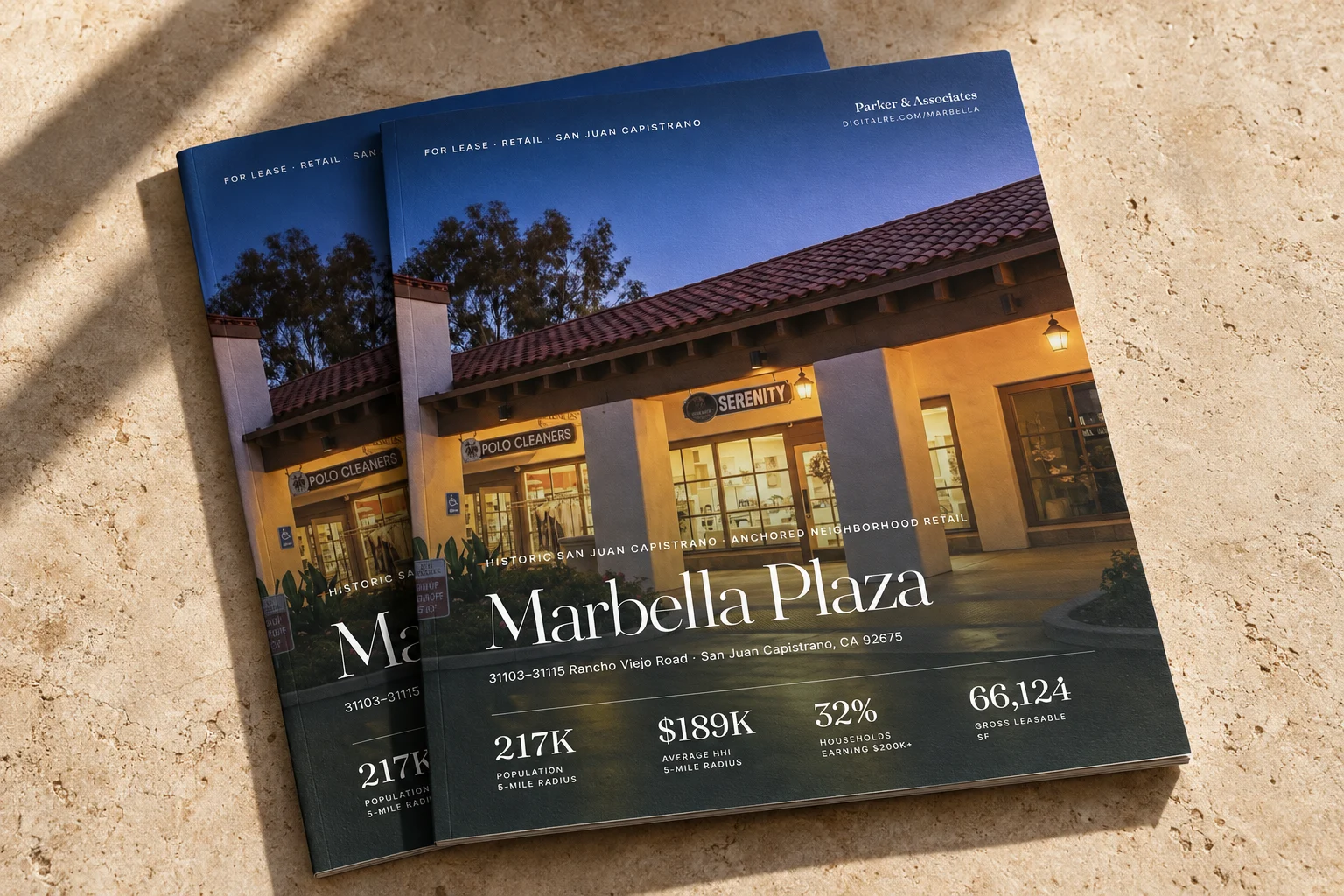
We build property websites for retail centers, and the pieces a backfill needs are the pieces those sites already carry. On Marbella Plaza, a 66,124 SF grocery-anchored center, the site is organized around an interactive site plan, the co-tenancy roster, and trade-area data presented with its sources visible rather than buried in a PDF appendix. Those three elements are exactly what a box prospect interrogates: what surrounds me, who else is here, and who lives within a fifteen-minute drive.
For a vacant anchor, we would give the box its own page inside the center's site, deep-linked from its footprint on the plan, and we would put the demising options on that page as drawings a visitor can switch between rather than as a sentence promising flexibility. Documents that cannot be public, the restriction summary and the survey, sit behind a short form so the owner learns who asked. The approach to interactive plans is covered in more depth in our piece on site plans that lease space, and the sourcing standard for the demographics is in the trade area guide.
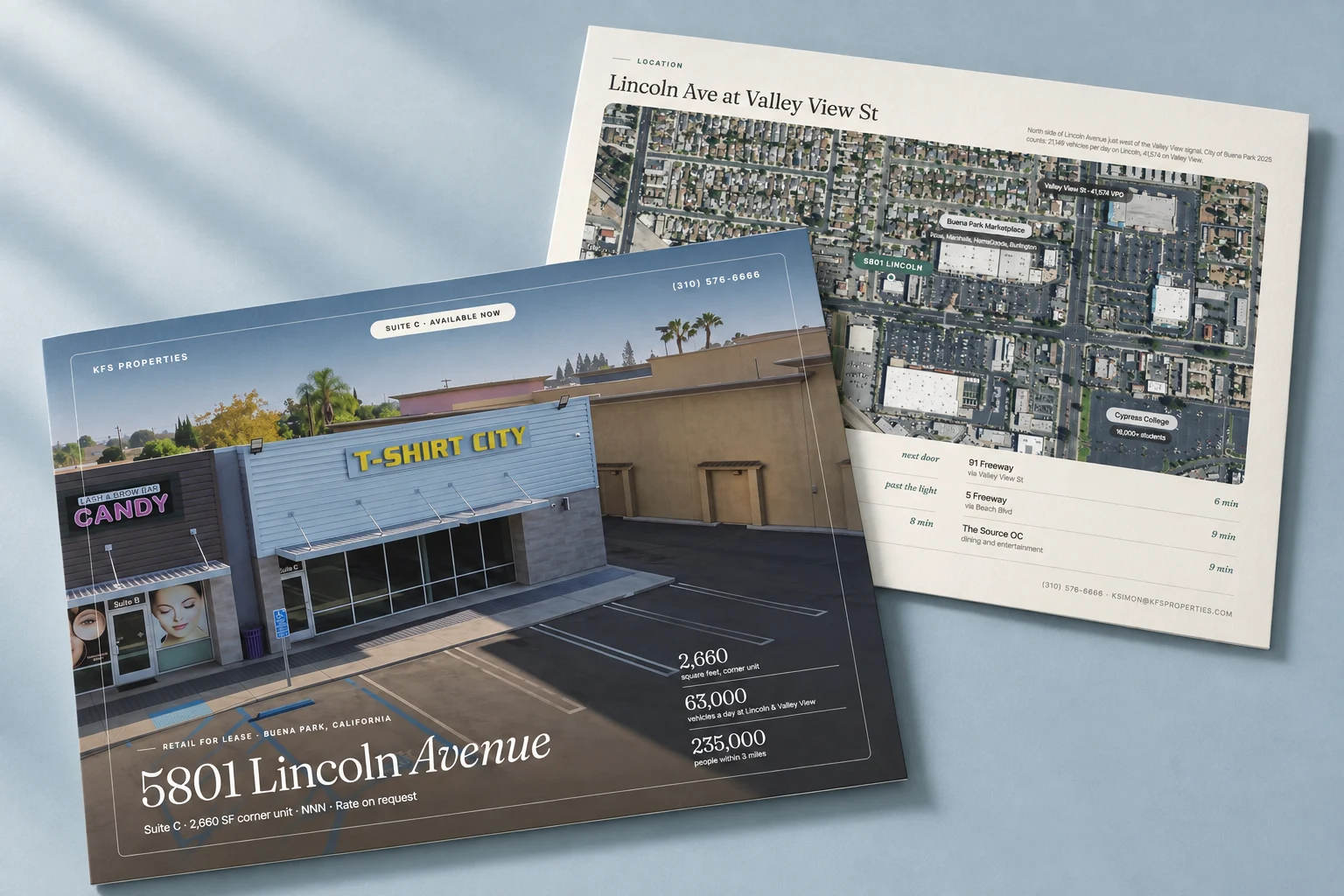
Speed matters more here than owners expect, because the co-tenancy clock starts the day the box goes dark. Our smallest recent build, a 2,660 SF corner suite at 5801 Lincoln, went from brief to live in three days with a dedicated site and a seven-page flyer produced from footage that already existed. The production standard does not have to scale down with the timeline, and a backfill assignment rarely has weeks to spare before the first ownership meeting.
Publish the constraints early
The instinct is to hold the restriction list back, on the theory that constraints scare tenants off. In our experience the opposite is true of the tenants worth having. A one-page summary of exclusives, prohibited uses, REA limitations, and parking obligations does three things at once: it disqualifies the wrong prospects in week one instead of week six, it signals that ownership knows its own asset, and it gives the reps who do stay a document they can take to their client without a follow-up call.
Say what is unresolved, too. If the anchor's deed restriction has an expiration date, publish the date. If a demise requires a variance nobody has applied for, say that it requires a variance nobody has applied for. Specific uncertainty reads as competence. Vagueness reads as something to be discovered later.
Expect a long campaign, and instrument it
Box backfills are measured in quarters, not weeks, and a campaign that long needs evidence of progress that is not just "we are getting calls." A dedicated page gives you that: which demising option gets clicked, which documents get requested and by which firms, whether the traffic is coming from the direct outreach or from search, and which cities the sessions originate in. That last one has told us more than once that the interest was regional rather than local, which changes the call list. We wrote about what to ask for in the analytics piece.
Keep the page honest as facts change. When a demising plan is superseded, replace the drawing. When a restriction expires, update the summary and note the date. A backfill page that still shows last year's plan tells every returning rep that nobody is minding the asset, which is the one message a dark box does not need help sending. If the campaign has genuinely stalled, work the diagnostic before the price conversation: our notes on a listing that stops getting calls apply to boxes as much as to inline suites.
For scale, ICSC's U.S. shopping center classification puts neighborhood centers at roughly 30,000 to 125,000 square feet and community centers at 125,000 to 400,000. A box in the first is most of the property's identity, and the marketing should treat the backfill as a repositioning of the whole center rather than the leasing of one suite. A box in the second is a large problem inside a property that still has a story of its own. Knowing which one you are handling determines whether you are updating a listing or rebuilding the center's case.
Start a project
Have a box to backfill and a center to reassure?
Work with Endcap Design
Listing marketing for a vacant space
We produce the photography, flyer, and website for a space, built around the material you already have.
Included
- Photography of the space and the storefront
- A lease flyer or brochure with the suite size, plan, and leasing contact
- A property website when the listing needs one
“The Flyer is all that I need and it is outstanding.”
Photography from $325 · Lease flyers from $175 · Property websites from $495
We agree on the scope, timing, and price with you before work begins.
Get a quote for your listingOr call or text Noah at (425) 233-0769
See the full service ↗Contact Endcap
START A
project.
A website, a brand, or a complete set of materials.
We’ll agree on the scope, timing, and price before starting.
Start a conversation or call or text Noah at (425) 233-0769