Web design
Broker bios that win business.
On most brokerage sites the bio page is the last thing written and the first thing an owner reads. Someone is deciding whether to hand you a listing worth years of fees, and the page they are deciding from opens with a sentence about being passionate about client service. Here is what to put there instead.
Who is actually on the page
Three people read a broker bio, and they want different things.
The first is an owner or an asset manager about to interview two or three firms. They already know your name from a referral or a pitch deck. They are on the page to check that the person in the room matches the person on the website, and to find one concrete reason to feel safe. The second is a tenant rep or a principal on the other side of a live deal who wants to know who they are negotiating against before the call. The third is a producer at another firm, quietly reading every bio on your site, deciding whether this is a place where their business would grow.
None of them are browsing. All three arrived with a question, and the page either answers it in the first screen or sends them back to LinkedIn to answer it themselves. The failure mode is not an ugly page. It is a page that says nothing checkable.
The first screen has three jobs
Above the fold, before any scrolling, a bio needs to establish three things: who you are, what you do and where, and why that claim is credible. In practice that means a name, a title, a market and product type stated plainly, a real photograph, and direct contact details. Not a form. The mobile phone number and the email address, as text, callable and copyable.
"Retail leasing and investment sales, Orange County and the South Bay" is a positioning statement. "A trusted advisor with a proven track record across all asset classes" is filler that would survive a find-and-replace of the name. If a sentence on your bio would read identically under a competitor's headshot, it is costing you space rather than earning it. We wrote about this problem at the firm level in commercial real estate branding, and the individual page is where it bites hardest, because that is where the reader most wants a specific human being.
Write the track record without breaking confidentiality
This is the part brokers avoid, and the avoidance is usually reasonable. Deal terms are confidential, clients do not want their names on a website, and nobody wants to publish a number a principal never agreed to release. So the bio retreats to adjectives.
There is a middle position. Almost everything an owner wants to know can be said without naming a party or a price:
- Volume and shape, not terms. Square footage leased, number of transactions, years active, product types. Aggregate figures across a career rarely require anyone's permission and tell an owner far more than "extensive experience."
- Geography with edges. Name the corridors and submarkets you actually work. A broker who claims all of Southern California reads as a broker who owns none of it. The reader is looking for someone who knows their intersection.
- Assignment types, described honestly. Grocery-anchored center leasing is a different job from single-tenant net lease sales. Say which one is yours, and say what you refer out. Naming what you do not do is the single most credible move available on a bio page.
- Public deals, cited as public. Recorded sales, permitted projects, and openings covered in the trade press are already on the record. Those you can name, with the source.
- Clients only with written permission. Every logo and every testimonial should trace back to someone who said yes in writing. This is not a legal footnote; it is the difference between a reference and a liability.
An owner is not reading your bio to be impressed. They are reading it to reduce risk. Every specific fact lowers the risk, and every adjective raises it.
The photograph is doing more work than the copy
The headshot is the only element on the page that gets processed before any words are read, and it is routinely the weakest asset on a brokerage site: a cropped wedding photo, a ten-year-old shot from a former firm, or a set where six brokers were photographed on three different days against three different backgrounds. Inconsistency across a team page reads as a firm that does not run a tight process, which is precisely the inference you do not want an owner making.
One session, one background, one lighting setup, everyone in the same crop. Shoot it against something that is not a gradient, ideally a real wall or a real property. Budget for a reshoot when someone new joins rather than dropping a phone snapshot into a grid of studio portraits. The same discipline we apply to property media applies here, and the reasoning is laid out in our photography guide: the images set the price expectation before anyone reads a number.
What California requires on the page
If you are licensed in California, your bio is advertising, and advertising has rules. Business and Professions Code section 10140.6 requires a licensee to disclose their license identification number on solicitation materials intended to be the first point of contact with consumers, and it requires a responsible broker's identity on those materials as well. The Department of Real Estate publishes guidance on what counts, and a website bio page with your contact information on it is not a close call.
Put the DRE number under the name, in plain text, on every bio and in the site footer. It costs one line and it is checkable in the DRE's public license lookup, which is the point. A reader who can verify your license in ten seconds trusts the rest of the page more. Salespersons should name the responsible broker on the same screen.
Two related habits worth keeping: if you hold designations, name the issuing body so a reader can confirm them, and if you sit on a board or a council, say the years. Unsourced credentials are the easiest thing on a website to check and the most damaging thing to get wrong.
Bio pages are search pages
When we pull analytics before a brokerage rebuild, the pattern repeats: individual property pages and broker bios earn a disproportionate share of organic traffic, well ahead of the services page. That matches what we found working through the redirect inventory on a rebrand, which we covered in rebranding a brokerage without losing your search traffic. People search for a broker by name constantly: before a call, after a business card, during a reference check. If your bio does not rank for your own name, someone else's profile of you does.
Three things make that page hold its ground. Give every broker a permanent URL of their own at a clean path, not a modal or a tab that shares an address with the whole team page. Mark it up with schema.org Person structured data, including jobTitle, worksFor, telephone, and sameAs links to the profiles you control. And write a real page title and meta description with the name and the market in them, because a name query with a matching title is one of the easier wins in this business.
Google's own guidance on creating helpful content asks publishers to make clear who produced a page and why a reader should trust them. A bio page with a license number, a specific market, a named track record, and links to the properties that broker actually handled is that guidance answered directly. Our practical SEO guide covers the rest of the site structure.
Connect the bio to the work
The strongest bio page on a brokerage site is not the one with the best writing. It is the one that links to live listings and finished assignments, and where those pages link back.
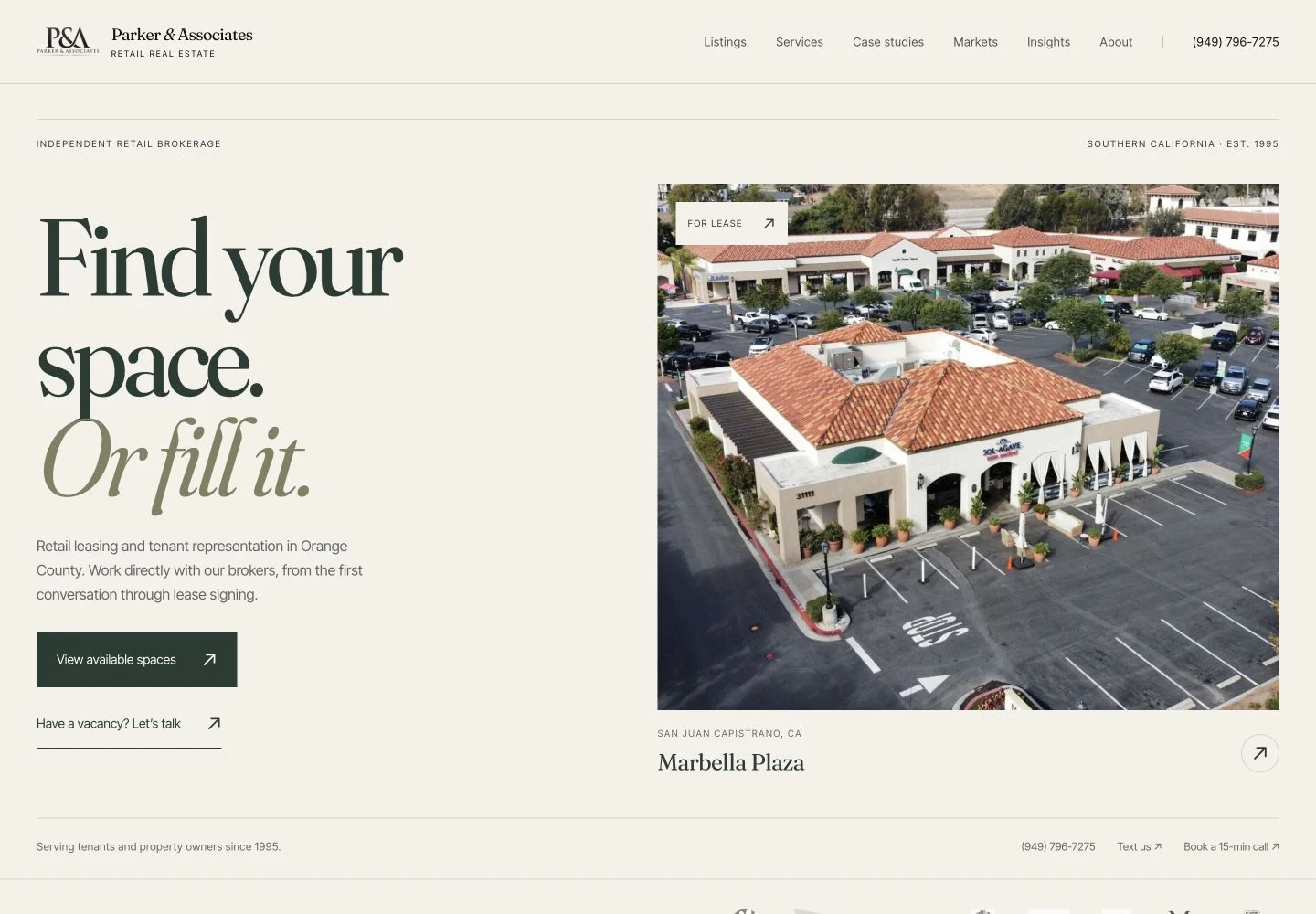
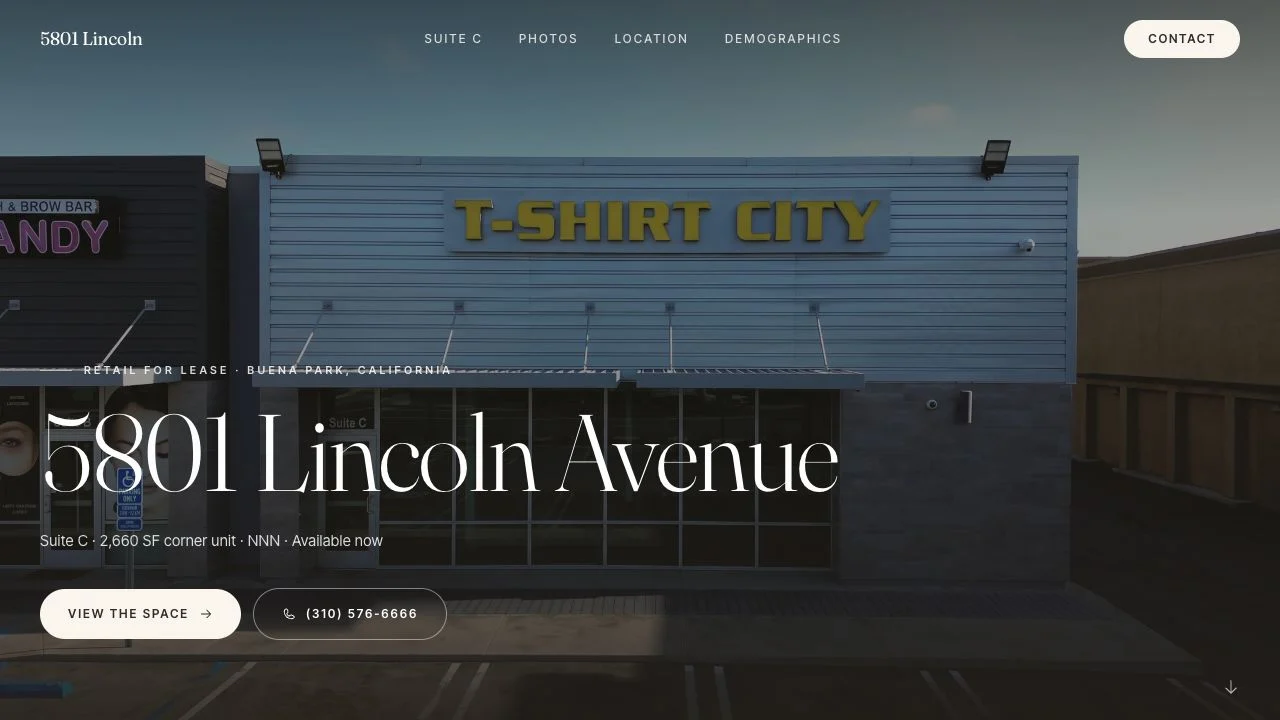
We build that link in both directions on the property sites we produce. At Marbella Plaza, a 66,124 square foot grocery-anchored center in San Juan Capistrano, the site carries the leasing contact as a named person with a direct line rather than a generic info address, because a tenant rep with a question at 7pm calls a person. At 5801 Lincoln, a 2,660 square foot corner suite in Buena Park, Ken Simon at KFS Properties is the sole listing contact, including on the seventh page of the flyer. We took that one from brief to live in three days, and the contact treatment was settled on day one, not bolted on at the end. The day-by-day account covers the rest of that build.
The habit worth stealing is simple. Every listing page names the broker and links to their bio. Every bio links to the listings and the closed assignments that broker can publish. An owner who lands on either end can walk the whole path in two clicks, and the path is the proof.
A pass you can run this week
Open your firm's team page and read each bio as if you were an owner with a vacant center and three firms to interview.
- Delete every sentence that would be true of any broker anywhere. Most bios lose their first paragraph entirely, and read better for it.
- Add one number and one place to the first two sentences.
- Confirm the DRE number is present, correct, and matches the public lookup.
- Check that the phone and email are text a phone can act on, not an image and not a contact form.
- Search each broker's name in a private window and see what outranks their bio.
- Fix the photographs last, because that is the item with a lead time, and start scheduling it now.
None of this requires a rebuild. It requires deciding that the page where owners judge your people deserves the same care as the page where they judge your buildings. If the whole site needs that attention, our services page explains how we scope the work, and choosing a CRE web design firm covers what to ask whoever you hire.
Work with Endcap Design
Brokerage website design
We design and build brokerage websites with property listings, team pages, company information, and inquiry forms.
Included
- A page for each listing with its size, rate, photos, plan, brochure, and broker contact
- Team pages and company information
- Inquiry forms, content migration, redirects, and launch checks
From $2,950 · Typically a few weeks, depending on content, migration, and approvals
We agree on the scope, timing, and price with you before work begins.
Get a quote for your brokerage websiteOr call or text (425) 233-0769
See the full service ↗Contact Endcap
START A
project.
A website, a brochure, or a complete set of materials.
We’ll agree on the scope, timing, and price before starting.
Start a conversation or call or text (425) 233-0769