Property websites
What belongs on a coming-soon page for a development.
A project that delivers in eighteen months starts leasing today. The coming-soon page is where that leasing happens before there is anything to walk. Most of them are a rendering, a logo, and a form, which wastes the one window when a tenant can still influence the plan.
The page is a leasing tool, not a placeholder
The pre-delivery period is when the decisions worth the most money get made. Anchor commitments, pad splits, drive-thru feasibility, whether suite 4 is 1,800 square feet or 3,600: all of it is still soft while the project is in entitlement or under construction, and all of it hardens the month the slab goes down. A tenant who finds the project during that window is worth more to the developer than the same tenant found after certificate of occupancy, because that tenant can still be designed for.
So the coming-soon page has one job: make a tenant rep who has never heard of the project understand it in ninety seconds and know exactly who to call. That is a different job from generating buzz. It rules out most of what usually goes on these pages.
Publish it before the renderings are final
The instinct is to wait. Wait for the architect's final elevations, wait for the anchor to sign, wait until there is something photogenic. That instinct costs you the most valuable months the page will ever have.
Two reasons. First, the facts exist long before the pictures do. Entitlement applications, site plans, and staff reports are public record at the city planning department, which means the program, the parking count, and the hearing schedule are all knowable and citable before anyone has rendered a single facade. Second, a brand-new URL has to be discovered, crawled, and indexed before it ranks for anything, and Google's Search Central documentation is clear that none of that is instant. A page published at entitlement has a year of runway. A page published at delivery is starting from zero on the day you most need it working.
Publish a plain, accurate page early, then improve it monthly. That is a better sequence than a perfect page six months late.
What actually belongs on it
- The location, unambiguously. Street address if there is one, cross streets if there is not, and a map. A surprising number of development pages describe a site as being "in the heart of" somewhere and never give a corner. Tenant reps work off intersections.
- The program in numbers. Total square footage, building count, the range of suite sizes, parking count and ratio, pad availability. If a suite can be demised or combined, say the range rather than a single figure.
- A site plan, even a schematic one. Label it. A gray massing diagram with suite numbers and dimensions is more useful than a beautiful rendering with no plan at all. Tenants think spatially, and the plan is the first thing a rep screenshots to send internally.
- Trade area numbers with sources and dates. Population and income by ring, traffic counts by street segment, the co-tenancy in the corridor. Every figure carries where it came from and what year it is from. We cover the method in our trade area guide.
- Approvals status, stated plainly. Entitled, in plan check, permitted, under construction. A rep reading "fully entitled, permits issued March 2026" is reading a different project than one reading "in design."
- A delivery window, dated. More on this below.
- Contact, on every screen. Name, direct line, email, license number. If the project is co-listed, both firms on equal billing everywhere either one appears.
- An inquiry form that asks the two useful questions. Use type and square footage requirement. Those two fields turn a raw lead into something the leasing broker can triage before returning the call.
- The flyer at a stable link. Hosted on the site, same URL every time, so the PDF can be updated without re-emailing anyone who already has it.
The date question
Delivery schedules move. Everyone in the industry knows this, and nobody holds a slipped date against a developer who said so. What people hold against you is finding out late.
State the schedule as a window rather than a day, attribute it, and date it: "Delivery targeted Q3 2027, per developer, as of August 2026." Then actually revise it when it changes. There is a compliance dimension here too, not just a courtesy one. In California, Business and Professions Code section 10140 makes it unlawful for a licensee to knowingly publish false or misleading statements about property they are marketing, and a delivery date you know to be dead is exactly the kind of statement that provision exists for. The same discipline applies to renderings: label them as artist's renderings, and do not show a signed anchor's logo on a building until the lease is signed.
A tenant rep will forgive a schedule that moved. They will not forgive learning from someone else that it moved six months ago.
Build it as version one of the permanent site
The most common structural mistake is treating the teaser as disposable. A temporary domain, a template splash page, a form that dumps into a spreadsheet, all of it deleted the week the project opens and replaced with something new at a different address.
Build the coming-soon page on the domain and the URL the finished property will use, in the design system the finished property will use. When delivery comes, you are not launching a site, you are updating one: renderings swap for photography, the schematic plan swaps for the as-built, "delivering Q3" swaps for live availability, and the page keeps every inbound link, every bookmark, and whatever search authority it accumulated during construction. The redirect discipline for when a URL genuinely has to move is covered in our piece on rebranding without losing search traffic, and the broader mechanics are in the CRE SEO guide. The cheapest redirect is the one you never needed.
This is also the argument against a splash page with a logo and an email capture. Google's Search Essentials treat pages with no substantive content as low value, so the splash never ranks. More to the point, a tenant rep who clicks a leasing sign and lands on nothing does not click a second time. If you are putting the URL on signage, put something behind it. We wrote about sizing and destinations for those codes in leasing signs and QR codes that actually get scanned.
How we build them
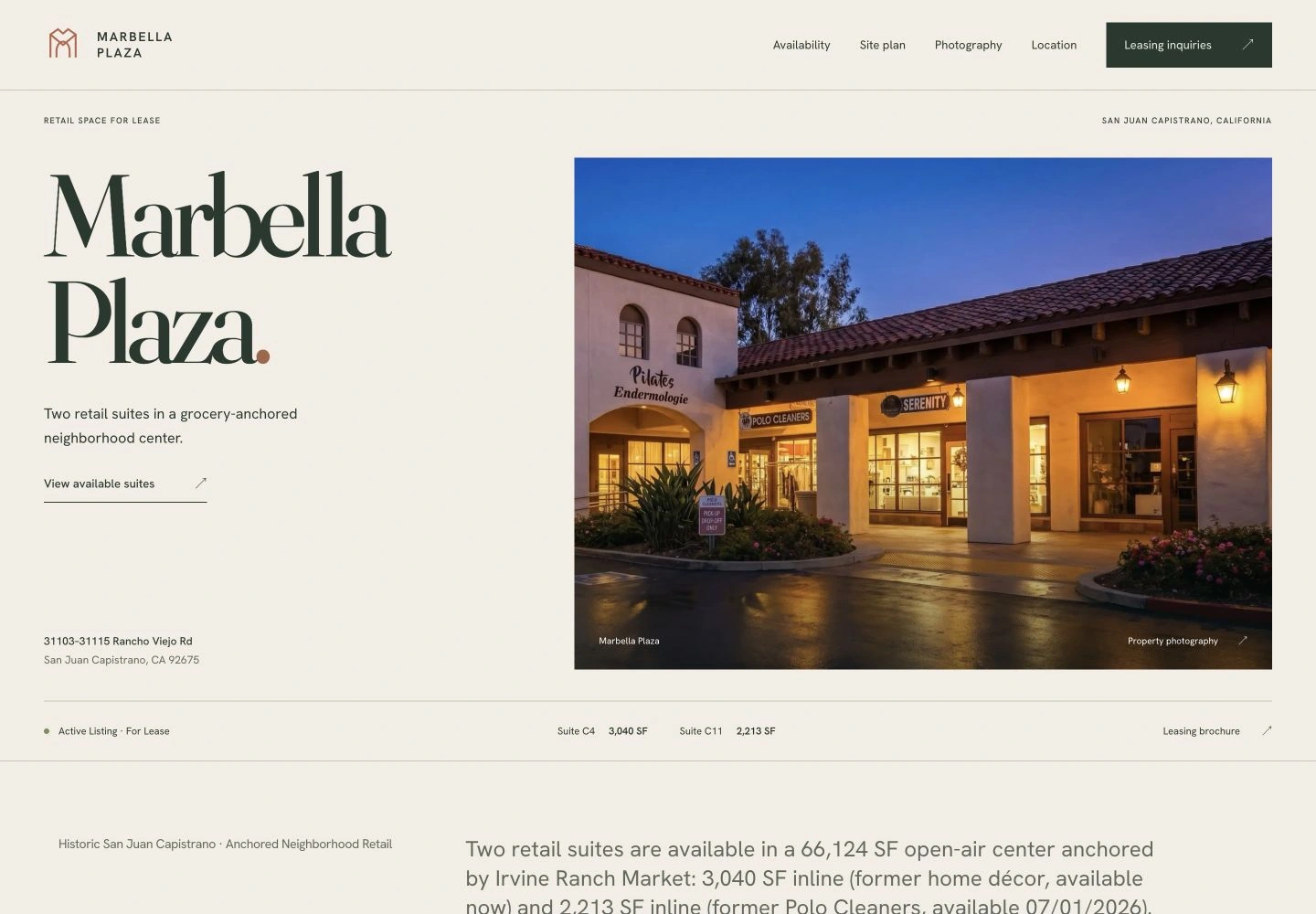
The architecture a coming-soon page needs is the architecture a finished center site needs, with fewer photographs on day one. Marbella Plaza, a 66,124 SF grocery-anchored center in San Juan Capistrano, is built exactly this way: availability by suite, an interactive plan, sourced trade area data, and inquiry routing that carries the suite the prospect asked about. Take the photography out of that structure and you have a credible pre-leasing site. Put it back in eighteen months later and nothing else has to change.
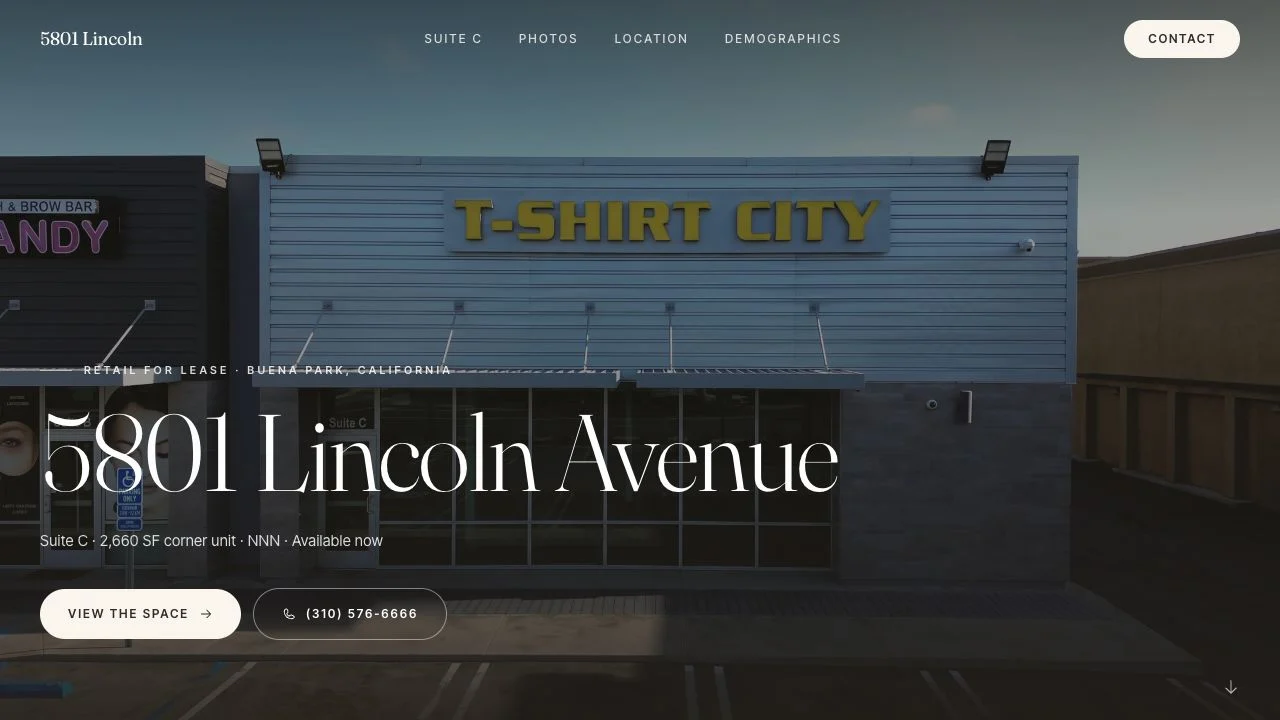
Research is what makes a page credible when there is no building to shoot. On 5801 Lincoln, a 2,660 SF corner suite in Buena Park, the traffic counts came from the City of Buena Park's 2025 GIS traffic layer: 21,149 vehicles per day on Lincoln Ave at the site, 41,574 on Valley View at the corner. Ring demographics were computed from census tracts rather than copied off a portal. That work is available to a development site months before the renderings are, and it is the part a tenant rep can verify.
Speed matters too, since these pages get opened from a phone in a car more often than from a desk. What actually slows a media-heavy property page is covered in our page speed piece.
That Lincoln listing went from brief to live in three days, including a seven-page flyer. We mention the timeline for one reason: "the renderings are not ready" is not a reason to have no page. Production is not the bottleneck people think it is. If you want to see how we scope this kind of work, our services page lays it out, and every project is quoted as one flat number before work starts.
What to leave off
Countdown timers, which age badly the moment the schedule moves. Renderings with no scale reference and no label. Gated PDFs, which cost you more inquiries than the email addresses are worth. Autoplaying flythrough video ahead of the site plan. A "register your interest" form that nobody has assigned themselves to answer, which is worse than no form, because it converts an interested rep into someone who now believes the project is not being run seriously.
One more: do not let the page go stale. A development site that still says "breaking ground spring 2026" in August 2026 tells every visitor the same thing about how the rest of the project is being managed. Put a review on the calendar for the first of each month. It takes ten minutes and it is the difference between a page that earns trust for two years and one that quietly loses it. If you are also running an announcement list alongside the page, the email piece covers cadence.
Start a project
Have a project that starts leasing before it opens?
Work with Endcap Design
Property websites
We build a website for one property: your photo gallery, property facts, plans, brochure download, and a broker inquiry form.
Included
- Your photo gallery, property facts, plans, and brochure download
- A broker inquiry form and a layout for desktop and mobile
- Many sites launch in about a week once the material is ready
“We own ten homes at Casa De Laguna and were still sending people to a site built in 2013. [Endcap] pulled the photos and details out of the old site, designed a logo from the rooflines and the pond, and put the community, the homes and current availability in one place. It’s the first time the website has looked like the place we actually rent.”
From $495 for a one-page property website using your approved content · Two revision rounds
We agree on the scope, timing, and price with you before work begins.
Get a quote for a property websiteOr call or text (425) 233-0769
See the full service ↗Contact Endcap
START A
project.
A website, a brochure, or a complete set of materials.
We’ll agree on the scope, timing, and price before starting.
Start a conversation or call or text (425) 233-0769