Insights
The best commercial real estate website designs, and what they get right
This guide looks at commercial real estate websites from national firms, regional brokerages and individual properties, and at the specific features that make them useful. We reviewed each site on September 22, 2026. Sites change often, so treat the details as a snapshot. If you are looking for sites that list commercial property for lease or sale, such as LoopNet and Crexi, see our guide to commercial real estate listing sites.
What we looked for
A brokerage website has two audiences. Owners and landlords use it to decide whether to hire the firm, and tenants, buyers and cooperating brokers use it to find a property and the broker responsible for it. We judged each site on how well it served both:
- Listings on the firm’s own pages, with a stable address for each property, the facts people filter on, and the brochure or offering memorandum available.
- Broker profiles that show relevant experience and give a direct way to reach the broker.
- Evidence of the firm’s work, such as case studies, closed transactions or market research.
- A clear path from a listing or profile to a conversation.
National firms
Kidder Mathews
kidder.com runs its own map-and-list property search, which can be searched by location, property name or broker and filtered by property type, class, price, cap rate, lease rate and size. Listing pages combine a gallery, lease terms, building details, other available suites, a brochure download and broker cards with phone, email and license number. Broker profiles are unusually complete, with transaction history, named clients, memberships and a downloadable bio.
Marcus & Millichap
marcusmillichap.com is built around investment sales. Each listing has its own readable address and an offering memorandum and deal room button. Advisor profiles are a good model: direct contact details, then the advisor’s featured listings, featured closings and related research on the same page, so an owner sees current work and track record together.
JLL
JLL keeps listings on a separate site, property.jll.com, with landing pages by city and property type, such as office space for rent in Los Angeles. Listing pages include a suite-by-suite availability table, brochures, a call button and the names of the brokers on the assignment.
Colliers
Colliers’ property search gives each listing its own page with photos, documents and expert contacts, and links out to a property’s dedicated website where one exists. That link is a useful habit: the portal-style page and the property’s own site support each other.
CBRE
CBRE separates properties for lease and for sale, gives each office its own local property search, and provides broker profiles with license numbers, a downloadable contact card and a list of that broker’s properties.
Regional and specialist firms
Voit Real Estate Services
voitco.com, a Southern California firm with an office in Irvine, shows its track record in two ways: company-wide transaction totals on the homepage and a library of case studies written as challenge, solution and result, each naming the broker. Its broker directory can be filtered by office and specialty. Listings come from an embedded LoopLink search.
SRS Real Estate Partners
srsre.com organizes its listings by transaction type and asset type, and its listing addresses describe the property, including state, city and street address. Retail investment listings can be filtered by tenant and tenancy, and each listing links the offering memorandum directly. A newsroom of closed transactions supports the track record.
Hanley Investment Group
hanleyinvestmentgroup.com, a retail investment firm in Corona del Mar, puts featured listings with tenant, price and an offering memorandum link on the homepage, followed by the team and a feed of closed transactions. The team page includes the research and design staff as well as the brokers, which tells an owner who will produce the marketing.
Lee & Associates
lee-associates.com gives each of its many offices its own section and properties page, with a people finder by office and specialty. Listings come from an embedded Buildout inventory, which is a practical choice for a firm with many offices and one shared listing system.
Property and portfolio websites
Irvine Company Office
irvinecompanyoffice.com covers a large Orange County office portfolio. Searches can be run by market, submarket, size, team size and workplace type, and each property page shows availability by building, brochure downloads, photos and video, plus a separate path for current tenants.
One Vanderbilt
onevanderbilt.com structures its navigation around what is being leased, with separate pages for each group of floors and for furnished suites, and names the leasing contacts with direct phone and email.
Savannah Gateway Industrial Hub
savannahgatewayindustrialhub.com opens with the facts an industrial tenant screens on, including the park’s size, rail service and distances to the port and major employers. Each available building has its own page, and the site includes a master plan, current tenants and a marketing library.
Our own work
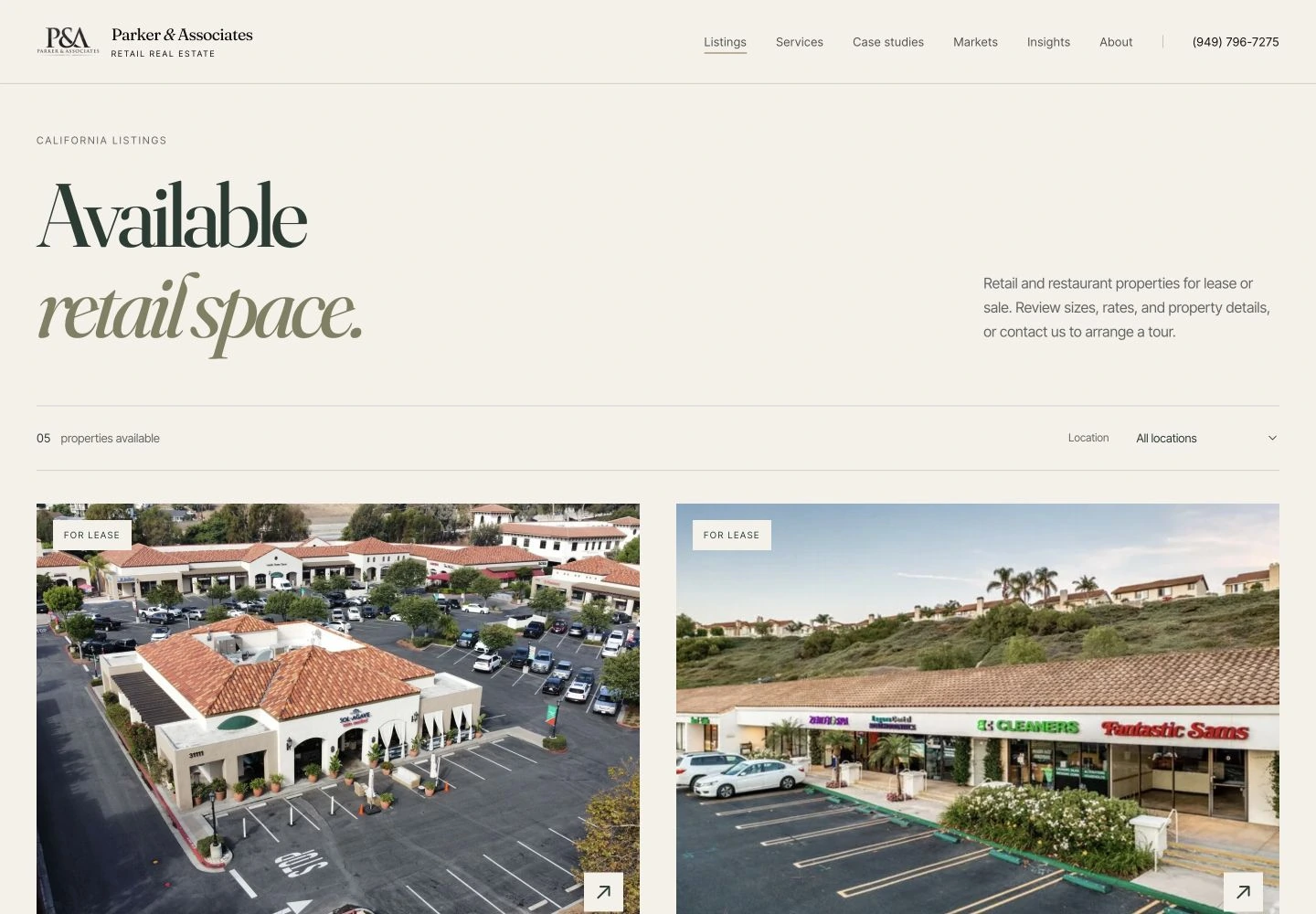
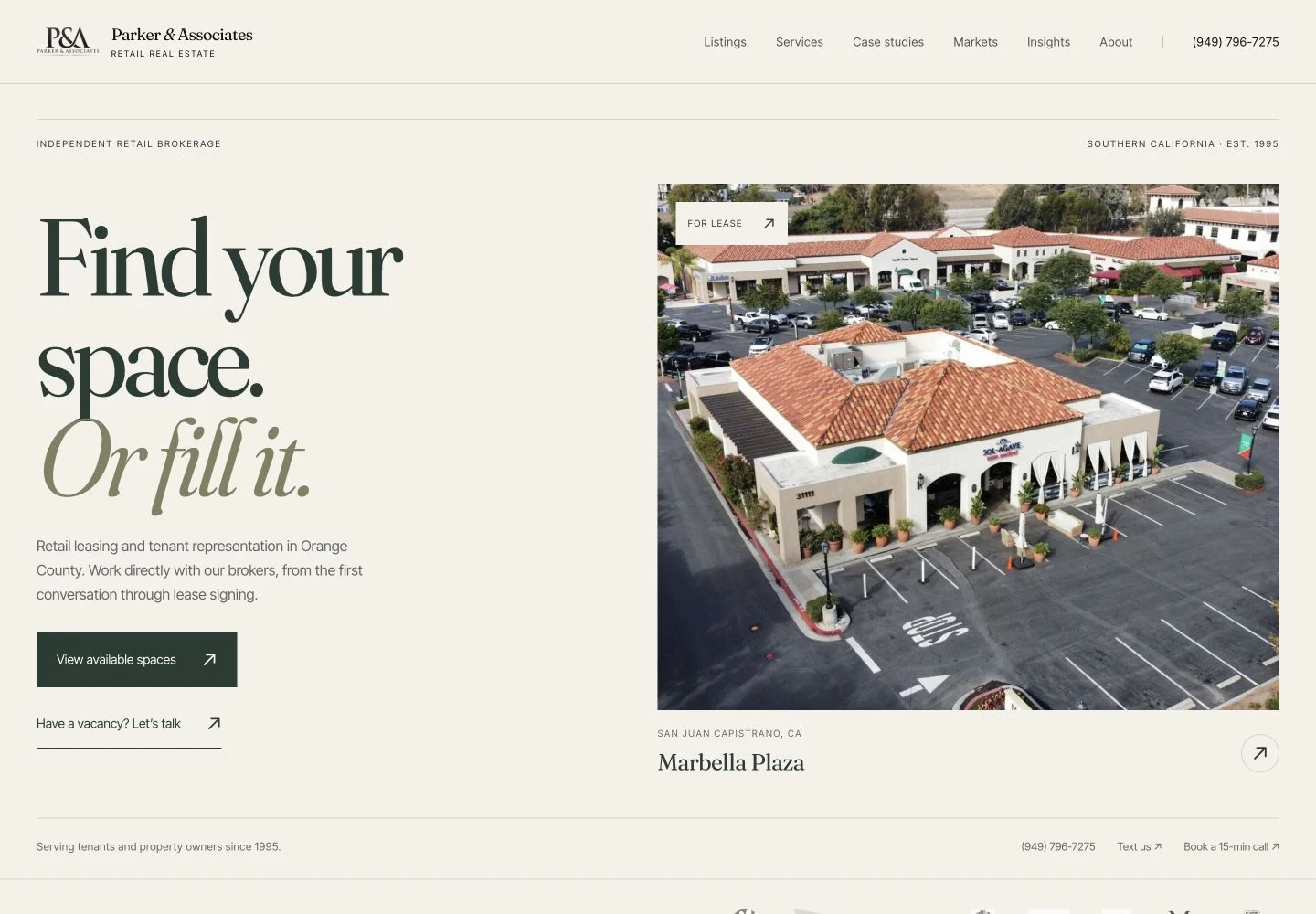
We design and build these websites, so we are not a neutral judge of our own projects. For Parker & Associates, Inc., a retail brokerage, the website brings the firm, its brokers, its listings and its case studies together. For Marbella Plaza in San Juan Capistrano, the property website and leasing brochure were designed together, and our guide to single-property websites explains when a listing needs one.
What the strongest sites have in common
- Every listing has its own page. Listings with a stable, readable address can be shared, indexed by search engines and read by AI assistants. Public PDFs can be indexed too, while embedded listings depend on how they are implemented. An accessible property page gives you direct control over the facts, links, and inquiry path.
- The documents are one click away. The brochure or offering memorandum is attached to the listing, or a confidentiality agreement leads straight to it.
- A named broker is on every listing. Direct phone and email, a license number and a link to the broker’s profile.
- Profiles show work, not adjectives. The most useful profiles list current listings, closed transactions and relevant clients.
- Track record is specific. Case studies with a property, a problem and a result, or a feed of closed transactions.
- Old listings are handled. Leased or sold listings are redirected, archived or marked as closed. Several sites we reviewed still had listing pages in Google that returned an error or a blank page, which wastes the visit.
Templates and platforms
Many brokerage sites are built from the same real estate themes and site builders, which is why so many look alike. A template is a reasonable way to launch quickly and cheaply. It is less suited to a firm that wants its website to show what makes it different, and themes loaded with plugins are often slow on mobile. Our guide to CRE website templates covers the trade-offs, and what a commercial real estate website costs covers the budget.
More examples
For a wider range of designs, inMotion Real Estate Media keeps a list of commercial real estate web designs, and Siteinspire has a property and real estate category. Both are useful for visual references.
Work with Endcap Design
Brokerage website design
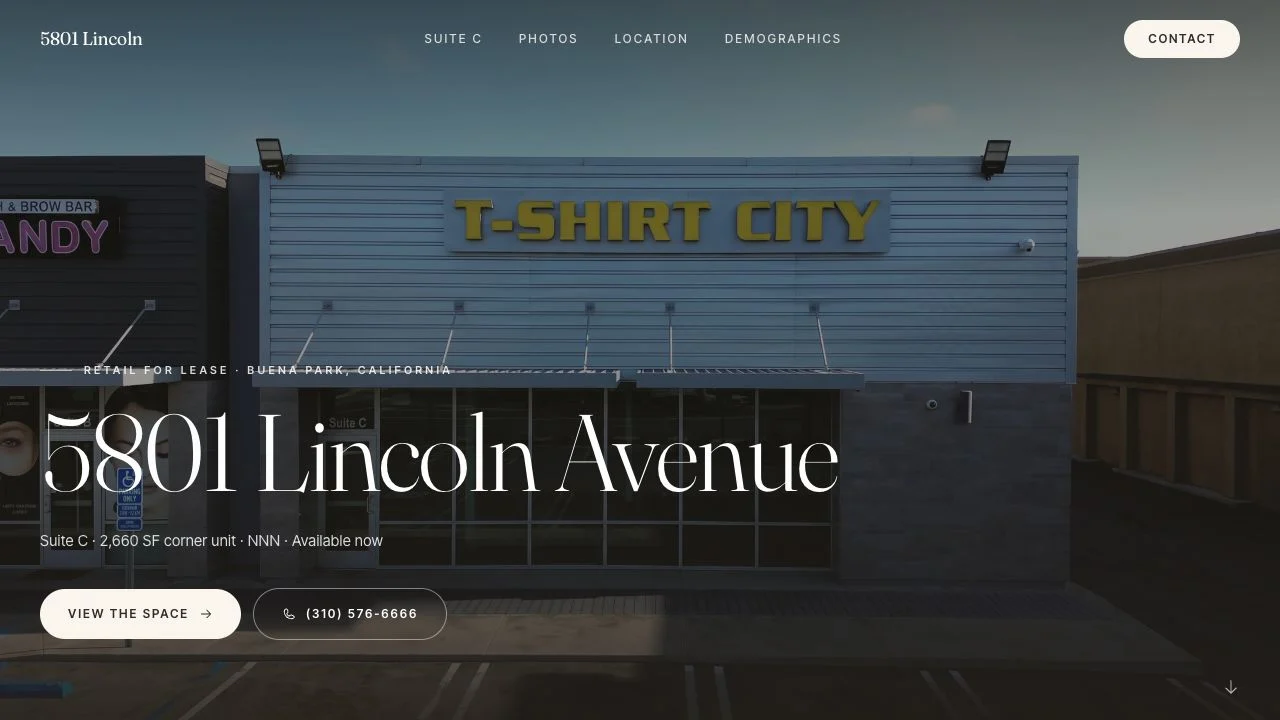
We design and build brokerage websites with property listings, team pages, company information, and inquiry forms.
Included
- A page for each listing with its size, rate, photos, plan, brochure, and broker contact
- Team pages and company information
- Inquiry forms, content migration, redirects, and launch checks
Typically a few weeks, depending on content, migration, and approvals
We reply within an hour during business hours, and we only use your details to answer you.
Get a quote for your brokerage websiteOr email Noah at hello@endcap.design
See the full service ↗Contact Endcap
LET’S
talk.
A website, a brand, or a complete set of materials.
We reply within an hour during business hours, and we only use your details to answer you.
Let’s talk or email Noah at hello@endcap.design