Marketing
Marketing land and pad sites: selling what could be built.
Every other asset class hands you something to photograph. Land hands you dirt, a fence, and a legal description. The buyer is not purchasing the dirt, they are purchasing permission and time, and the marketing has to sell those. Here is what belongs on a land page, in the order a developer reads it.
The buyer is underwriting risk, not square footage
A tenant leasing a suite asks what it is. A developer buying a parcel asks what it can become, how long that will take, and what could stop it. Those three questions are the entire deal. A land listing that leads with acreage and price per square foot has answered none of them, which is why so many parcels sit while the broker fields the same five phone calls every week.
The questions behind the questions are specific. What does the zoning permit by right, and what requires a conditional use permit or a variance. Does the general plan designation match the zoning, or is there a plan amendment buried in the path. Is the parcel one legal lot or three, and does the deal require a lot line adjustment. Where does sewer stop, and who pays to bring it. Is there an existing curb cut, and will the city or Caltrans let you keep it. Every one of those has an answer somewhere in a file, and the listing that publishes the answers gets the calls from buyers who have already done math instead of buyers who are starting from zero.
The facts that belong above the fold
We build the top of a land page as a fact block, not a paragraph. A developer scanning six sites on a Tuesday morning is eliminating, not falling in love. Give them what they eliminate on:
- APN and legal parcel count. The assessor parcel number lets a buyer pull the county record in thirty seconds. Say plainly whether it is one legal lot or several, because under California's Subdivision Map Act a split into four or fewer parcels takes a parcel map and five or more takes a tract map (Government Code section 66426), and that distinction changes a schedule by months.
- Gross and net acreage, stated separately. Gross to the centerline, net after dedications and setbacks. If you only publish gross, the first sharp buyer who runs a yield study will assume you were hiding the difference.
- Zoning and general plan designation, both. Name the code section. If they conflict, say so and say what the fix is.
- Utilities, by name and distance. Which purveyor, where the line stops, what size it is. "Utilities to site" is a phrase buyers have learned to distrust.
- Access and frontage. Linear feet on each street, existing curb cuts, signalized corner or not, and whether the frontage road is city or state controlled.
- Flood, fault, and fire. The FEMA Flood Map Service Center gives a flood zone in a minute, and California publishes Alquist-Priolo fault zone and fire hazard severity maps. Publish the answers before a buyer finds them and wonders what else you left out.
None of this is exotic. It is the diligence a serious buyer will do in week one anyway. Doing it first is a marketing decision: it moves the qualifying conversation from the phone call to the page, and it filters out the tire kickers without a broker having to be rude to anyone.
Sale, ground lease, or build to suit, on one page
Land is often marketed three ways at once, and the page has to hold all three without turning into a maze. An owner who will sell outright, ground lease to a user, or build to suit and lease back is offering three different products to three different buyers with three different underwriting models. The clean structure is one page with a clearly labeled section for each structure, each carrying the one number that matters to that audience: price for the sale, rent and term for the ground lease, and delivery timing for the build to suit.
What we avoid is the hedge. A page that says "sale or lease, terms negotiable" and stops has pushed the work back onto the reader. If the ground lease is genuinely open ended, say what the owner is looking for: term length, rent structure, who takes entitlement risk. Naming a starting position costs nothing and saves a month of positioning calls.
Land does not photograph. It has to be drawn, measured, and explained, which means the marketing is the product in a way it never is for a building.
The site plan concept, and how far to take it
A conceptual site plan is the single most useful asset a land listing can carry, and the single easiest one to overdo. Its job is to prove the parcel works: that a building of a plausible size, the parking it requires, the drive aisles, and the trash enclosure all fit inside the setbacks with room for landscaping. That is a yield test, and a buyer will trust it if you show your work.
It becomes a liability when it starts to look like an approved plan. Label it conceptual, state the assumptions on the drawing itself, and cite the parking ratio you used and where it came from in the code. We treat this the way we treat retouched photography, which is disclosed on the listing every time we do it, for the same reason: the credibility of every other number on the page depends on the reader believing the one they can check. Our approach to that is covered in more depth in virtual staging for commercial space, done honestly.
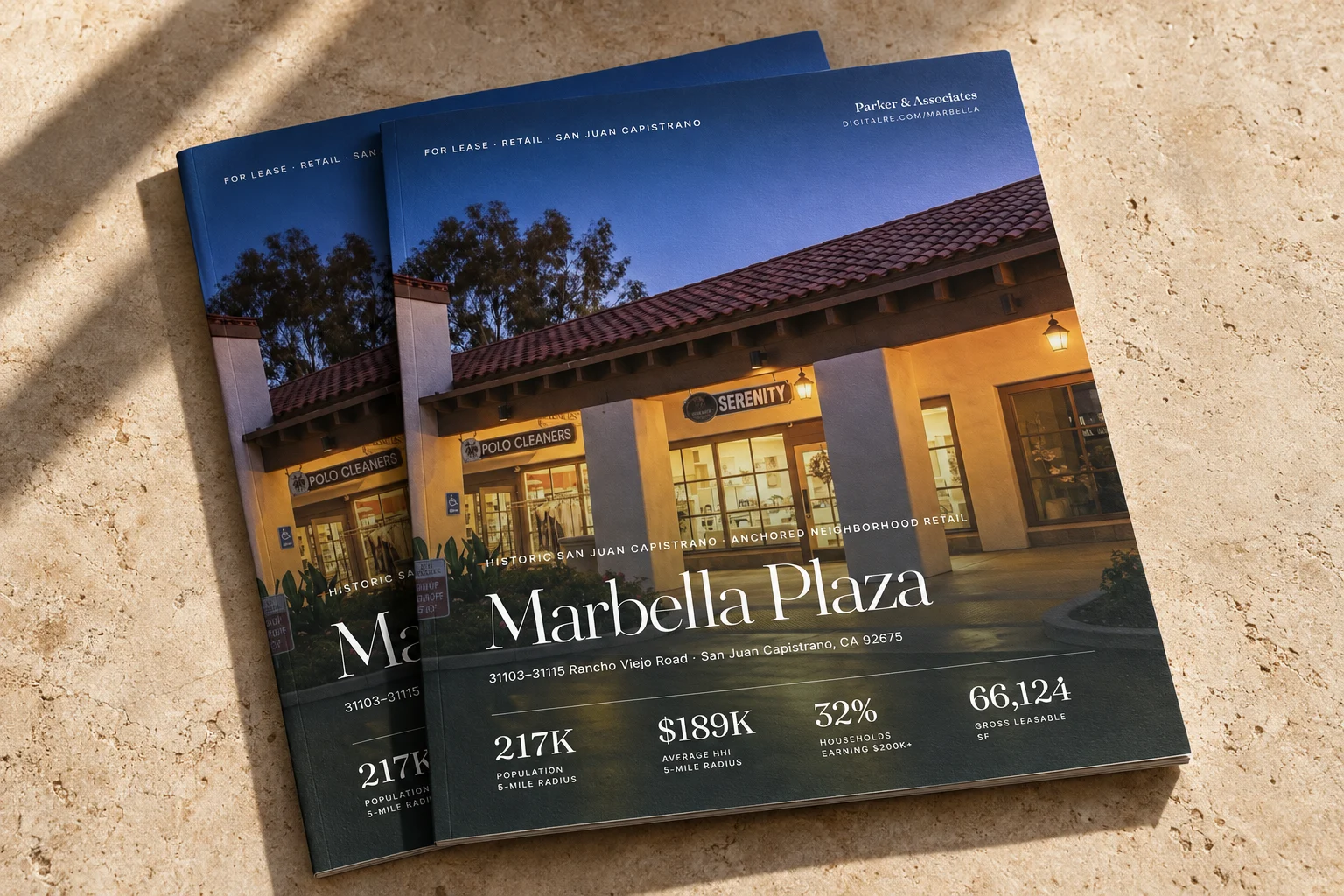
For a pad site inside an existing center, the concept plan has a second job: showing the relationship to what is already there. Where the pad sits relative to the anchor, how the shared drive aisle works, which parking field is common area, and what the reciprocal easement agreement allows. We built an interactive site plan into the Marbella Plaza case study site, a 66,124 square foot grocery-anchored center in San Juan Capistrano, precisely because tenants and buyers think spatially. A pad buyer reads that plan the same way, just with a different question in mind.
Traffic and trade area are the proof
For retail and quick service pads, the trade area is not context, it is the underwriting. A drive-thru operator has a sales model that takes traffic counts, daytime population, household income, and competitive locations as inputs, and the site either clears the threshold or it does not. Publishing those numbers with their sources is the fastest way to get onto the short list.
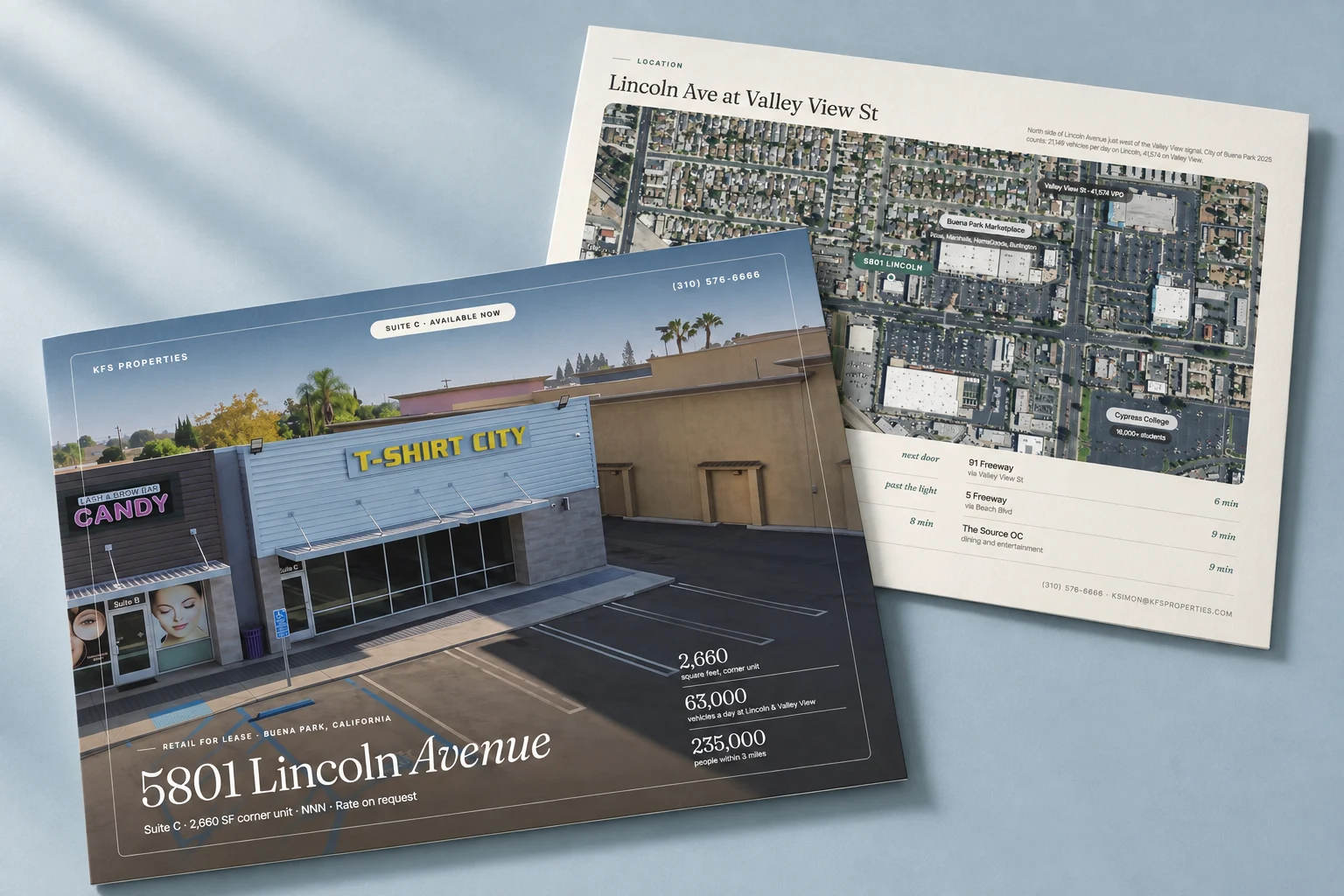
Pull them from primary sources and date them. Caltrans publishes annual average daily traffic counts through its Traffic Census program for state routes, and most cities publish their own counts by street segment. When we marketed a corner suite at 5801 Lincoln Ave in Buena Park, we used the city's published GIS traffic layer: 21,149 vehicles a day on Lincoln at the site and 41,574 on Valley View at the corner, both 2025 counts, both labeled with the source on the page. Demographics were computed from census tracts and area weighted to true one, three, and five mile rings rather than copied from a portal, which put roughly 235,000 people and an average household income near $133,000 inside the three mile ring. That listing went from brief to live site and a seven page flyer in three days, and the Lincoln case study shows the whole timeline. The method scales up to a fifteen acre parcel without changing. More on how we build those numbers is in our guide to trade area analysis.
What is public and what is gated
Land deals carry a diligence set that grows through escrow: title report and exceptions, ALTA survey, geotechnical report, Phase I environmental site assessment, existing entitlements, correspondence with the city. Almost none of that belongs in public view, and all of it should be one request away.
Publish the summary, gate the documents. State that a Phase I exists and give its date, because under the EPA's All Appropriate Inquiries rule at 40 CFR part 312 a Phase I is presumptively valid for 180 days before parts of it need updating, and a buyer needs to know whether they are inheriting a fresh report or paying for a new one. State that an ALTA survey exists and who ordered it. State whether the seller has had a pre-application meeting with planning and roughly what came out of it. Then put a request form behind a single button. The pattern is the same one that works for a disposition, which we wrote up in the disposition package.
The page has to survive the entitlement period
A retail suite leases and the page comes down. A land listing lives for a year or more, and its value compounds if it is maintained. Under California's Permit Streamlining Act, an agency generally has 180 days after certifying an environmental impact report to approve or deny a development project, and 60 days when the project is exempt from CEQA (Government Code section 65950). Those clocks are public, and the site that reports progress against them keeps buyers who would otherwise drift.
Practically, that means a short, dated update log on the page: application submitted, comments received, hearing scheduled, conditions of approval issued. Each entry is two sentences. Brokers who do this find that the update itself becomes the reason to send an email, which is a better reason than a price reduction. When entitlements land, the same site converts into a pre-leasing page for the project, and the work already done carries over. That transition is worth planning at the start, and what belongs on a coming-soon page covers the version that follows.
The thread through all of it is that land marketing rewards specificity more than any other asset class, because there is nothing else to look at. Publish the facts, cite where they came from, draw the plan honestly, and keep the page alive while the deal takes its year. That is most of the job. If you want help building it, see how we scope projects.
Start a project
Have a parcel that needs to be explained, not just listed?
Work with Endcap Design
Listing marketing for a vacant space
We produce the photography, flyer, and website for a space, built around the material you already have.
Included
- Photography of the space and the storefront
- A lease flyer or brochure with the suite size, plan, and leasing contact
- A property website when the listing needs one
“The Flyer is all that I need and it is outstanding.”
Photography from $325 · Lease flyers from $175 · Property websites from $495
We agree on the scope, timing, and price with you before work begins.
Get a quote for your listingOr call or text (425) 233-0769
See the full service ↗Contact Endcap
START A
project.
A website, a brochure, or a complete set of materials.
We’ll agree on the scope, timing, and price before starting.
Start a conversation or call or text (425) 233-0769