Marketing
Commercial real estate direct mail, and when it still works.
Mail is slow, it costs real money per piece, and it cannot be tested and revised by lunchtime. It also reaches the owner of the multi-tenant building on the corner, who has held it since 1994, has no website, and will never open a marketing email. That gap is the whole case for direct mail in this business. Here is where it earns its cost, how to build the list, and what belongs on the piece.
The three jobs mail actually does
Mail is not a general-purpose channel. It does a small number of things better than anything else, and it is a waste of postage everywhere else.
- Owner outreach. This is the strongest case. Owner mailing addresses are public record: every county assessor maintains a parcel roll with the address where the tax bill goes, and in California the Orange County Assessor and its counterparts publish that data. Owner email addresses are not public anywhere. If you want to reach the person who controls a parcel, mail is often the only address you can get honestly.
- Tenant prospecting for one specific vacancy. A named list of regional operators, franchisees, and local businesses you actually want in the space. A piece addressed to a franchise development office gets opened by someone whose job is reviewing sites. A cold email to the same office competes with fifty others.
- Neighborhood announcements. A center finishing a renovation, a new anchor opening, a project breaking ground. The audience is residents and nearby businesses, and the goal is awareness rather than a reply.
Where mail loses is tenant reps at national firms. They work out of email, portals, and their own databases, and a printed piece to a downtown office tower is a piece of paper handed to an assistant. Reach them the way they already work, which we covered in our note on email that gets opened.
Two lists, built two different ways
The owner list is built from parcels, not from names. Draw the geography first: a corridor, a submarket, a two-mile ring around a center you already represent. Pull the assessor's parcel data for that area, filter by use code and building size so you are looking at the asset class you actually service, then dedupe by mailing address. One owner frequently holds four parcels under four entity names, and mailing them four identical letters is worse than mailing none.
Two details save the whole exercise. Entity names are not people: a piece addressed to a family trust or a numbered LLC lands in a bookkeeper's stack, so where the roll gives a care-of line, use it. And returned mail is information, not waste. Presorted mail has to meet the USPS Move Update standard set out in the Domestic Mail Manual, section 602.5, but even on a stamped sixty-piece drop, every return should be corrected in the list before the next round rather than mailed again.
The tenant list is built by hand and there is no shortcut worth taking. Drive the corridor. Note who is expanding, who signed in the last year, who has three locations and is looking for a fourth. Most franchisors publish a development page with the real contact for site submittals. Forty minutes of reading a trade area beats any list you can buy, and it produces something a purchased list never does: a reason to be writing to that specific operator about that specific space.
EDDM or an addressed drop
These are different products and they solve different problems. Every Door Direct Mail is the USPS program that lets you buy whole carrier routes without addressing anything. The rules are published in USPS Quick Service Guide 140: an EDDM Retail mailing runs from 200 pieces up to a maximum of 5,000 pieces per ZIP Code per day, the piece has to qualify as a flat rather than a letter, it has to stay under 3.3 ounces, and it does not require a bulk mail permit. Per-piece postage is posted on the USPS EDDM page and it changes, so price it the week you plan to mail rather than from a number someone quoted you last year.
The thing to understand about EDDM is that you cannot choose addresses. You buy a carrier route and everyone on it gets the piece. That makes it right for the third job above, a grand opening or a renovation announcement to the households around a center, and wrong for the first two. Nobody should buy 4,000 impressions to reach sixty owners.
For an owner or tenant list, use addressed First-Class mail with a real stamp. At sixty or a hundred pieces the postage is a rounding error against the value of a single listing, and the piece looks like correspondence instead of advertising, which is most of why it gets opened.
What goes on the piece
The most common mistake is mailing the flyer. A leasing flyer is a document someone reads after they are already interested; it earns its length. A mailer gets about three seconds at a sorting table next to a recycling bin. Different job, different object.
A mailer's job is not to explain the property. It is to get one person to type one URL.
So: one asset, one photograph, one number that matters, one link. The front carries the property shot properly and a single line saying what it is and where. The back carries three or four facts, the size, the use, the availability or the fact that you are asking about an off-market sale, plus your name, your license line, and the URL set large enough that someone can type it into a phone from across a desk.
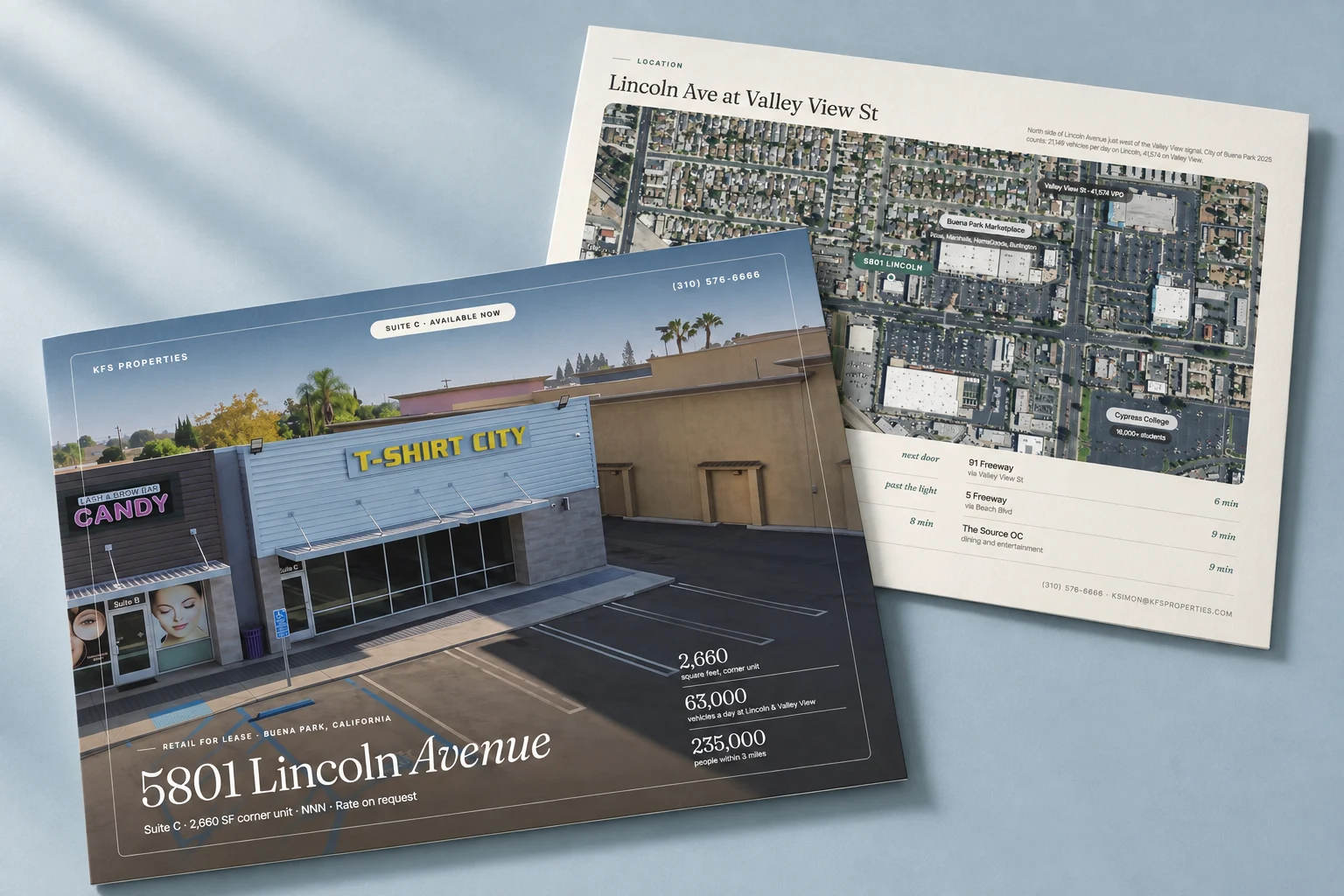
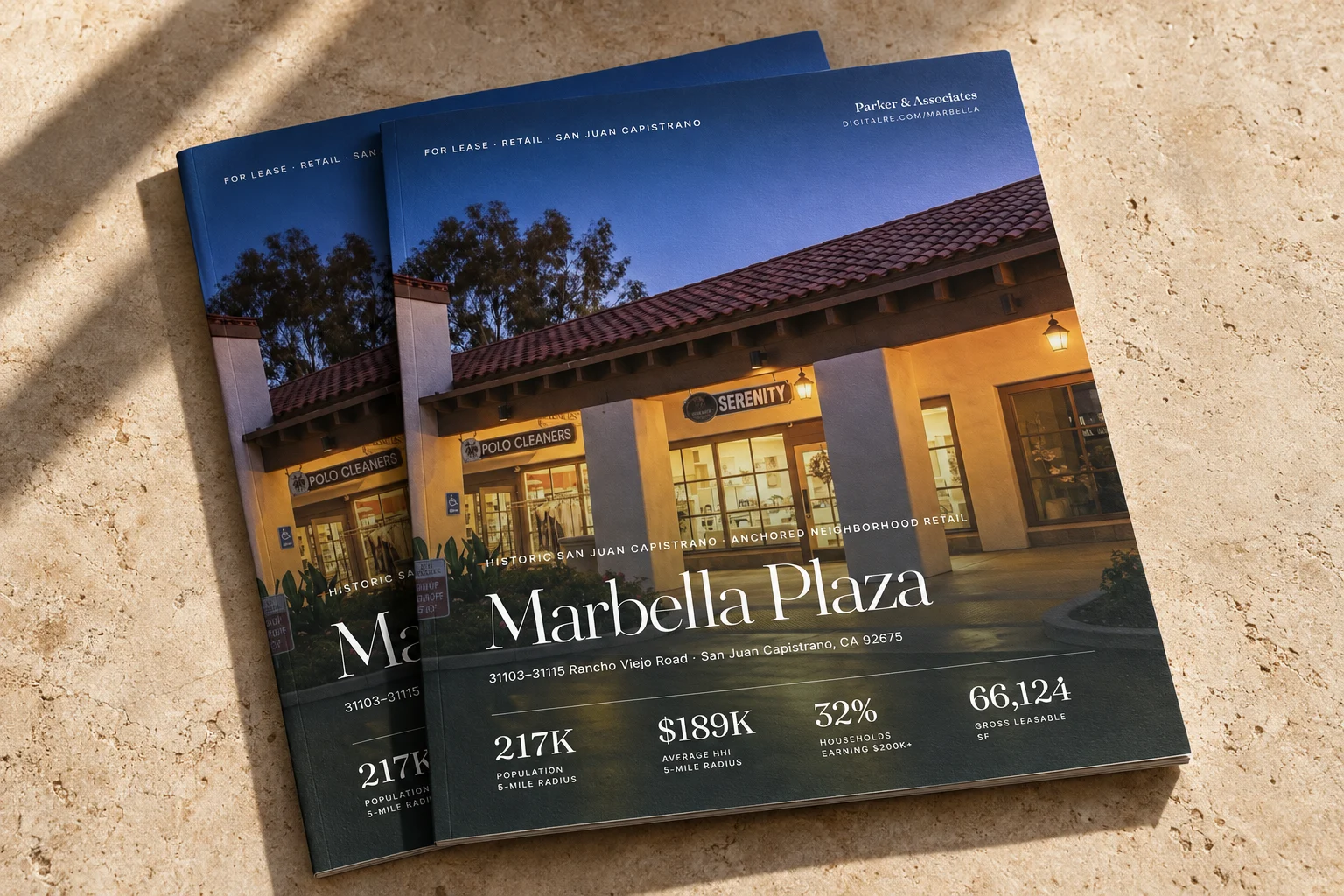
The economics improve when the piece is not a separate production. When we built the site for Marbella Plaza, a 66,124 SF grocery-anchored center in San Juan Capistrano, the same design system produced the site, the interactive site plan, and the print pieces, so everything a prospect touches reads as one campaign rather than three vendors' work. You can see how that was assembled in the Marbella case study. On the 5801 Lincoln listing in Buena Park, a 2,660 SF corner suite we took from brief to live in three days along with a seven-page flyer, a mailable piece would be a crop of assets that already exist: the cover photograph, the annotated aerial, the suite facts, the address of the site. That is the cheapest print there is, because the expensive part, deciding what the property's story is and producing the media, is already paid for. The build itself is documented in the Lincoln case study.
The link is the point, so make it measurable
Mail has no open rate. The only way to learn anything is to give the campaign its own address. Use a distinct short path, print it, and put a QR code next to it rather than instead of it. Expect real people to do both: some scan, and a meaningful share type the URL into a browser later that evening, which is why the printed version has to be short enough to remember. We wrote about what makes a printed code actually get used in leasing signs and QR codes that get scanned, and the same rules apply on paper that fits in a hand.
Then watch the right things in the week after the drop: sessions on that path, direct or typed traffic, and inquiries that arrive with no referrer. It will not be a clean number and you should not pretend otherwise. On a list this size the most reliable instrument is still asking the caller how they found you, and writing the answer down. For what an owner should expect to see reported, see website analytics for listings.
The line most mailers get wrong
In California, a licensee has to disclose their eight-digit license identification number and the responsible broker's name on solicitation materials intended to be the first point of contact with a consumer. The statute is Business and Professions Code section 10140.6, and the specifics, including what counts as solicitation material, are in the Commissioner's Regulation at title 10 of the California Code of Regulations, section 2773. A prospecting letter to a property owner is squarely a first point of contact.
Design it in rather than bolting it on. Set the license line in the same family as the rest of the piece, small, at the bottom, legible. It costs nothing and it signals the same thing the rest of the piece is trying to signal: this was done by someone who knows the rules of the business they are asking to do business in. If you are mailing outside California, confirm the equivalent disclosure before printing five hundred of anything.
Cadence, and how to judge it
One mailer is not a campaign, and six is a nuisance. Three touches over a quarter to a tight list will outperform a single large drop to a list you did not curate. Vary what each one carries: an introduction and a link, then a piece of proof such as a comp or a short read on that corridor, then a specific ask about a specific parcel. The third piece is the one that works, and it only works because the first two established that you are still going to be here next quarter.
Set the bar before you mail. On a sixty-owner list, a handful of conversations is a good quarter and a single listing pays for years of postage. On a tenant list for one vacancy, the honest measure is tours, not replies. And be clear-eyed about the ceiling: mail buys you attention for a few seconds and moves someone to a link. Everything after that is decided by what they find when they arrive, which is why we spend most of our time on the destination rather than the delivery. That work is described under our services.
Work with Endcap
Sending people somewhere? Make it somewhere worth landing.
Work with Endcap Design
Listing marketing for a vacant space
We produce the photography, flyer, and website for a space, built around the material you already have.
Included
- Photography of the space and the storefront
- A lease flyer or brochure with the suite size, plan, and leasing contact
- A property website when the listing needs one
“The Flyer is all that I need and it is outstanding.”
Photography, lease flyers, and property websites, quoted together or separately
We reply within an hour during business hours, and we only use your details to answer you.
Get a quote for your listingOr email Noah at hello@endcap.design
See the full service ↗Contact Endcap
LET’S
talk.
A website, a brand, or a complete set of materials.
We reply within an hour during business hours, and we only use your details to answer you.
Let’s talk or email Noah at hello@endcap.design