Marketing
Commercial real estate social media: posting like a broker, not a brand.
Most brokerage feeds are the same three posts on a loop: a Just Listed card, a Closed graphic with the address blurred out, and a holiday image nobody asked for. Social media will not lease your space. What it will do, cheaply, is put a link in front of the two hundred people whose opinion of your listing actually matters. That is worth doing well, and it takes about twenty minutes a week once the marketing already exists.
Two audiences that do not overlap
The first mistake is running one account at two completely different rooms. There is a deal audience: tenant reps, expanding operators, investors, lenders, appraisers, and the owners who might hire you next. And there is a consumer audience: the people who shop, eat, and park at your center. Those groups want opposite things. The deal audience wants square footage, restrictions, and a rate. The shopper wants to know that the new taco shop opened Saturday.
A brokerage account and a shopping center account are two different products with two different jobs. When a center's Instagram starts posting availability flyers, the followers who came for the coffee shop tune out, and the tenant reps were never there to begin with. Decide which room you are in before you write anything.
Where the deal audience actually is
For leasing and investment sales, LinkedIn is the channel that carries the people who sign things. LinkedIn's own About page reports more than a billion members, and more usefully, the Pew Research Center's Social Media Fact Sheet has consistently found LinkedIn reaching a much smaller share of U.S. adults than Facebook, Instagram, or YouTube. That gap is the entire point. You are not trying to reach adults. You are trying to reach the forty tenant reps who cover your corridor, and they keep their professional identity on one platform.
Instagram is a real channel for centers, mixed-use projects, and anything where the property has a public face. It is a weak channel for a 14,000 square foot industrial suite, and pretending otherwise wastes hours. Facebook still carries local community groups, which matter for a neighborhood center and almost nothing else. Video platforms are a distribution surface for property tours rather than a place to build an audience, which we get into in our note on video marketing for commercial properties.
The channel that never shows up in a dashboard is the group text. Deals travel through forwarded links: a broker sends a listing to a client, a client sends it to their partner. A large share of what a good post accomplishes happens off the platform entirely, in messages you will never see. That changes what you should optimize for. You are not writing for the feed. You are writing something a broker would be comfortable forwarding with the words "take a look at this."
What to post when a space hits the market
A Just Listed card with a rendering and a logo tells a reader nothing they cannot get from a portal. The posts that get forwarded contain one specific, checkable fact that makes the space interesting to somebody.
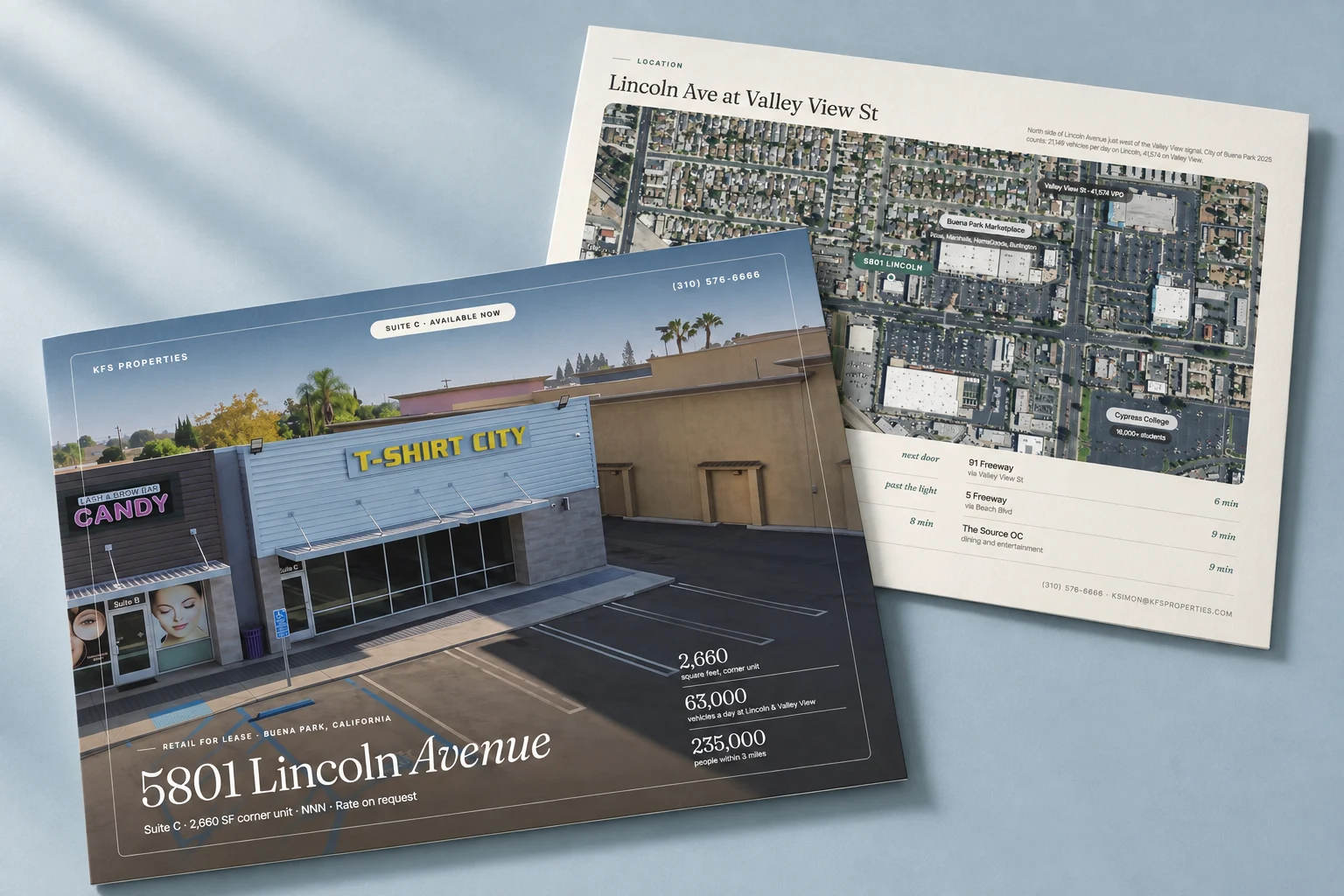
When we took Suite C at 5801 Lincoln Ave in Buena Park to market, a 2,660 square foot corner unit in a three-tenant strip, the interesting fact was not the square footage. It was the corner: the City of Buena Park's 2025 GIS traffic layer puts 21,149 vehicles a day on Lincoln Ave at the site and 41,574 on Valley View St at the intersection. That is a post. So is the 34-second property tour we cut from the owner's raw drone footage, and so is the floor plan with the frontage dimension called out. The full build is written up in how we built that listing site in three days.
Things worth posting, roughly in order of how often they get forwarded:
- A number with a source attached. Traffic counts, ring population, a co-tenant's opening date. Naming the source is what separates a post from a brochure.
- The constraint, stated plainly. No grease duct, 16-foot clear, exclusive prohibits quick-service Mexican. Publishing what a space cannot be saves you the four tours that were never going to work, and reps remember who told them early.
- A short tour, not a slideshow. Thirty seconds of moving footage that shows the frontage, the depth, and the parking field.
- Progress on something real. Demo started, the pylon sign went up, the roof is done. Construction posts do quiet work: they tell the market the ownership is spending money.
- A closed deal with an actual detail. Not "another one closed." What the tenant is, why the space fit, how long it took. Owners read those posts as a work sample.
The destination is the whole point
Here is where most CRE social effort leaks out. A social link should lead to current property information with a readable layout and a direct inquiry path. A PDF can be part of that page, with tracked download links if configured, but a downloaded copy will not update when availability changes. Check the experience on a phone before sharing it.
A post is a shipping label. The package still has to be a page worth landing on.
Point every post at a page you control. For a single asset, that is a dedicated listing site with current availability, the site plan, the trade area, and a form that routes to the listing broker; we make the case for when one is justified in single-property websites. On the Lincoln listing, the seven-page flyer lives at a stable link on the site itself, which means we can correct a number on Thursday without emailing three hundred people a new PDF. Same link, updated file. The Lincoln case study shows how the site and flyer were built from one design system so the post, the page, and the handout all read as one campaign.
A page you control also means the visit shows up in your own analytics rather than a portal's, which is the only way the next section works at all.
Center accounts have a different job
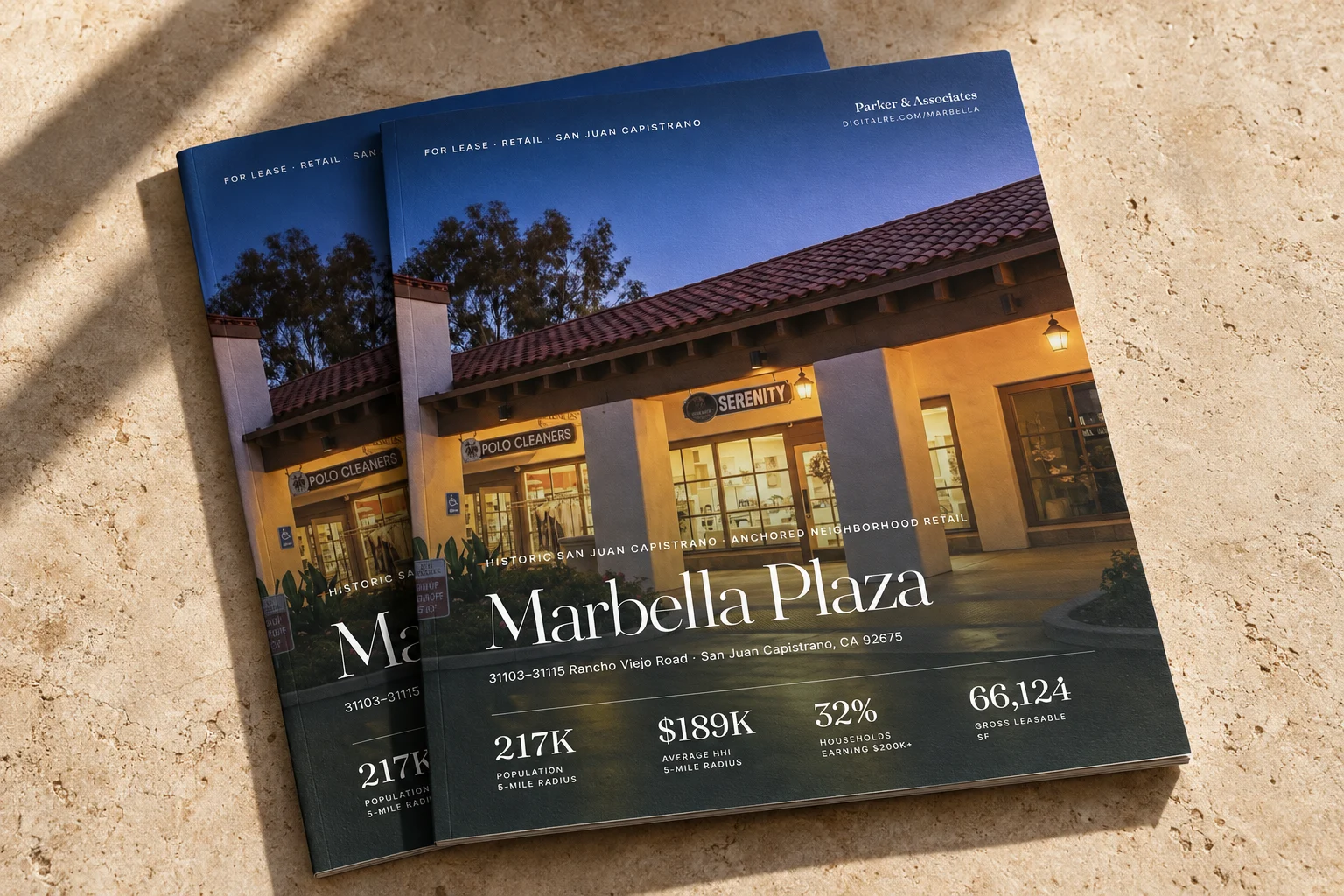
A shopping center's account is not a leasing tool, and it performs badly when you use it as one. Its job is foot traffic and tenant goodwill. Marbella Plaza, the 66,124 square foot grocery-anchored center we built a site for in San Juan Capistrano, has an audience of people who live within a few miles and shop there weekly. What they want is openings, hours, holiday schedules, and the new patio. You can see how the property side is organized in the Marbella case study.
That work pays back on the leasing side indirectly and slowly. Tenants notice a landlord who promotes them, and they remember it at renewal. Sales volumes hold up better at a center that stays visible. But the direct discovery work for a center is mostly not happening on social at all. It is happening in Google Maps, which is why we spend more time on Google Business Profile for shopping centers than on any center's Instagram calendar.
Measuring it without fooling yourself
Follower count is not a metric anyone should report to an owner. Two things are worth tracking: referral sessions arriving at the listing page from each channel, and inquiries that name the channel or arrive shortly after a post.
Tag your links. A UTM parameter on the URL in a post costs nothing and turns a vague "the site got traffic" into "eleven sessions from LinkedIn on Tuesday, four of which opened the flyer." Expect the picture to stay incomplete: forwarded links stripped of their tags land in your analytics as direct traffic, and there is no honest way to attribute them. We go through what an owner should reasonably ask to see in website analytics for listings.
The other test is the informal one, and it is more reliable than it sounds. Within a few weeks of posting consistently about a corridor, the right people start mentioning it to you. A rep says they saw the Buena Park suite. That is the signal. It does not fit in a report, and it is the thing you are actually buying.
A cadence you can keep
Two posts a week from a broker who is doing deals beats five a week from a scheduling tool. The way to make that sustainable is to stop treating social as its own project. Every listing that gets marketed properly produces a month of posts as a byproduct: the site launch, the tour video, three stills, the site plan, one demographic fact, the flyer, and eventually the closing. Batch them on the day the marketing is produced, while the files are open.
Post from the individual broker's account rather than the firm's when the two compete. Deals are done with people, and a named broker's post carries further than a logo's. The firm account can share it.
And accept the ceiling. Social media is a distribution channel for work that already exists, not a substitute for the work. If the underlying listing has three phone photos and no data, posting it more often just shows more people the same thin package. Fix the package first. That is what we build, and the posting part gets easy afterward.
Work with Endcap Design
Listing marketing for a vacant space
We produce the photography, flyer, and website for a space, built around the material you already have.
Included
- Photography of the space and the storefront
- A lease flyer or brochure with the suite size, plan, and leasing contact
- A property website when the listing needs one
“The Flyer is all that I need and it is outstanding.”
Photography, lease flyers, and property websites, quoted together or separately
We reply within an hour during business hours, and we only use your details to answer you.
Get a quote for your listingOr call or text Noah at (425) 233-0769
See the full service ↗Contact Endcap
START A
project.
A website, a brand, or a complete set of materials.
We reply within an hour during business hours, and we only use your details to answer you.
Start a conversation or call or text Noah at (425) 233-0769