Marketing
Marketing an office building for lease.
Retail is chosen by an operator and industrial is chosen by a logistics manager. Office is chosen by a committee: a tenant rep, a CFO, a head of people, and often a founder who will tour exactly one building. Most of that committee never walks the property. They form their opinion from a link somebody forwarded them, which means the link is doing more of the work in office than in any other asset class.
The market decides how much the page has to do
Office landlords are marketing into the loosest conditions on record. Moody's Analytics put the national office vacancy rate at roughly 21 percent in the first quarter of 2026, the highest reading in its series, and above where it stood at the start of the pandemic. A tenant with a 12,000 square foot requirement has options, tours are expensive in calendar time, and the shortlist gets cut on paper long before anyone books one.
The demand that exists is also uneven. Kastle Systems, which measures badge swipes across the buildings it secures, reported average weekly occupancy of 56.3 percent of its February 2020 baseline in the week of December 8, 2025, with its A+ class buildings back to 78.8 percent. Whatever you make of badge data as a proxy, the spread is the story. The marketing job is to prove which category your building sits in, with evidence rather than adjectives.
What the tenant's team filters on
Every one of these is a number, and every one of them gets asked in the first email if it is not on the page:
- Rentable and usable area, with the load factor stated. Publish both figures and say which measurement standard produced them. The ANSI/BOMA Z65.1 office standard, published by the Building Owners and Managers Association, is the common reference. A tenant comparing a 15 percent load factor to a 22 percent one is comparing real money, and hiding the difference is a conversation you lose later rather than never.
- Parking, as a ratio and as a cost. Stalls per 1,000 rentable square feet, reserved versus unreserved, the monthly charge per stall, and whether visitor parking is validated. In suburban Southern California the ratio decides deals for tenants bringing staff back three days a week.
- Delivery condition, stated plainly. As-is, warm shell, built-out spec suite, or a turnkey build to a stated allowance. If there is a tenant improvement allowance, publish it or say it is negotiable. Do not photograph a finished suite and quietly market a shell.
- Term the owner will actually do. Office tenants under 5,000 square feet are shopping flexibility as hard as they are shopping rent. If ownership will sign three years, that is a selling point worth its own line.
- Building systems and hours. HVAC zones and the after-hours HVAC charge, backup power, riser and carrier access, and the actual security hours.
- Contiguity. How much space can be combined, on which floors, and what it would take. A growing tenant is underwriting its next five years, not this suite.
Rate can stay on request when ownership prefers it. The rest of this list is not a negotiating position, it is a set of facts, and withholding facts reads as a building with something to hide.
Availability, floor by floor, kept current
A multi-tenant office building has the same problem a shopping center has, rotated ninety degrees. The center publishes a site plan with every suite labeled; the office building publishes a stacking plan. Both fail the same way: the graphic is produced once at listing and then drifts while the rent roll moves underneath it.
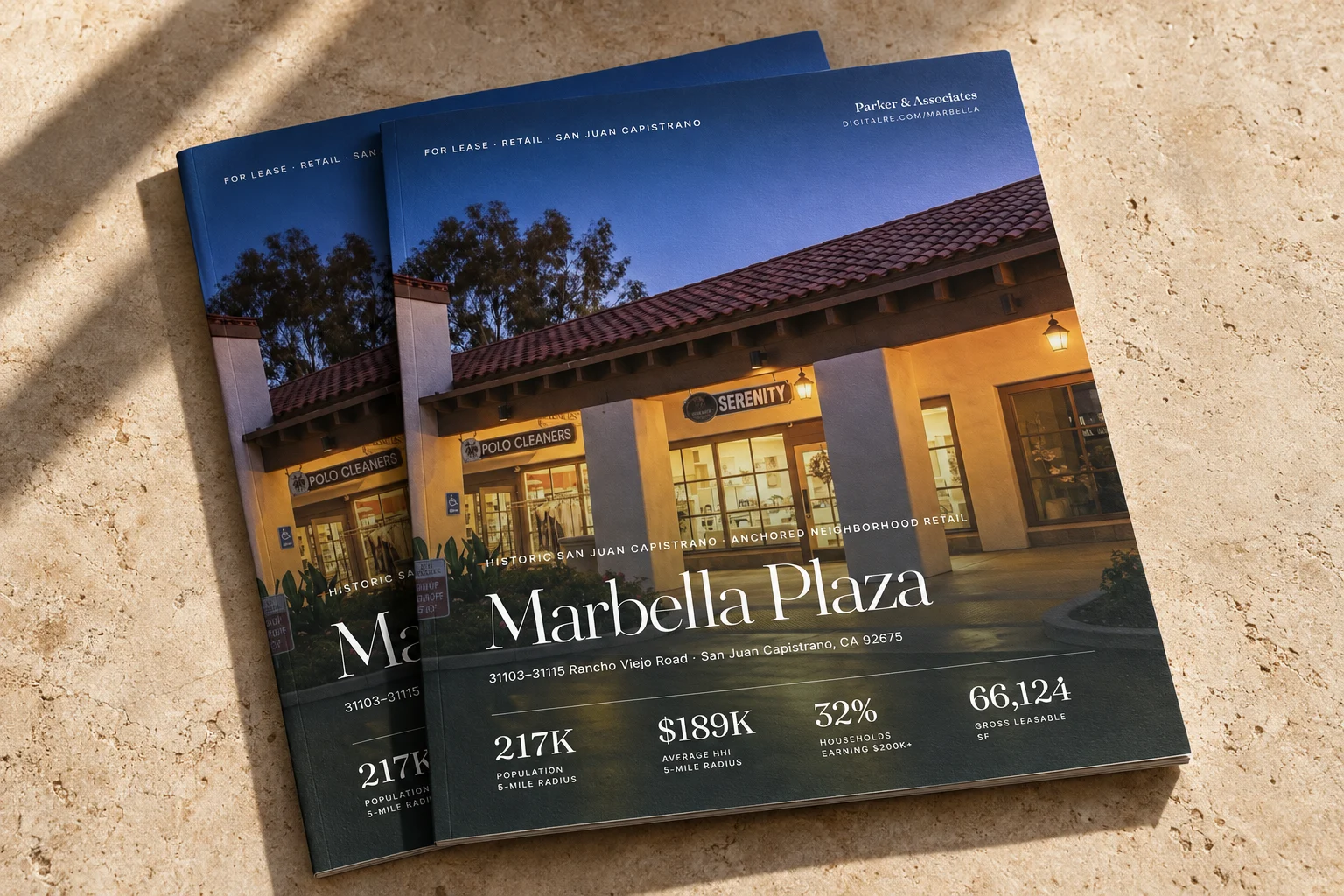
We built the center version of this for Marbella Plaza, a 66,124 square foot grocery-anchored center in San Juan Capistrano, where every suite on the plan connects to its own square footage, status, and photos. The Marbella case study covers how that page is structured. For an office building the same discipline means a floor plate diagram where each vacancy is clickable, each suite carries its rentable and usable area, and the status changes the same week the deal does. A stacking plan still offering a leased suite costs you credibility with the one rep who noticed.
Nobody signs a lease off a website. Plenty of buildings get cut from the list on one.
Spec suites deserve to be marketed as products
Built-out suites are the standard answer to a tenant that will not spend six months and its own capital on construction. Most owners waste the opportunity: the suite gets one wide photo and a line in the availability table.
A finished suite should be treated the way a retail space is treated: its own set of photos, a dimensioned plan, a furniture count if furniture conveys, and an honest statement of what a tenant would still need to do. If the suite is not built yet, say it is planned and show the plan, labeled as a plan. Rendering an unbuilt suite as though it exists is the fastest way to burn a tour. We hold the same line on retouching and staging, and we disclose both on the listing and the flyer every time, which is the whole argument in our piece on virtual staging done honestly.
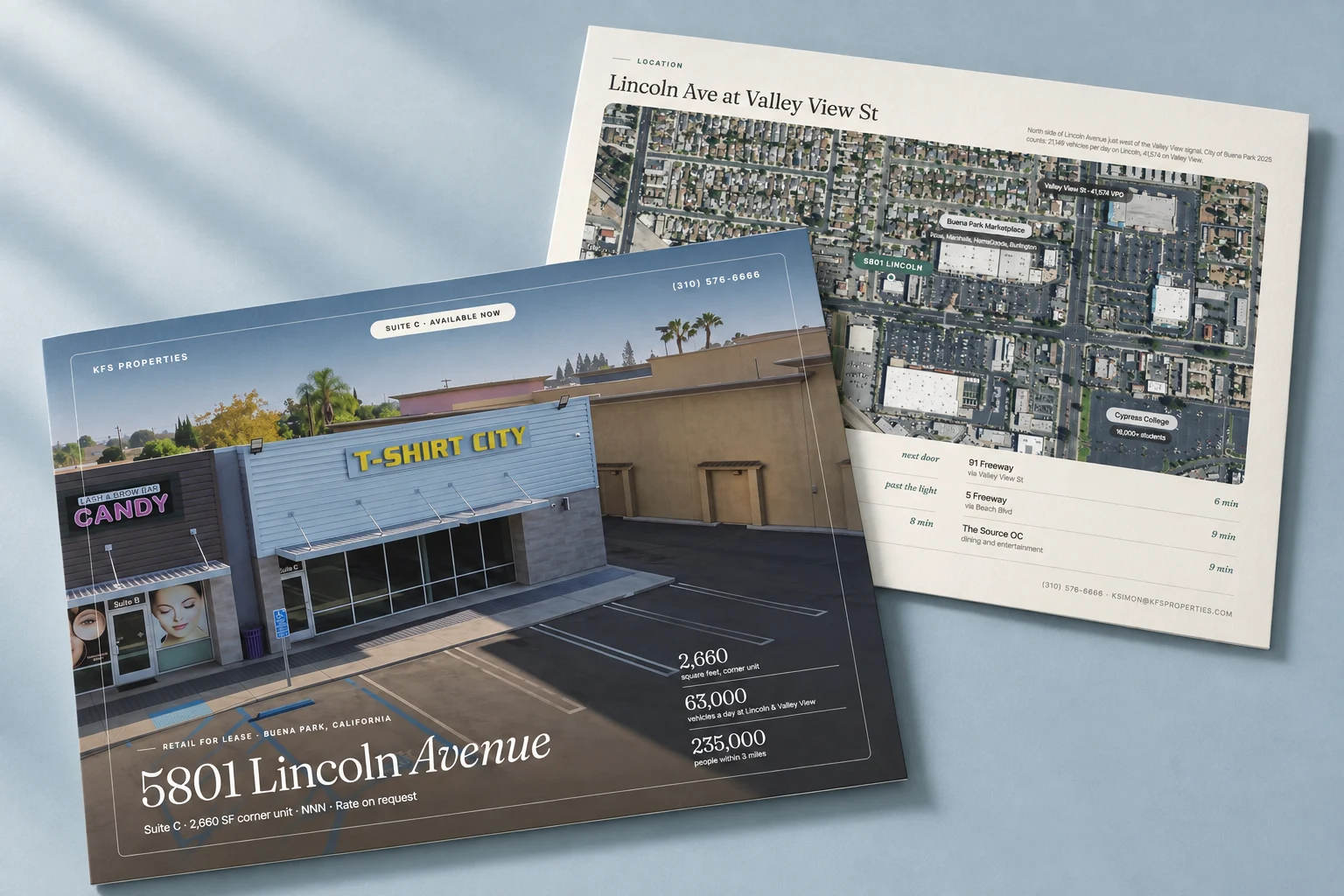
Production does not have to be expensive to be good. On a 2,660 square foot corner suite at 5801 Lincoln Ave in Buena Park we had no shoot day and no budget for one, so raw drone footage became the media package: a short hero loop, a 34 second tour, and stills pulled from 4K frames and retouched to listing grade, all of it disclosed. Brief to live took three days, including a seven page flyer. The sequence is in the Lincoln case study, and the day-by-day version is in how we built a listing site in three days.
Amenities are claims until you publish the details
Every office listing in the country says modern amenities. The word carries no information, and the committee reading your page has seen it on the four other buildings on the list. Details carry information: the conference center seats 40 and books through the property manager at no charge, the fitness room is 900 square feet and open 24 hours with locker rooms and towels, the ground floor cafe is operated by a named local roaster and closes at 3 p.m., there are 12 EV chargers and they are free to tenants through 2027.
The commute is part of the amenity set now, and it is the part with public data behind it. Drive times from the submarkets your tenants hire from, the transit lines and their walk distance, and what is within a ten minute walk for lunch can all be computed and published rather than asserted. We do this work on retail listings with census tracts weighted to true radius rings and traffic counts pulled from city GIS layers with the year attached, described in our piece on trade area analysis. The inputs change for office, the standard does not: every number on the page names where it came from.
Sublease space is a different listing
Sublease space fails when it is marketed as though it were direct space. The facts a subtenant needs are specific: months remaining on the term, whether ownership would consider a direct deal at expiration, what furniture and cabling convey, the consent process, and any restoration obligation that will land on somebody at the end. Publishing that set up front loses you the tenants who need a seven year term and were never going to work. Losing them early is the point.
The page has to survive being forwarded
Office decisions travel. Your page gets pasted into a Slack channel, forwarded to a CFO who opens it on a phone between meetings, and pulled up on a conference room screen by a rep comparing four buildings. That imposes three production requirements. It has to load fast on a phone, which for a media-heavy page is mostly a question of image weight and deferred embeds, covered in page speed for property websites. It has to be readable by everyone on the committee, including the ones using a screen reader or zoomed to 200 percent, which is not just courtesy and which we walk through in ADA and accessibility for CRE websites. And it has to be the canonical link, so the flyer, the sign, the portal record, and the launch email all point at one address that stays current instead of a PDF that is stale the moment a suite leases. That argument in full is single-property websites.
The flyer still matters, because the flyer is what gets attached when someone forwards the building to a colleague who will not click a link. Build it from the same design system as the site so the two read as one campaign, and host it at a stable URL on the site so it can be updated without re-emailing anyone. And instrument the page, because with an office listing you can learn which floor plate the market is actually asking about. What to measure and what to ignore is in website analytics for listings.
One California detail worth building into the process
If you are marketing office space in California, the lease will need to state whether the property has been inspected by a Certified Access Specialist, and what the inspection found, under Civil Code section 1938. That is a lease document requirement rather than a marketing one, but the buildings that handle it well handle it early, because a CASp question surfacing mid-negotiation slows a deal at the worst possible moment. Knowing the building's status before you launch protects the campaign you are about to spend money on.
A production sequence that works
Measure and verify first: confirm rentable and usable areas against the current measurement, pull the actual parking count and charge, and get the availability list from the person who maintains the rent roll rather than from last year's flyer. Shoot next, including the spec suites individually and one exterior that shows the building in its context. Build the page around the availability and the numbers, then produce the flyer from the same system. Portals, signage, and the launch email go last, all pointing at the property page.
That is the order we run on every listing, at every size, and it is what our services are scoped around: one flat number quoted before anything starts, with the research, design, code, and media handled by the same shop so nothing waits on a handoff.
Work with Endcap Design
Listing marketing for a vacant space
We produce the photography, flyer, and website for a space, built around the material you already have.
Included
- Photography of the space and the storefront
- A lease flyer or brochure with the suite size, plan, and leasing contact
- A property website when the listing needs one
“The Flyer is all that I need and it is outstanding.”
Photography from $325 · Lease flyers from $175 · Property websites from $495
We agree on the scope, timing, and price with you before work begins.
Get a quote for your listingOr call or text (425) 233-0769
See the full service ↗Contact Endcap
START A
project.
A website, a brochure, or a complete set of materials.
We’ll agree on the scope, timing, and price before starting.
Start a conversation or call or text (425) 233-0769