Production
Co-listed deals: two firms, one campaign.
The listing agreement settles the commission split in one paragraph and says almost nothing about the marketing. So two firms go produce it in parallel, and a tenant rep ends up holding two flyers with two square footages, two phone numbers, and two different pictures of the same suite. That rep now knows something about the deal that nobody meant to tell them.
The failure mode is parallel production
Co-listings are common on assets that need two relationships to lease or sell: a local firm that knows the corridor paired with a national platform that knows the tenant, or two brokers who each brought half of what the owner wanted. The pairing is usually sound. The marketing goes wrong for a boring reason, which is that each firm has its own template, its own coordinator, and its own idea of when a listing is ready to go out.
What comes out the other side is two campaigns wearing one address. The rate on one flyer says negotiable and the other says a number. One version has the suite at 2,600 square feet and the other has it at 2,660. The email blasts go out four days apart to overlapping lists, so half the market gets the listing twice and reads the second one as a price cut that has not happened. None of this is a disagreement between the firms. It is drift, and drift is a production problem with a production fix.
Decide who produces before you decide who pays
The cost split is the easy conversation, and it is the one everybody has first. The harder and more useful conversation is who holds the pen. Settle these at kickoff, in an email that both firms can find later:
- One production owner per asset. One firm, or one outside shop, produces the site, the flyer, the photography, and the email. The other firm reviews. Splitting production by asset type sounds fair and creates two design systems that will never quite match.
- One named approver per firm. Not a department. A person, with a stated turnaround, usually one business day. Two approvers per firm is four approvers, and four approvers is a schedule.
- A facts of record document. Square footage, measurement source, availability by suite, term, delivery condition, and what the rate line says. Both firms sign off on it once, and every asset is built from it. When a fact changes, it changes there first.
- Who holds the working files and the media license. Photography and video are the assets most likely to get argued about a year later. License them to the property or the owner rather than to either firm, and put it in writing on the day of the shoot.
Equal billing is a design problem, not a diplomacy problem
Most of the awkwardness about whose name goes first evaporates once somebody treats it as layout. Build one lockup: both marks at matched optical weight, a fixed order, and a rule for what happens when the space is too narrow to hold both side by side. Decide the order once, on a defensible basis such as alphabetical or the order on the listing agreement, and then use that same lockup on the site header, the flyer cover, the sign, the email footer, and the portal record. A firm that sees its mark handled with care in every placement stops counting placements.
The licensing lines are not optional and they are easy to get wrong when one firm's template produced the piece. In California, a licensee must disclose their license identification number on materials designed to solicit business, under Business and Professions Code section 10140.6, with the covered materials described in the Commissioner's Regulation 2773. On a co-listed deal that means both firms' identifying information appears, not just the one whose coordinator built the file. Rules differ by state, so check yours before anything goes to print.
The address the whole campaign points at
Every co-listing eventually has to answer where the listing lives. A property site sitting inside one firm's website quietly makes that firm the host and the other firm a guest, which is fine if everyone agrees and corrosive if nobody discussed it. The cleaner answer on a co-listed deal is an address that belongs to the listing rather than to either firm, with both firms holding access to the registrar account and auto-renew on. We wrote up the tradeoffs between a standalone domain, a path on a domain you already own, and a subdomain in domain names for property websites.
Whatever you choose, write down now what happens to it when the co-listing ends, because the co-listing will end before the property does. One firm may retain the listing, the space may lease, or the agreement may simply expire. Deciding then who keeps the address, whether it redirects, and which media can be reused is a negotiation. Deciding it at kickoff is a sentence.
Leads have to arrive, not get forwarded
The single most common way a co-listing curdles is a lead path that runs through one person. It is rarely malice. Somebody is on a plane, the email sits, and by the time it moves the other firm has heard about the inquiry from the tenant rep instead of from their partner. Build the routing so that cannot happen:
- The inquiry form sends to both brokers in the same send, with the suite the prospect asked about attached. Responding fast is a race worth having. Finding out late is not.
- The sign carries a number that belongs to the listing, not one broker's cell, so drive-by calls are logged where both firms can see them. That argument in full is the cell on the listing sign is the wrong number.
- Both firms get analytics access, read-only and from day one. Shared numbers keep a co-listing from turning into two campaigns with a scoreboard nobody agrees on. What is worth measuring and what to ignore is in website analytics for listings.
- The owner gets one report, produced from one dataset. Two firms sending an owner two different activity summaries is how a listing gets re-pitched.
A co-listing rarely fails because two firms disagree. It fails because two versions of the truth are in circulation and nobody knows which one the tenant read.
One page, one flyer, one place to change them
The reason drift is so expensive on a co-listed deal is that there are twice as many copies of everything. Each firm has the PDF in a folder, attached to a hundred sent emails, and posted to its own portal record. When a suite leases, all of those go stale simultaneously and none of them can be recalled.
The fix is to stop circulating files and start circulating a link. Host the flyer at a stable URL on the property site so it can be replaced without re-emailing anyone, and let the site carry the availability, which is the fact most likely to change. We built the multi-tenant version of this for Marbella Plaza, a 66,124 square foot grocery-anchored center in San Juan Capistrano, where every suite on the site plan carries its own square footage and status; the case study covers how that page is structured. On a co-listed deal the same discipline does a second job: it gives both firms one artifact to point at, so neither has to guess whether their partner's copy matches theirs. What belongs in the flyer itself is in our flyer design guide.
The kickoff checklist
Ten minutes on a call, before anyone opens a design file:
- Who produces each asset, who reviews, and the review turnaround.
- One named approver per firm.
- The billing rule: order, lockup, and the required license disclosures for your state.
- The facts of record, agreed and dated, including what the rate line says.
- The address, the registrar account, and who has access.
- Lead routing: the form, the sign number, analytics access, and the owner report.
- The exit: who keeps the address, what redirects, and how the media is licensed.
None of that is difficult. It is just easier to skip, and the cost of skipping it shows up three weeks later in front of the one tenant rep you wanted. We scope co-listed projects as a single flat number with the production owner and the billing rule agreed before design starts, which you can read about in our services.
Work with Endcap
Co-listed deal that needs one campaign, not two?
Work with Endcap Design
Listing marketing for a vacant space
We produce the photography, flyer, and website for a space, built around the material you already have.

Included
- Photography of the space and the storefront
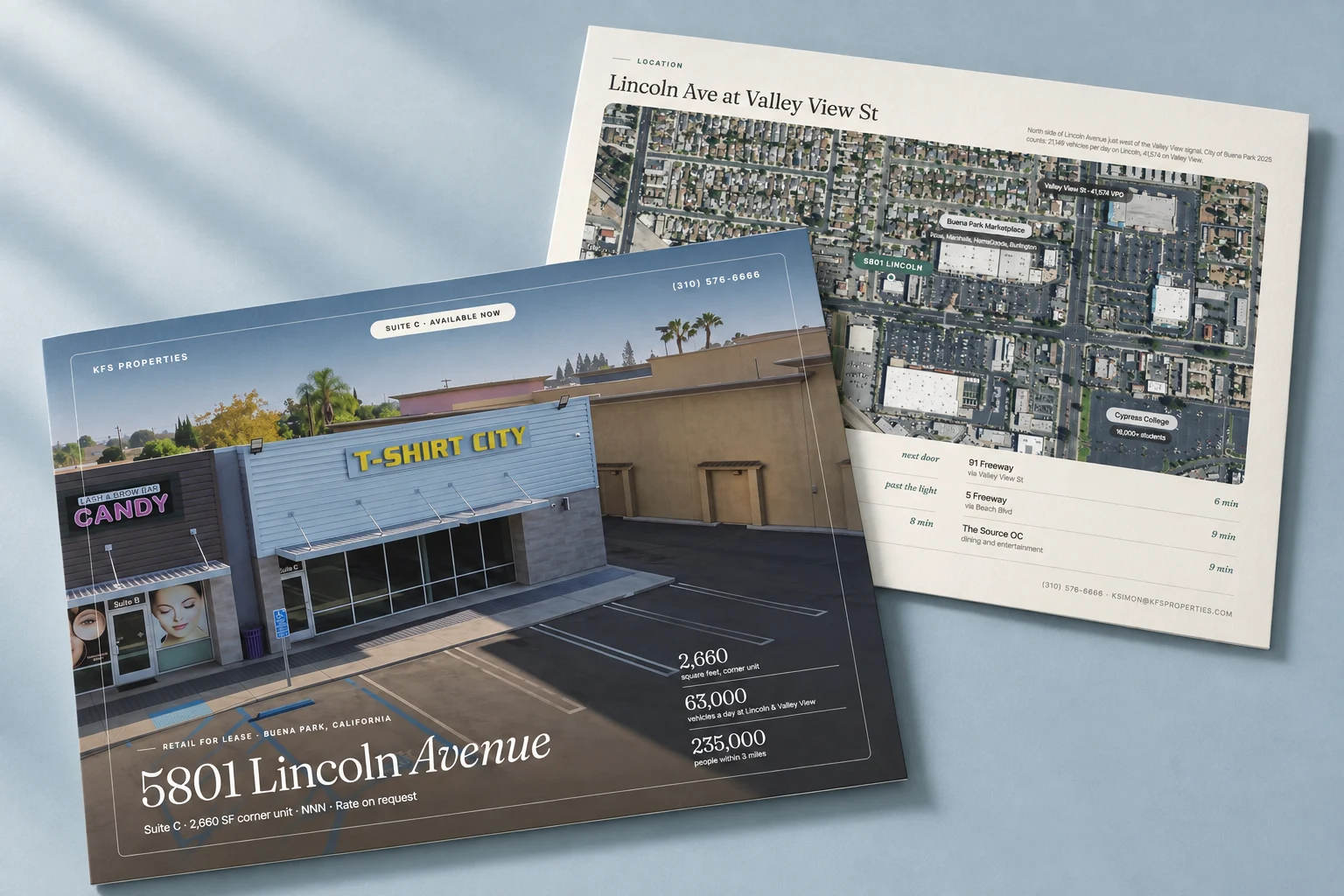
- A lease flyer or brochure with the suite size, plan, and leasing contact
- A property website when the listing needs one
“The Flyer is all that I need and it is outstanding.”
Photography, lease flyers, and property websites, quoted together or separately
We reply within an hour during business hours, and we only use your details to answer you.
Get a quote for your listingOr email Noah at hello@endcap.design
See the full service ↗Contact Endcap
LET’S
talk.
A website, a brand, or a complete set of materials.
We reply within an hour during business hours, and we only use your details to answer you.
Let’s talk or email Noah at hello@endcap.design